 Society
Five fishermen rescued after boat catches fire in Quảng Trị
1.
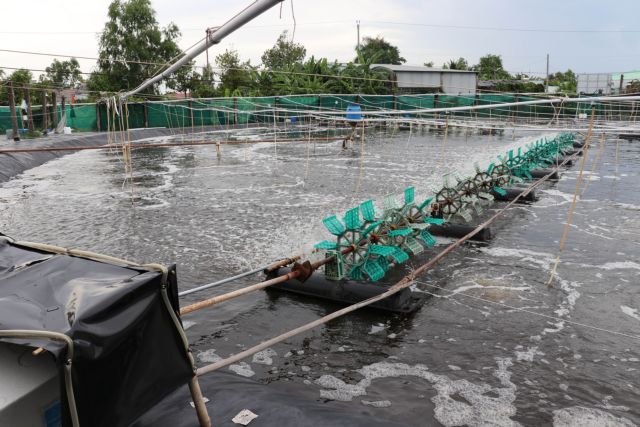 |
| A high technology whiteleg shrimp farm in Vĩnh Long Province’s Long Thành Commune, helps improve productivity and disease control. — VNA/VNS Photo |
VĨNH LONG — Aquaculture production in the Mekong Delta province of Vĩnh Long continued to post solid growth in the first half of the year, but a shortage of high quality breeding stock is emerging as one of the sector's biggest obstacles, threatening sustainable development and increasing disease risks.
According to the provincial Department of Agriculture and Environment, total aquaculture farming area reached about 75,000 hectares by mid-June, up 2.1 per cent from the same period last year and equivalent to more than 81 per cent of this year's target.
Harvest output rose 5.2 per cent year on year to 255,640 tonnes. Production increased across most major cultured species, including brackish water shrimp, giant freshwater prawns, mud crabs and freshwater fish.
Despite the encouraging figures, local authorities say the province remains heavily dependent on breeding stock imported from other localities.
Phạm Minh Truyền, deputy director of the provincial Department of Agriculture and Environment, said Vĩnh Long was facing an acute shortage of quality aquatic breeding stock.
The province currently has 64 hatcheries and nursery facilities, including 23 breeding establishments and 41 nursery operations.
However, local production remains insufficient to meet farming demand.
For whiteleg shrimp, one of the province's key aquaculture species, only seven hatcheries are in operation.
Although they have a combined design capacity of around 10 billion post larvae each year, actual production reaches only about three billion, enough to satisfy roughly 14 per cent of local demand.
The situation is similar for pangasius fingerlings.
This year's production is estimated at 230 million fry and 48 million fingerlings, meeting only about 16 per cent of stocking requirements.
Most of the remaining supply must be sourced from Khánh Hòa, Lâm Đồng, Cà Mau and Đồng Tháp.
Most hatcheries in the province operate on a small scale with ageing infrastructure.
Many black tiger shrimp hatcheries have reduced production because of rising operating costs, while technical staff often rely on practical experience rather than formal training, limiting their competitiveness against producers in other provinces.
The shortage has become particularly severe for shellfish farmers.
Đặng Xuân Thảo, director of the Phương Đông Clam Farming Cooperative in Trường Long Hòa Ward, said the declining availability of clam seed had become the greatest concern for coastal farming cooperatives.
He said natural clam seed resources had fallen sharply since 2020, while supplies from other Mekong Delta provinces and central Việt Nam had become increasingly scarce, more expensive and difficult to verify for quality.
Although the new farming season has already begun, the cooperative has yet to secure sufficient seed for stocking.
Thảo urged provincial authorities to attract investment from enterprises capable of developing large scale hatcheries so that farmers could gain a more stable and reliable supply.
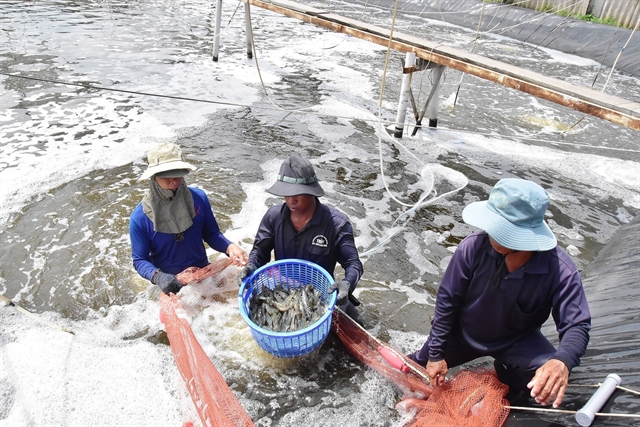 |
| Farmers harvest whiteleg shrimp raised under a high technology farming model in Vĩnh Long Province. — VNA/VNS Photo |
Similar challenges are affecting many other aquaculture producers along the province's coastline.
Nguyễn Trọng Nhân, secretary of the Party Committee of Trường Long Hòa Ward, said aquaculture remained one of the locality's most important economic sectors.
The ward has more than 4,418 hectares devoted to aquaculture, producing intensive whiteleg shrimp, improved extensive black tiger shrimp, mud crabs, oysters and various shellfish species. Total aquaculture and fisheries output has exceeded 7,600 tonnes so far this year.
However, farmers continue to face mounting difficulties as breeding stock becomes increasingly scarce and harder to verify for quality.
Natural shellfish seed has declined significantly, while supplies from outside the province are no longer as abundant as before and prices have continued to rise, making it difficult for farmers to implement planned production cycles.
Shrimp farmers are also seeking greater access to disease free breeding stock with clear traceability and stable prices to reduce production costs and minimise disease risks.
Lê Thị Hạnh Chuyên, deputy head of the provincial Fisheries, Fisheries Surveillance and Sea and Islands Sub Department, warned that heavy reliance on breeding stock from other provinces not only raised production costs but also complicated quality control and increased the likelihood of disease outbreaks.
Disease remains a major challenge for the province's aquaculture industry.
During the first five months of the year, more than 222 hectares of black tiger shrimp ponds were affected, representing 21.3 per cent of the stocked area.
Nearly 300 hectares of whiteleg shrimp farms were also damaged, accounting for 2.5 per cent of the total farming area.
Most losses occurred when shrimp were between 15 and 50 days old.
Common causes included white spot disease, red body syndrome, microsporidian infection, white faeces disease, hepatopancreatic diseases and adverse environmental conditions.
Disease surveillance has also revealed continuing risks in the farming environment.
Monitoring conducted at 50 upstream river sampling sites serving concentrated shrimp farming areas found that 126 of 225 wild crustacean samples collected since the beginning of the year tested positive for disease pathogens, accounting for 56 per cent of all samples.
Dangerous pathogens, including White Spot Syndrome Virus, Acute Hepatopancreatic Necrosis Disease, Infectious Hypodermal and Haematopoietic Necrosis Virus and Enterocytozoon hepatopenaei, continue to circulate in farming areas.
Agricultural officials said the findings highlighted the need to strengthen both breeding stock quality control and environmental monitoring to provide farmers with timely warnings.
Authorities are encouraging farmers to treat intake water before use, properly process wastewater before discharge, avoid releasing untreated water from infected ponds and adopt better pond preparation and water quality management practices.
Looking ahead, provincial officials believe attracting investment in modern hatcheries will be essential to reducing dependence on external suppliers.
Priority measures include upgrading hatchery infrastructure, improving technical training, expanding large scale breeding facilities and strengthening inspections of breeding stock traded on the market.
According to Vice Chairman of the provincial People's Committee Châu Văn Hòa, aquaculture production has maintained positive momentum, with output value increasing by more than five per cent in the first months of the year.
However, he said the quality and availability of breeding stock remained one of the industry's most pressing bottlenecks.
He called on the agricultural sector to strengthen quality management of breeding stock and farming inputs while accelerating the development of local hatchery production to improve self sufficiency and enhance the competitiveness of Vĩnh Long's aquaculture industry amid climate change and increasingly demanding export markets. — VNS
Society
 Society
 Society
 Society
 Society
 Society
 Society
 Society
 Society
 Society
 Society
 Society
 Society
 Society
 Society