 Society
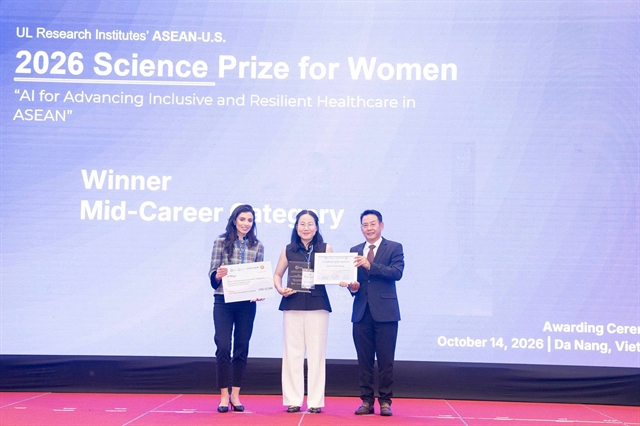
Vietnamese scientist wins ASEAN-US Science Prize for Women
1.

|
| Deputy Prime Minister Hồ Quốc Dũng delivers a speech at the working session with Việt Nam National University-HCM City leaders on August 14. — Photos courtesy of VNU-HCM |
HCM CITY — Deputy Prime Minister Hồ Quốc Dũng has urged Việt Nam National University-HCM City (VNU-HCM) to pool all resources into mastering core technologies, building strong research groups and creating commercialisable products for national development.
Leading a high-level Government delegation on August 14, Deputy PM Dũng inspected operations at key research facilities, including the Stem Cell Laboratory at the University of Science and the Integrated Circuit Laboratory at the University of Technology, before chairing a working session with VNU-HCM leadership.
Speaking at the session, he asked VNU-HCM to vigorously innovate its training models, build high-quality human resource roadmaps aligned with national needs, and prioritise strategic fields such as artificial intelligence (AI), semiconductor microchips, and biotechnology.
“Technology research must aim to master core technologies and create products ready for technology transfer and commercialisation, thereby maximising research resources and making practical, tangible contributions to national development,” he said.
|
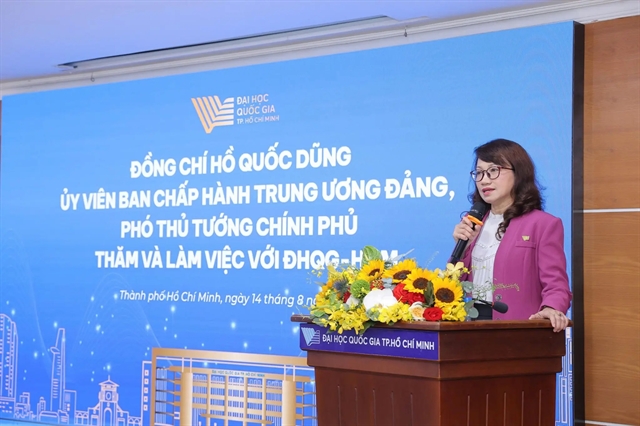
| Prof. Dr. Nguyễn Thị Thanh Mai, President of VNU-HCM, delivers her welcome address and report to the Government delegation on August 14. |
Building a 'triple-helix' ecosystem
Emphasising the connection between the State, academia, and industry, Deputy PM Dũng asked VNU-HCM to serve as a core nucleus connecting talent, knowledge, technology, and social resources.
He urged HCM City authorities to collaborate closely with VNU-HCM and researchers to solve major, practical development problems facing the region and the country.
Reporting at the meeting, Prof. Dr. Nguyễn Thị Thanh Mai, chancellor of VNU-HCM, pointed out that the biggest bottleneck in the national innovation landscape is the fragmentation between training, research, and innovation, which prevents the formation of an integrated value chain.
“VNU-HCM is focusing on developing a cooperative ecosystem combining the State, the university, and enterprises, in which VNU-HCM serves as the core connecting talent, knowledge, technology, and social resources,” she said.
To address current constraints, she submitted seven proposals to the Government and relevant ministries.
These include securing stable financial mechanisms for basic science and strategic technology laboratories under a "virtual institute" model, expanding institutional autonomy for innovative training programmes, establishing a clear legal framework for new technologies, and introducing special mechanisms to attract global scientific talent.
Regarding its human resource capacity, VNU-HCM currently boasts nearly 1,700 faculty members holding doctoral degrees, including 43 Professors and 381 Associate Professors.
Looking ahead to the 2026–30 period, the university aims to attract, train, and develop an additional 1,500 PhD holders to bolster its academic strength.
To achieve these targets, flagship recruitment initiatives, notably the "VNU350" programme and the "Visiting Professor Programme," have already successfully attracted nearly 180 scientists and experts with extensive international experience.
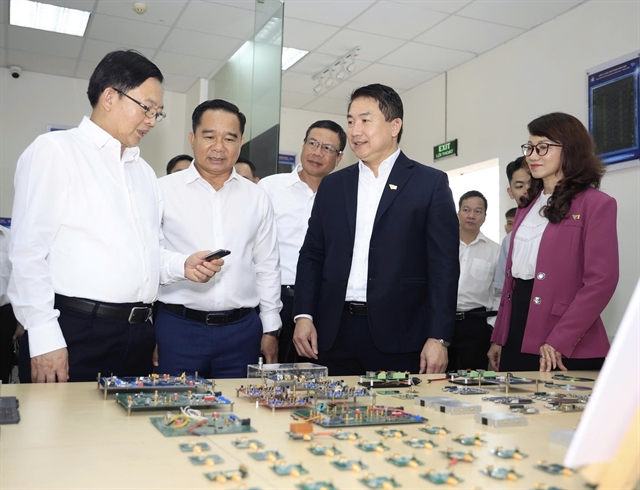
|
| Deputy Prime Minister Hồ Quốc Dũng (first, left) and the delegation visit the Integrated Circuit Laboratory at the University of Technology under VNU-HCM on August 14. |
Strengthening strategic research and policy frameworks
Addressing the working session, Deputy Minister of Science and Technology Lê Xuân Định proposed that VNU-HCM concentrate on building strong research teams and signature scientific products, while accelerating the commercialisation of research results.
He recommended expanding the "VNU350" programme through joint collaboration between the Ministry, VNU-HCM, and HCM City.
Regarding regulatory mechanisms, Deputy Minister of Education and Training Phạm Quang Hưng clarified that under Circular 54/2026/TT-BGDĐT, higher education institutions already possess full autonomy to open new interdisciplinary programmes based on programme design rather than rigid major classifications.
In addition, Circular 34/2026/TT-BGDĐT provides explicit legal pathways to engage industry experts and international scholars in university teaching and joint student supervision.
In his concluding remarks, Deputy PM Dũng committed to working directly with relevant ministries to address institutional hurdles, financial mechanisms, and policy bottlenecks to empower VNU-HCM's strategic growth. — VNS
Society
 Society
 Society
 Society
 Society
 Society
 Society
 Society
.jpg) Society
Society
 Society
 Society
 Society
 Society
 Society
 Society