 Society
PVI Insurance, SAVICO partner to streamline motor insurance services
1.
|
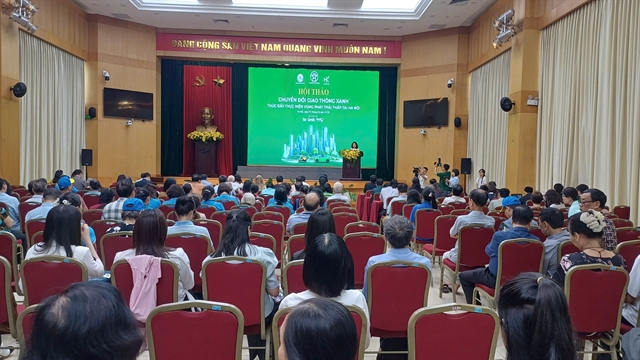
| The 'Green Transportation Transformation' workshop features many experts, managers and businesses discussing about public transportation, a key solution for green development. Photo courtesy of organisers |
HÀ NỘI — The Hà Nội Department of Agriculture and Environment has organised a series of activities in response to the 2026 Environmental Action Month under the theme 'Clean Air – Green Transportation – Hà Nội in Action'.
These are considered important steps in spreading awareness, mobilising social participation and affirming the city's determination to implement the low-emission zone pilot project according to a cautious, feasible roadmap with the support of citizens and the business community.
Hà Nội will implement a pilot low-emission zone in the historic core Hoàn Kiếm (Sword Lake) area, covering an area of approximately 1.65sq.km and with a population of about 90,000 people, from July 1 to December 31.
This is the central area of the capital, concentrating many commercial, service and tourism activities, and also facing significant pressure on traffic and air quality.
The city prioritises public awareness campaigns, guidance and encouragement of vehicle conversion and assesses the practical impact before considering expanding the scope and applying higher emission standards in the future.
The plan aims to gradually reduce polluting vehicles, promote the use of public transport, clean vehicles, walking, and cycling; and create more convenient, environmentally friendly transportation options for residents, tourists and workers.
One of key activities was the launch of the 'Community Environmental Monitoring System', a platform that helps citizens directly participate in monitoring, reporting, and supervising local environmental issues.
In its initial phase, the system will collect reports on activities such as trash burning, straw burning, smoke and dust emissions, and violations of environmental sanitation regulations. Over time, the platform can be expanded to cover a wider range of urban environmental issues.
By encouraging greater community participation in environmental monitoring, the initiative is expected to improve transparency, enhance government accountability, and build a broad public network dedicated to protecting the living environment.
The other activity was the 'Green Transportation Transformation' workshop where experts, managers and businesses all agreed that public transportation was a crucial foundation for the efficient operation of low-emission zones.
Within Ring Road 1, where streets are narrow and densely populated, Hà Nội plans to promote suitable transport options such as electric buses, minibuses and public bicycles, supported by parking facilities, charging stations and other green transport infrastructure.
|
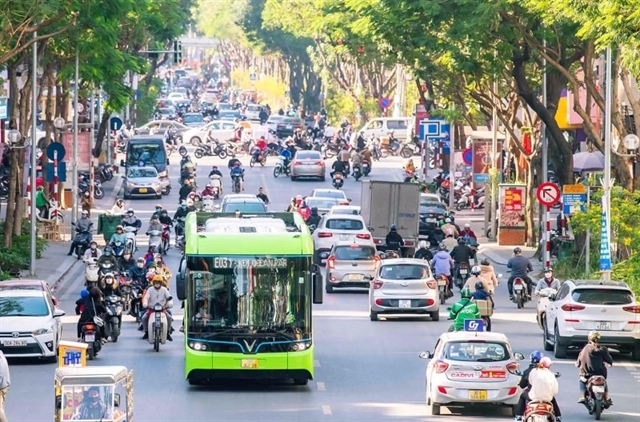
| Public transport and green vehicles are the foundation of low-emission zones. VNA/VNS Photo |
As of April 2026, the city converted 28 of its 128 bus routes to electric operation, with 490 electric buses in service. Together with 139 buses powered by compressed natural gas (CNG), the fleet of green-energy buses had reached 629 vehicles, accounting for about 32.7 per cent of the city's total bus fleet.
By the end of 2026, the number of clean-energy buses is expected to rise to 827, representing nearly 43 per cent of all buses operating across the network.
Within the pilot low-emission zone, Hà Nội will continue converting existing bus routes to green energy and introduce additional electric minibus services linking transport hubs, residential areas, office districts, tourist attractions, and parking facilities.
The city is also expanding its public bicycle network. At present, Hà Nội operates around 130 public bicycle stations with 1,800 bicycles, including 300 electric bikes. Plans are underway to add 79 more stations within the Ring Road 1 area, along with approximately 1,000 additional electric bicycles.
Support from businesses
At the workshop, many delegates paid attention to the collaborative solutions offered by the business community.
Representatives from technology companies, transportation connectivity service providers and companies deploying public electric vehicles shared numerous proposals related to charging infrastructure, financial support mechanisms, vehicle transition roadmaps and technological applications to promote low-emission transportation.
A Grab representative said the company supports Hà Nội's green transformation initiative and Việt Nam's goal of zero net emissions. Grab developed various solutions within the green transportation ecosystem and is collaborating with Hà Nội Metro to encourage people to use public transportation.
Meanwhile a Be Group representative said that the transition process also needed to take into account the livelihoods of tens of thousands of ride-hailing drivers who used gasoline-powered cars daily.
He said green transformation was not just about changing vehicles, but directly related to the adaptability of workers. Therefore, policies supporting financial assistance, leasing or ownership of electric vehicles needed to be studied in a flexible manner and tailored to each target group.
Other business managers also proposed promoting the application of digital technology to prioritise low-emission vehicles, expand the proportion of electric vehicles, and provide data for government management.
According to the Hà Nội Department of Agriculture and Environment, the overarching principle throughout the implementation process is "support first, restrictions later," ensuring fairness, feasibility, and avoiding sudden disruptions to people's lives or production and business activities.
After the pilot phase, the city plans to expand the low-emission zone to the Hoàn Kiếm–Cửa Nam area in 2027. It will cover the entire Ring Road 1 area from 2030 onwards.
The goal by 2030 is to reduce PM2.5 fine dust directly generated from traffic by approximately 20 per cent and CO and NO₂ emissions by approximately 30 per cent compared to the previous plan in the Ring Road 1 area. — VNS
Society
 Society
 Society
 Society
 Society
 Society
 Society
 Society
 Society
 Society
 Society
 Society
 Society
 Society
 Society