 Society

Amid Mounting Global Health Crises, World Health Summit Closes in Berlin with New Commitments
1.
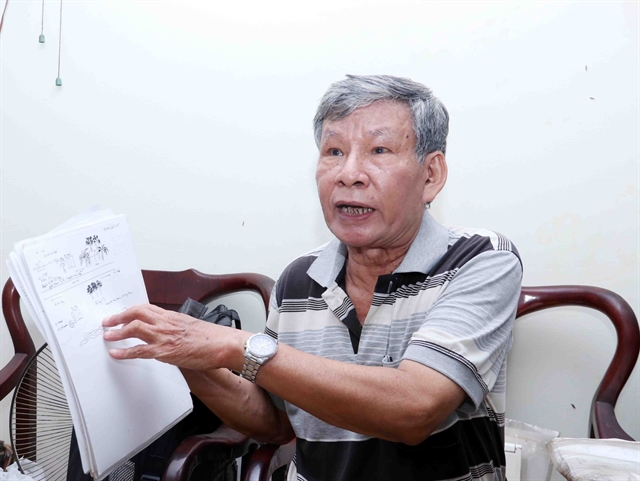 |
| Nguyễn Văn Tâm with the hand-drawn maps and field notes that have guided his search for fallen comrades. — VNA/VNS Photo |
HCM CITY — The war has been over for more than half a century, but Nguyễn Văn Tâm never really stopped marching.
For 25 years, the veteran has been making his way back and forth across the sun-scorched land of Hà Tiên in the southern province of An Giang, looking for the men from his old unit who never left, so their families can finally bring them home.
Tâm was 19 when he went to war. In late June 1972, he and other recruits of his age headed south to reinforce the front, and he was assigned to Company 10, Battalion 6 of Regiment 46, Division 1 of the Liberation Army of South Vietnam.
In early July, the battalion crossed the Vĩnh Tế Canal into two communes in Kiên Lương District (today part of An Giang). The mission was to expand liberated territory and gain the upper hand before the Paris Peace Accords were signed.
For more than four months, Battalion 6 held its ground under constant bombardment. The unit did what it was sent to do, but the cost was more than a hundred men, killed in the prime of their lives and left in nameless fields and cajuput forests.
There was rarely time to bury the dead properly as the next barrage could come at any moment. Sometimes the man who buried his friend was killed the next day.
Tâm was one of those doing the burying. When reunification came and he returned to civilian life, the friends he'd left in distant ground kept coming back to him at night, and he understood better than anyone why so many had never been found.
Graves were marked with hurried notes and hand-drawn sketches pointing to landmarks that the changing landscape had long since swallowed. Of those who had done the burying, some were dead; the rest were scattered.
If anyone was going to find those men, it would have to be someone who had been there. In 2001, Tâm began pulling on the threads – old battle maps, surviving friends.
The fieldwork was punishing: wartime footpaths had become roads, and the fields and cajuput stands he remembered were gone or unrecognisable. He kept going, making dozens of trips with a few friends – south, north, back to the old battlefield again and again.
The information he gathered went to Team K92, the unit in the former Kiên Giang Province tasked with finding and recovering the remains of fallen soldiers. So far, it has led to 24 recoveries, and the end of decades of waiting for 24 families.
Senior Lieutenant Colonel Lã Hữu Vĩnh, who represents Division 1's veterans association in HCM City, said Tâm pushed past his own limits and searched with a pure heart, earning the respect of fellow veterans, martyrs' families and local officials. His example has been written into the division's official history.
But the history records the what. Tâm carries the how, and two stories in particular still bring a lump to his throat when he tells them.
The first shows what a single recovery takes. Võ Nguyễn Trọng was a comrade whose father, the late Võ Nguyễn Lương, had been the Communist Party chief of Thanh Hóa Province.
Working from leads supplied by Trọng's younger brother and records from the Policy Department of Military Region 7, Tâm spent years tracking down the old comrade, piecing together how Trọng died and where he might be buried. Then he went back to the battlefield to find the exact spot.
In September 2011, with Tâm on site marking the ground, the K92 team dug at a position on a hill in Dương Hòa Commune.
Two days in, they uncovered eight sets of remains with personal effects identified as belonging to soldiers of Battalion 6. Tâm took the remains to Hà Nội for genetic testing and waited. Two months later, the Institute of Biotechnology confirmed DNA matches with the relatives of all eight men, among them Trọng.
Tâm wept at the news. Not just out of joy, he said, but because it was the end of years of searching, and a promise to his brothers finally kept.
The second story is a reminder that finding a grave is not always the end of the road. Phạm Văn Mào from the northern port city of Hải Phòng had enlisted alongside Tâm in August 1971 and never made it home.
When Mào's grave was found, Tâm rushed to contact the family, only to learn that Mào's parents had died, and his only sister, Phạm Thị Lơ, couldn't afford the trip to Hà Tiên to bring her brother back.
Tâm went around to friends and raised VNĐ10 million (US$380), then secured another VNĐ5 million ($190) from the Vietnam Martyr Families Support Association. The money went straight to Hải Phòng, covering the sister's travel and lodging so the family could do what it had wanted to do for years: bring Mào home.
Twenty-four men returned. But for Tâm, the ledger is still open. In April 2026, he and two friends set out for the old battlefield once more, hoping to verify fresh leads.
They had barely reached An Giang when he fell suddenly ill – his eyes aching so badly he couldn't continue – and the group turned back to HCM City. The work he meant to do on that trip is still waiting.
"They're with me every night, every breath. Some of them were my commanders. Some were my friends. They're still out there. I can't stop until they're home," he said.
Vietnamese tradition has a saying for what Tâm does: uống nước nhớ nguồn – 'when you drink the water, remember the source.' There is nothing loud about him or his work. But it is quiet men like Tâm who give that saying its meaning, and who, decades on, are still bringing the fallen home. — VNS
Society
 Society
 Society
 Society
 Society
 Society
 Society
 Society
 Society
 Society
 Society
 Society
 Society
 Society
 Society