 Society
Free surgery brings smiles to children with cleft lip, palate deformities
1.
|
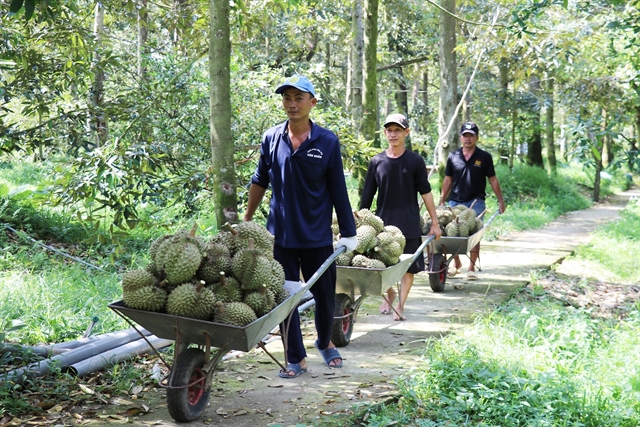
| Workers transport durian after harvest in Đồng Tháp Province’s Ngũ Hiệp Commune. — VNA/VNS Photo |
ĐỒNG THÁP — Đồng Tháp Province is expanding its certified planting areas and deep processing to strengthen fruit exports and the development of the sector.
The country’s largest fruit-producing province has more than 134,000ha of orchards that yield over 2.5 million tonnes annually.
Located in the Cửu Long (Mekong) Delta, it is home to several speciality fruits with strong competitive advantages like durian, dragon fruit, jackfruit, and mangoes.
In recent years, it has focused on developing planting areas that meet Vietnamese and global good agricultural practices (VietGAP and GlobalGAP) and organic standards, while accelerating the issuance of planting area codes to satisfy the increasingly stringent requirements in import markets.
Durian is now one of the province’s key agricultural products, with more than 32,000ha under the fruit and annual output exceeding 511,000 tonnes.
Authorities have issued 355 planting area codes covering more than 13,900ha.
Nguyễn Văn Tuấn, a farmer in Mỹ Thiện Commune, said his family earned profits of more than VNĐ1 billion (US$38,000) per hectare from over 3ha of Monthong durian last year.
Phùng Thanh Quang, chairman of the Mỹ Thiện Commune People’s Committee, said durian is generating large profits for farmers.
The commune is working with businesses and co-operatives to speed up the issuance of planting area codes and guiding farmers to adopt safe farming practices that meet export requirements, he said.
Dragon fruit is another major export.
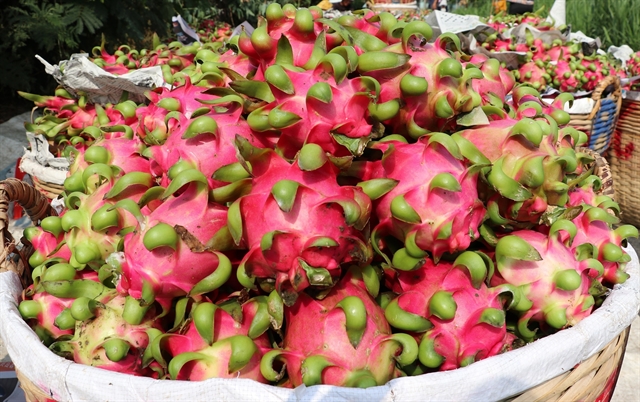
The province has 9,400ha under the fruit, producing nearly 272,000 tonnes a year, with 2,800ha cultivated to VietGAP and GlobalGAP standards.
It has approved 64 planting area codes covering 2,030ha for export to China, South Korea, the US, Australia, and New Zealand.
|
| Chợ Gạo dragon fruit from Đồng Tháp Province has been granted collective trademark protection by the National Office of Intellectual Property, creating ideal conditions for its export. — VNA/VNS Photo |
In Mỹ Tịnh An Commune, Lê Văn Thủy has an organic dragon fruit model on his 1.6ha orchard.
It generates annual profits of VNĐ1 billion (US$38,000).
Dragon fruit cultivation is concentrated in communes such as Tân Thuận Bình, Lương Hòa Lạc, An Thạnh Thủy, Mỹ Tịnh An, and Đồng Sơn.
Cao Tấn Hiệu, chairman of the Tân Thuận Bình Commune People’s Committee, said: “The People’s Committee will continue creating favourable conditions for co-operatives and businesses to work with dragon fruit farmers to develop higher-value products, increase exports, and overcome technical barriers to trade to access more export markets through official channels.”
The province also has more than 25,680ha under jackfruit, of which 20,500ha are currently being harvested, and average annual output of 437,000 tonnes.
It has been granted 180 planting area codes covering around 6,000ha of jackfruit, and 110 packing facility codes serving export markets.
As importing countries impose increasingly strict requirements, the province’s agricultural authorities are tightening quality management across planting areas.
|
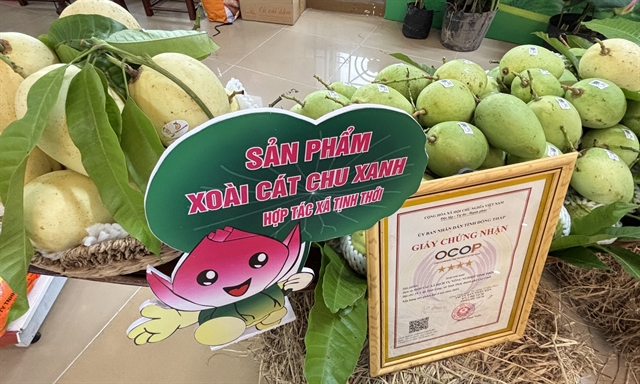
| Cát Chu mangoes produced by the Tịnh Thới Co-operative in Cao Lãnh Ward meet export standards and are shipped to more than 20 countries around the world. — VNA/VNS Photo |
Lê Hà Luân, director of its Department of Agriculture and Environment, said the province would continue promoting agricultural production under VietGAP, GlobalGAP, and organic standards to ensure sustainable growth of the fruit sector.
It would also step up the issuance of planting area and packing facility codes, strengthen linkages between farmers, co-operatives, and businesses, and promote deep processing, he said.
The province considers deep processing a key solution for increasing value and reducing pressure on fresh produce consumption, he explained.
It has 25 companies with a combined processing capacity of about 700,000 tonnes a year.
Many businesses have invested in modern technologies such as Individual Quick Freezing, a rapid freezing method that helps preserve quality and nutrients, cold drying, irradiation, heat treatment, vacuum packaging, and modified-atmosphere storage.
As a result, processed fruit products have become increasingly diverse and are meeting the requirements of demanding markets like the EU, Japan, and South Korea.
Nguyễn Phước Thiện, deputy chairman of the Đồng Tháp People’s Committee, said ensuring clean planting areas, strictly managing production processes and improving growers’ awareness were essential foundations for maintaining export markets, increasing added value and ensuring steady incomes for farmers. — VNS
Society
 Society
 Society
 Society
 Society
 Society
 Society
 Society
 Society
 Society
 Society
 Society
 Society
 Society
 Society