 Society
Việt Nam highlights UNESCO’s role in promoting peace, inclusive development
1.
|
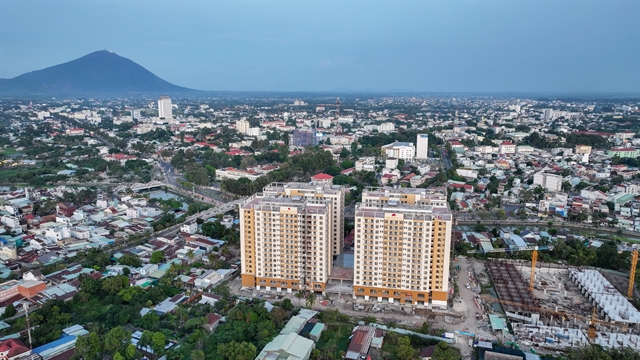
| The Golden City social housing apartment project in Tân Ninh Ward, Tây Ninh Province. — VNA/VNS Photo |
TÂY NINH — Authorities in Tây Ninh Province are introducing a special “green lane” mechanism to accelerate social housing developments, aiming to meet rising demand from workers and low-income residents while supporting the province's industrial growth strategy.
The move comes as industrialisation and urbanisation continue to attract large numbers of migrant workers to the province, placing increasing pressure on housing supply around industrial parks and urban areas.
According to the provincial Department of Construction, the Government has assigned Tây Ninh a target of completing 80,240 social housing units during the 2025-30 period.
This year alone, the province is required to complete 13,500 units.
Including 896 units carried over from 2025, the total target for this year rises to 14,396 units.
To meet the target, Tây Ninh plans to implement 28 social housing projects in 2026, covering nearly 123 hectares and providing more than 30,700 apartments.
Provincial authorities estimate that around 15,159 units could be completed this year if projects remain on schedule, exceeding the government-assigned target by 5.3 per cent.
Seven projects have already broken ground, covering nearly 49 hectares and comprising 8,584 apartments.
These developments are expected to deliver 5,267 units this year.
Among the major projects is a social housing complex within the Hậu Nghĩa New Urban Area in Đức Hòa, which will provide 1,467 apartments on a site of more than 7.1 hectares. The project is designed to serve workers, young families and low income residents, while integrating community facilities and essential services.
Nguyễn Minh Dũng, deputy general director of MIK Group, said the developer expects the project to help address housing shortages for workers employed in industrial zones while contributing to local social welfare and improving living standards.
Alongside projects already under construction, Tây Ninh aims to commence work on 21 additional social housing developments this year, adding more than 22,100 apartments to the market.
The province is also accelerating investment approval procedures for 11 further projects with a combined capacity of over 39,600 units.
Authorities have mapped out a detailed roadmap for the 2027-30 period, targeting the completion of 15,762 units in 2027, 16,749 units in 2028, 18,780 units in 2029 and 18,938 units in 2030.
All figures exceed the annual targets assigned by the Government.
Nguyễn Hồng Thanh, vice chairman of the provincial People's Committee, said local authorities are implementing a range of measures to remove bottlenecks and support developers.
For projects already under construction, investors have been instructed to mobilise resources and apply modern construction technologies to shorten delivery schedules.
For projects preparing to break ground, authorities are urging developers to complete land, planning, design appraisal and construction permit procedures as quickly as possible.
A key component of the province's strategy is the introduction of a priority administrative process, described as a “green lane”, for social housing projects.
Under the mechanism, procedures related to investment, land allocation, planning, construction and environmental approvals will be handled simultaneously rather than sequentially.
Provincial authorities aim to reduce administrative processing times and compliance costs by at least 50 per cent compared with current regulations.
The province is also placing greater emphasis on housing quality, requiring social housing projects to meet standards comparable to commercial developments while remaining affordable for workers and low-income households.
Developers are being encouraged to invest in synchronised technical and social infrastructure, including transport links, healthcare facilities, schools and community services, creating stable and sustainable living environments for residents.
At the same time, Tây Ninh is promoting digital transformation in housing management and strengthening inspections to ensure social housing is sold and leased to eligible beneficiaries in accordance with regulations.
With dozens of projects moving forward and administrative reforms gaining momentum, Tây Ninh hopes not only to fulfil its social housing commitments but also to strengthen its attractiveness to investors by ensuring adequate housing for the workforce that underpins its industrial expansion. — VNS
Society
 Society
 Society
 Society
 Society
 Society
 Society
 Society
 Society
 Society
 Society
 Society
 Society
 Society
 Society