 Society
Vietnamese scientist wins ASEAN-US Science Prize for Women
1.
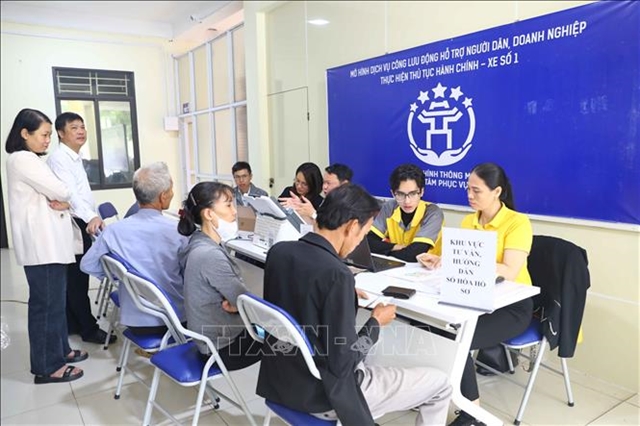 |
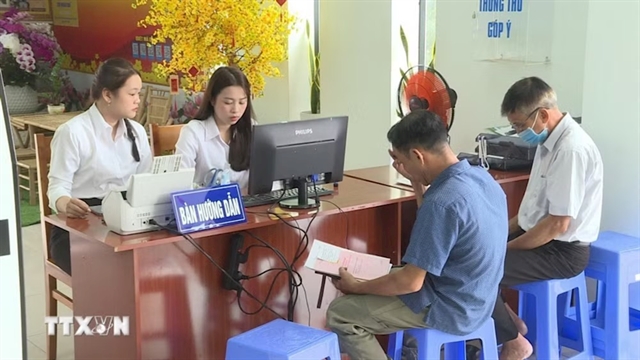
| People in Minh Châu Commune receive help with administrative procedures. VNA/VNS Photo |
HÀ NỘI From the middle of the Red River in Hà Nội's Minh Châu Commune to the city's densely populated urban areas, such as Tây Hồ Ward, or its rapidly developing areas in Quang Minh or Ô Chợ Dừa, one year of operating the two-tier local government model is leaving increasingly clear marks at the local level.
No longer a story about streamlining the apparatus, what is most clearly felt in many localities is the change in operations and services, and in the way staff are handling work and approaching people.
As many tasks are assigned directly to the commune and ward levels, the distance between Government and people has narrowed.
Longstanding work backlogs or problems arising in each local area are also gradually resolved.
A new approach
When people think of Minh Châu Commune, many immediately think of an oasis in the city lying right in the middle of the Red River.
For years, the commune was almost separate from the mainland. Travel depended on the ferry or the spillway route through Phú Thọ Province. Connectivity infrastructure was limited, and medical, commercial and entertainment services were underdeveloped.
People mainly relied on agricultural production for their livelihoods. It wasn't until 2023 that people gained access to clean water. Every rainy season, the risk of separation exists again.
But Nguyễn Đức Tiến, the commune’s Party secretary, said that the local authority has carried out a new approach in serving residents.
“One of the models is a ‘two-place service government’. In the morning, commune officials handle work at the headquarters as usual, but in the evening they go to people's homes to help resolve problems," said Tiến.
The most noticeable changes after a year of implementing the new model is a positive transformation in people's lives and an improvement in staff skills, mindset and efficiency. According to Tiến, the management model has gradually shifted to one focused on development, with serving the people as its core objective.
For an area like Minh Châu, which for many years faced difficulties in transportation, infrastructure and public services, the government's proactive approach in reaching out to the people instead of waiting for the people to seek it out carries new meaning, he said.
Meanwhile, in Quang Minh Commune, the effectiveness of the new model is seen through the resolution of backlogs that have built up over many years.
According to Nguyễn Thanh Liêm, secretary of the commune’s Party Committee, one outstanding result after nearly a year of operating the new model is the recovery of nearly 5,000sq.m of encroached pond land in the former Đại Thịnh Commune.
“When given substantive power and direct accountability to the people, commune authorities have the ability to be more proactive in solving local problems,” Liêm said.
New governance thinking
While changes in communes like Quang Minh and Minh Châu are seen in specific cases, in urban areas, the story takes on a more administrative dimension.
Nguyễn Đình Khuyến, secretary of the Party Committee and Chairman of the People's Council of Tây Hồ Ward, said that authority has decided to shift from administrative management to local governance, linking the responsibility of the head of the ward to the results of completing tasks.
During the implementation of large projects, localities display dialogue, openness, transparency and creating consensus with the people.
Thanks to their efforts, several difficult tasks were implemented smoothly, without creating hot spots for mass complaints.
A similar story has been recorded in Ô Chợ Dừa Ward, where the two-tier local government model is viewed from the perspective of governance capacity and quality of services provided.
If in the past, the government mainly performed administrative management functions in each specialised field, now it must directly and comprehensively manage the area, perform more decentralised State management tasks, and remain directly accountable to the people for results.
One of the clearest examples is site clearance work for the Ring Road 1 project, along the Hoàng Cầu-Voi Phục section. This is a particularly difficult project, directly related to the interests of hundreds of households and organisations.
Thanks to public implementation, information transparency and increased dialogue with residents, the ward has completed site clearance for the project.
The success of two-tier government services in Minh Châu, Quang Minh, Tây Hồ and Ô Chợ Dùa wards shows that many tasks that previously had to go through various levels of intermediaries can now be resolved right at the office.
As more authority is given, responsibilities are more clearly defined and leaders are more closely tied to the area, commune and ward levels are gradually becoming the centre of governance, solving people's problems where and when they arise. VNS
Society
 Society
 Society
 Society
 Society
 Society
 Society
 Society
 Society
 Society
 Society
 Society
 Society
 Society
 Society