 Society

Top Vietnamese leader meets with Belgian Senate Speaker, House President
1.
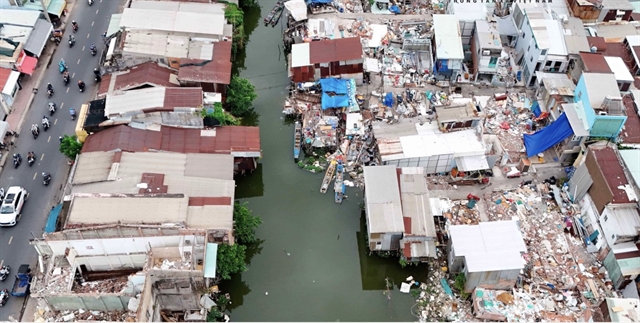 |
| Makeshift houses along a canal in HCM City. — VNA/VNS Photo |
HCM CITY — For the past few years, HCM City authorities have carried out several projects to renovate the environmental landscape and relocate houses along the city's canals and waterways.
However, the southern metropolis faces obstacles relating to legal issues, land clearance, resettlement and infrastructure investment.
Many of the makeshift houses along the Đôi, Tẻ and Xuyên Tâm canals in Phú Định, Chánh Hưng, Bình Đông and Gia Định wards are built on wooden stakes and are seriously degraded, with a risk of collapse at any time.
Waste water from many of these households is directly discharged into the canals, causing severe pollution.
Lê Thị Tuyết Nga, a resident who has lived more than 50 years along the Đôi canal in Chánh Hưng Ward, said that people here find it difficult to live in seriously degraded houses.
Heavy rains and high tides often cause the canal water to rise, flooding the houses. The area along the canal also accumulates a lot of waste and stagnant water, creating breeding grounds for mosquitoes and posing a risk of mosquito-borne disease outbreaks, especially dengue fever.
“Every time it rains heavily, water floods into our house. We have to elevate our belongings, and life is very inconvenient. So when we heard that the city would be clearing and relocating people to renovate the area along the canal, my family was very happy and hoped the project would be implemented soon,” Nga said.
Chánh Hưng Ward resident Nguyễn Văn Đạt, agreed, saying that the removal of houses along the canals is necessary.
For years, pollution in the canals has worsened due to residents discharging domestic waste and water directly into them, Đạt said.
The living space is also cramped and the surrounding infrastructure is severely degraded, making the lives of residents difficult, he added.
Despite the city government's implementation of several urban renovation programmes, the relocation of houses along canals and waterways has not progressed as expected.
According to a report by the city's Department of Construction, the goal is to relocate at least 20,000 houses along rivers, canals and waterways by 2030, focusing on main routes such as the Đôi, Tẻ and Ông Lớn canals.
City officials are planning 44 projects, with 40 making use of budgetary funds and four socialised projects, with a total of 23,400 houses needing relocation. The wards of Bình Đông, Chánh Hưng and Phú Định alone account for over 65 per cent of these homes, equivalent to approximately 15,700 houses.
Obstacles
According to a survey by the HCM City Institute for Development Research, the city currently has over 34,700 houses located on and along canals and waterways. However, only about 25 per cent have valid construction permits.
This is a major bottleneck for the relocation projects, as without the legal documents, most of these households – even those that have been there for decades – do not meet the requirements for compensation, said Đàm Nhật Quang, deputy head of the Economic and Urban Infrastructure Department of Gia Định Ward.
Experts argued that rigidly applying current regulations would make it difficult to gain public consensus, but providing support beyond the established limits would put significant pressure on the city's budget.
A solution that balances the interests of both the State and the people is therefore needed.
But even for those with the correct legal documents, compensation and resettlement policies can be a major bottleneck in the relocation process.
In many areas, residents have not yet reached agreements on the level of financial support and the price of resettlement housing.
Many of the affected households have said that the compensation being offered is insufficient to buy a new house, as the city's real estate prices continue to surge.
Nguyễn Thị Mỹ Thùy, a resident of Gia Định Ward, said that her family’s home is 43sq.m, but the area eligible for compensation is only 30sq.m.
Her family have thus been offered only VNĐ2 billion (US$76,000), which is not enough to buy accommodations large enough for all six of them.
For low-income households, moving to new places leads to pressures relating to living costs, children’s education and jobs, as many residents are concerned about having to move to resettlement areas far from their workplaces or their children's schools.
Meanwhile, changing residences can also significantly impact income and daily livelihoods for self-employed workers.
According to legal experts, resettlement must ensure long-term living quality for those affected, to avoid the risk of them falling back into poverty or re-encroaching on the cleared land.
According to lawyer Trần Anh Tuấn of the HCM City Bar Association, to accelerate urban renovation and improve the environment along canals and waterways, the city needs strong legal mechanisms and policies that both ensure project progress and harmonise the interests of the State and the people.
Change in mindset needed
According to urban economic experts, the most challenging issue is investment resources.
The city’s budget is hardly enough to meet the entire capital demand for compensation, ground clearance and infrastructure investment. Capital must therefore be mobilised from many different sources.
One of the most effective ways to do this is through a public-private partnership investment model.
To attract long-term investors, the city should set up a transparent and stable land use mechanism, along with simplifying investment procedures.
Experts also suggested that the city need to shift its mindset from a focus on simple land clearance to a full reconstruction of living spaces.
This means that after relocation, the area along the canals should not only be cleared, but also comprehensively planned with infrastructure, including transportation, electricity, water, schools, medical facilities, parks and public spaces. — VNS
Society
 Society
 Society
 Society
 Society
 Society
 Society
 Society
 Society
 Society
 Society
 Society
 Society
 Society
 Society