 Society
Multi-channel approach pushed to widen market access for local goods
1.
|
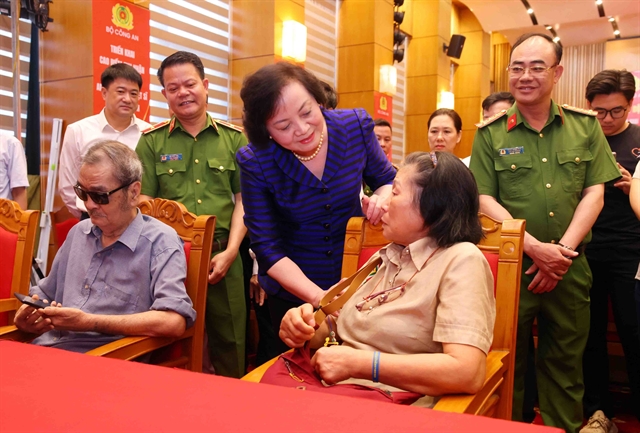
| Deputy Prime Minister Phạm Thị Thanh Trà encourages a relative of a martyr whose information has not been identified to provide DNA samples in Hà Nội on Wednesday. —VNA/VNS Photo Phạm Kiên |
HÀ NỘI — Ministries, agencies and local authorities have been told to treat the collection of DNA samples from relatives of fallen soldiers as a matter of special political importance.
They must make use of all available resources to accelerate efforts to identify the remains of war martyrs and ensure that no further delays diminish the remaining opportunities to do so, according to Party Central Committee Secretary and Deputy Prime Minister Phạm Thị Thanh Trà.
Trà made the call on Wednesday morning at the launch ceremony of a nationwide campaign to collect DNA samples from relatives of martyrs whose remains have yet to be identified.
The initiative forms part of the '500 Days and Nights Campaign to Intensify the Search, Recovery and Identification of Martyrs’ Remains', launched in preparation for the 80th anniversary of War Invalids and Martyrs Day on July 27.
According to Trà, the campaign has entered a decisive phase in achieving its objectives.
However, significant challenges remain, with more than 175,000 martyrs still unaccounted for nationwide and over 300,000 martyrs’ graves lacking sufficient information for identification.
“This sacred task compels us to act. It is both a responsibility to history and a race against time,” she said.
Many direct relatives of martyrs are now elderly and frail, while countless others have spent their entire lives searching for their loved ones.
“Every day that passes risks the loss of another opportunity and leaves another gap in our historical record,” Trà said.
She added that identifying the remains of martyrs, particularly those lacking information, requires a methodical, scientific, coordinated and long-term approach, underpinned by determination, perseverance and decisive action.
The deputy PM noted that collecting DNA samples from martyrs’ relatives plays a crucial role in that process, and tasked the Ministry of Public Security with continuing to serve as the lead agency in collecting DNA and managing the DNA database of martyrs’ relatives, ensuring scientific accuracy, security and data protection.
She also urged the ministry to propose additional equipment needed to enable the timely and coordinated handling of the substantial workload involved.
The Ministry of National Defence, the Ministry of Home Affairs, the Việt Nam Academy of Science and Technology and local administrations were instructed to intensify DNA testing of unidentified martyrs’ remains.
They are also required to work closely with the Ministry of Public Security in sharing and integrating data to facilitate DNA matching and identification efforts.
Local authorities at all levels were asked to strengthen public awareness campaigns and encourage martyrs’ relatives to provide information and biological samples.
To ensure the effective implementation of the campaign, authorities were also urged to make use of any and all resources from local budgets and social contributions.
Deputy PM Trà called on the ministries, agencies, localities, organisations, businesses and the public to actively support the initiative, describing it as a profoundly meaningful national mission.
She also appealed to martyrs’ relatives across the country to cooperate by providing information and participating in DNA sampling, so that efforts to restore the identities of fallen soldiers would have stronger evidence and a greater chance of success.
“Let all of us act with responsibility, gratitude and the highest determination for those who sacrificed their lives for the fatherland,” she said.
|
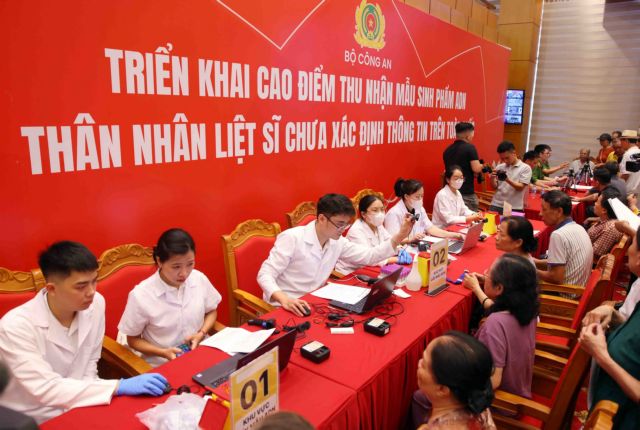
| Relatives of war martyrs whose information has not yet been identified provide DNA samples at a ceremony in Hà Nội on Wednesday. — VNA/VNS Photo Phạm Kiên |
MoPS in leading role
While chairing the launch, Senior Lieutenant General Nguyễn Văn Long, deputy minister of Public Security, said that the ministry regards the programme as a task of exceptional political and humanitarian significance, reflecting both responsibility and profound gratitude towards the nation’s martyrs and their families.
To ensure the effective implementation of the deputy PM’s directives, Long told the ministry's Department of Administrative Management of Social Order to maximise its leading role in guiding and supervising the nationwide rollout of the programme.
The department was tasked with organising the collection, development and management of the DNA database in a manner that guarantees scientific rigour, accuracy, security and confidentiality.
It was also instructed to urgently complete and integrate new functions into the VNeID digital identification application in July, making it easier for citizens to voluntarily submit information and thus contribute to efforts to identify martyrs’ remains.
Long assigned the department to act as the focal agency for monitoring, guiding and supervising implementation, while promptly reporting any difficulties to ministry leaders for resolution.
Following the launch ceremony, DNA samples were collected from martyrs’ relatives in Hà Nội.
The ministry has worked with the Ministry of Home Affairs, the Việt Nam Academy of Science and Technology and GeneStory Joint Stock Company to collect, compare, analyse and examine DNA samples, resulting in the identification and official recognition of 25 martyrs.
During the ceremony, organisers presented DNA analysis results confirming the identities of three martyrs to their relatives.
They were martyr Nguyễn Thiện Quyết, originally from the former Hải Dương Province, whose remains are buried at Đức Cơ Martyrs’ Cemetery in Gia Lai Province, and two martyrs buried at Ngã Bảy-Phụng Hiệp Martyrs’ Cemetery in Cần Thơ: Đoàn Văn Khải from Ninh Bình Province and Nguyễn Trọng Cát from Thanh Hóa Province. — VNS
Society
 Society
 Society
 Society
 Society
 Society
 Society
 Society
 Society
 Society
 Society
 Society
 Society
 Society
 Society