 Society

Top Vietnamese leader meets with Belgian Senate Speaker, House President
1.
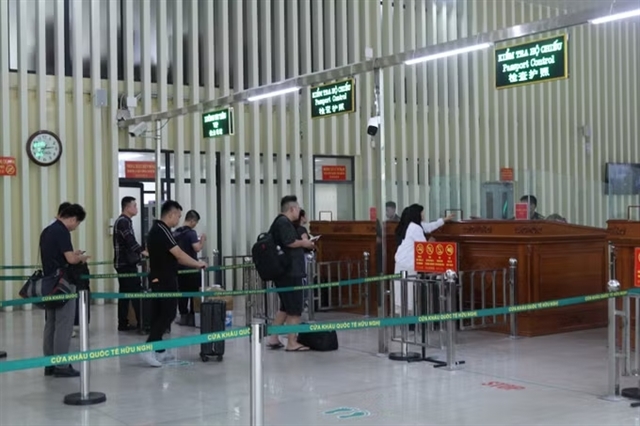 |
| Passport control at the Hữu Nghị International Border Gate in Lạng Sơn Province. — VNA/VNS Photo Quang Duy |
LẠNG SƠN — From modern international border gates to remote hamlets along the frontier in Lạng Sơn Province, digital transformation is gradually reshaping governance, production and daily lives of local people.
In this digitalisation process, officers and soldiers of the provincial Border Guard Command play a vital role. Beyond safeguarding national sovereignty, they also provide hands-on support to help border residents access and use technology in a practical and user-friendly way.
In mid-2026, the Hữu Nghị International Border Gate in Lạng Sơn remained as busy as ever. Thousands of travellers and vehicles crossed the Việt Nam–China border each day, reflecting the vibrant flow of trade and people between the two countries.
In the past, many inspection and declaration procedures at the border gate were carried out manually, resulting in lengthy waiting times. Today, most processes have been digitised.
At the processing area, border guards stand ready to assist travellers with electronic declarations, help businesses update their information on digital systems and conduct inspections using specialised equipment.
Thanks to digital technology, immigration data are now synchronised across systems, while surveillance cameras operate continuously, improving management efficiency and ensuring security and safety at the border gate.
Inspection and control procedures have also become faster and more accurate, significantly reducing workloads for authorities and waiting times for travellers and businesses.
Major Tô Đức Long, deputy head of the Hữu Nghị International Border Gate Station, said the unit has been actively implementing a wide range of digital transformation measures in border management.
These include operating immigration management software, introducing automated control gates for Vietnamese citizens using border passes, applying barcode systems and centralised data management.
According to Long, these digital applications have optimised inspection procedures, shortened processing times, improved management accuracy and created more favourable conditions for passengers and businesses.
As a frequent traveller through the border gate, Linh Thúy Hồng from Bắc Ninh Province said digital technology has made customs and immigration procedures much simpler than before.
In addition to improving administrative management, digital transformation at border gates has also helped stimulate cross-border trade, economic development and international integration.
In Lạng Sơn’s border communes, the sight of border guards patiently assisting residents with how to use smartphones and install mobile apps has become increasingly familiar.
In many remote villages inhabited by ethnic communities, access to digital technology remains limited. Many residents are using smartphones for the first time or have never familiarised themselves with online transactions.
The border guards’ support has become essential to helping people gradually adapt to modern technology.
In Hamlet 3 of Quốc Việt Commune, officers from Bình Nghi Border Guard Station regularly coordinate with local authorities to organise awareness campaigns and guide residents in using digital applications in everyday situations.
From creating online public service accounts, installing the national e-identification app VNeID and emergency apps to learning cashless payment methods, residents receive direct, hands-on guidance from border guards.
According to Lieutenant Colonel Hoàng Văn Lĩnh, political commissar of Bình Nghi Border Guard Station, the unit has actively implemented plans under the national digital transformation programme, established advisory teams and strengthened information technology (IT) training to better support locals.
The station has also leveraged technology to disseminate information related to border laws and border guard activities, helping residents better understand and comply with regulations on border security and protection.
Hà Văn Chiều, a resident of Hamlet 3, said many villagers had previously been hesitant to use smartphone applications for fear of making mistakes or losing personal data.
However, with guidance from border guards, they have gained a better understanding of the benefits of digital transformation and legitimate mobile apps, and many have become more confident in using them in daily life.
In addition to providing training on basic digital skills, border guards have also focused on raising awareness among local communities about cybersecurity and online crime prevention.
Hamlet 3’s community IT team currently has six members, according to Hamlet leader Hứa Văn Đại. Together with the local team, officers and soldiers from Bình Nghi Border Guard Station have conducted outreach activities for households, introducing digital apps and warning residents about online scams and fraudulent schemes.
Although seemingly small, these efforts have had a significant impact. By learning how to use smartphones effectively, residents can access information more quickly, complete administrative procedures more conveniently and gradually participate in the rapidly expanding digital economy. — VNS
Society
 Society
 Society
 Society
 Society
 Society
 Society
 Society
 Society
 Society
 Society
 Society
 Society
 Society
 Society