 Society
HCM City urged to expand social housing to improve affordability
1.
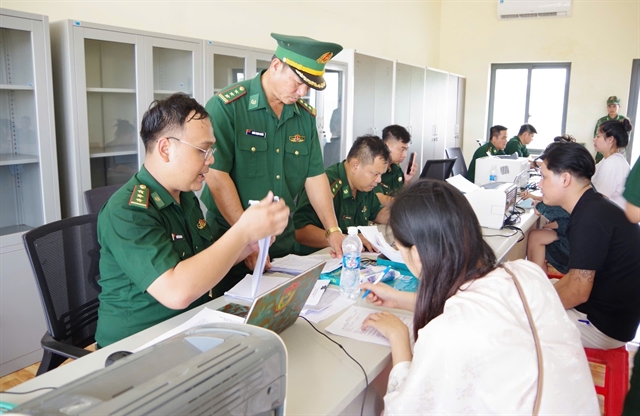 |
| Border guards in Đồng Nai Province receive illegal migrants of Vietnamese nationality from Cambodian authorities on May 7, 2026. — VNA/VNS Photo |
HÀ NỘI — Journalists covering human trafficking must balance the public’s right to know the facts with the responsibility to protect people affected by trauma, a press talk in Hà Nội heard on Monday.
Hosted by the International Organization for Migration (IOM) and the UK Embassy in Việt Nam, the event brought together journalists and experts on migration and human trafficking to discuss a more trauma-informed approach to reporting trafficking cases, which have grown increasingly complex with the rise of technology-enabled crimes.
IOM Chief of Mission in Việt Nam Kendra Rinas said: “Ethical storytelling is not always easy, especially in a fast-paced media environment, but sometimes taking a moment to pause and ask one more question about consent, dignity, privacy and potential harm can make all the difference.
“As trafficking methods continue to evolve, including emerging forms such as trafficking for forced criminality and online scam operations, thoughtful and informed reporting is more important than ever.”
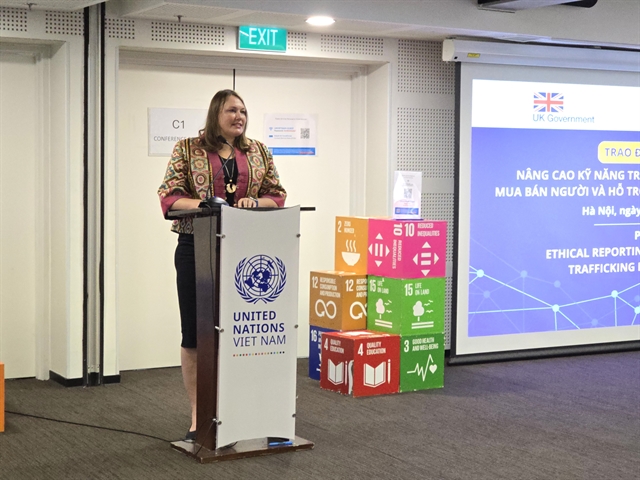 |
| Chief of Mission of the International Organization for Migration in Việt Nam Kendra Rinas addresses the press talk in Hà Nội on June 15. — VNA/VNS Photo |
According to Vietnamese social listening and monitoring tool Reputa, there were nearly 10,900 discussions related to migration happening across social media and news platforms in Q3 2025.
Among these, Facebook and YouTube remain the most widely used channels. Meanwhile, TikTok is increasingly being used to facilitate illegal migration, with users sharing information on migration routes, transit and destination countries, and traffickers using the app to identify and recruit potential victims.
Tracking such activities remains challenging, as perpetrators continually create new keywords to avoid detection by content moderators, and often move conversations to private messaging apps once they have established contact with a potential victim.
Victim profiles have shifted significantly, according to IOM. While women and children were once the primary targets of trafficking, more men are now falling victim to online scam operations.
The IOM Asia-Pacific Migration Data Report 2023 found that men accounted for 76 per cent of trafficking victims, up from 68 per cent the previous year.
The report also showed that most victims were young and relatively well educated, with 90 per cent aged between 18 and 35, and 50 per cent having completed higher education.
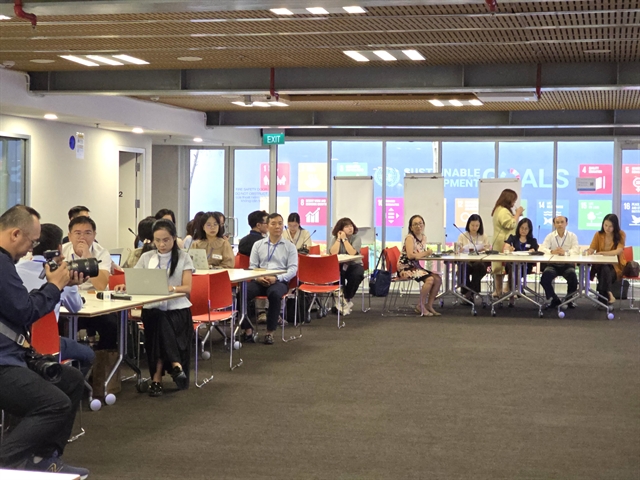 |
| Journalists at the press talk on ethical reporting on human trafficking held at the UN office in Hà Nội on June 15. — VNA/VNS Photo |
In response to the changing nature of human trafficking, Việt Nam has revised the Law on Human Trafficking Prevention and Control.
Officially taking effect on July 1, 2025, the law showed a shift in legislative approach from crime control to a survivor-centred framework. A definition for persons undergoing victim identification was introduced, while protection is extended to their family members and children where there is evidence of exploitation.
At the event, journalists also had the opportunity to engage with psychologists and veteran reporters specialising in human trafficking to explore trauma-informed, survivor-centred reporting grounded in the principle of ‘do no harm.’— VNS
Society
 Society
 Society
 Society
 Society
 Society
 Society
 Society
 Society
 Society
 Society
 Society
 Society
 Society
 Society