 Society
Vietnamese scientist wins ASEAN-US Science Prize for Women
1.
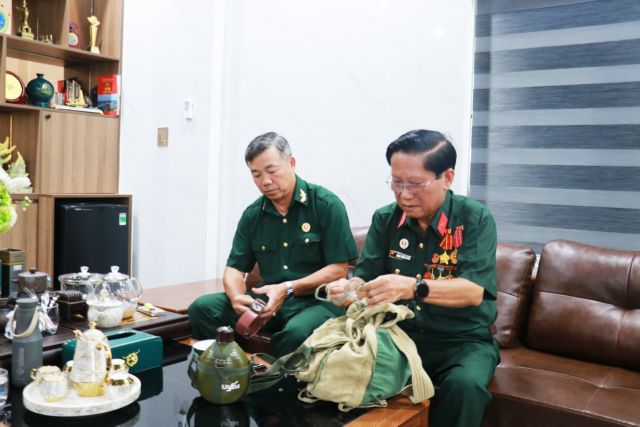 |
| Đoàn Xuân Luyến (right) cherishes mementos from his glorious time fighting on the Quảng Trị battlefield. — VNA/VNS Photo Tường Vi |
QUẢNG TRỊ — More than half a century after fighting on one of the most brutal battlefields, veteran soldier Đoàn Xuân Luyến from Nam Đông Hà Ward in the central province of Quảng Trị, continues to devote himself tirelessly to his community.
At the age of 72, he has chosen not a life of retirement and leisure, but one of continued services on a different front - economic development and job creation for local people.
As both a war veteran and a businessman, Luyến has remained closely involved in social welfare initiatives, supporting policy beneficiary families, poor households, disadvantaged veterans, educational promotion funds, disaster relief efforts and numerous charitable activities.
Each year, he contributes hundreds of millions of đồng to community programmes.
Many meaningful gifts and public works made possible through his support, including gratitude houses for people who contributed to the revolutions, solidarity houses for disadvantaged families, memorial houses dedicated to Heroic Vietnamese Mothers and monuments honouring fallen soldiers, stand as lasting evidence of the social responsibility of a solider deeply committed to his homeland and former comrades.
Building a business from scratch
After leaving the battlefield following national reunification, Luyến was selected by the State to attend the province’s first medical assistant training programme.
Upon graduating in 1978, he worked caring for wounded and sick veterans before joining the construction sector, contributing to post-war reconstruction efforts in his hometown.
Several years later, he was sent to Bulgaria under a labour cooperation programme.
Returning to the province at a time when the locality was still struggling with the legacy of war, he recognised growing demand for construction materials and began nurturing plans to start a business in the sector.
In 1999, he embarked on his entrepreneurial journey with a small shop selling cement, steel, bricks and roofing materials, using modest savings accumulated through years of hard work.
There was a time when he personally delivered goods to customers using an ox cart before graduating to bicycles and motorbikes to transport construction materials across the province.
Many days began before dawn and ended late at night, he said, adding that the early years were incredibly difficult.
With no substantial capital and no management experience, he had to travel across the central region to find suppliers and expand the market.
“There were moments when I thought I would have to give up," Luyến said.
"Sales were slow and capital was insufficient to sustain operations. But the determination of a soldier and the encouragement of local workers helped me keep going.”
While running the business, he continuously educated himself, reading extensively and studying market trends.
Gradually, he built trust among customers and laid the foundations for his enterprise.
From a small shop employing only a handful of workers, he went on to establish Quảng Trị No 1 Trading Company Ltd., which has become one of the province’s leading businesses in the production and trading of construction materials.
Today, the company operates three major factories, including a steel structure manufacturing plant, a fibre-cement roofing sheet factory and a Đại Long insulated roofing and purlin production facility, alongside an extensive network of retail outlets across the province.
The company provides stable employment for more than 200 workers.
In 2025, it generated revenue of VNĐ312 billion (approximately US$12 million), contributed more than VNĐ2 billion ($77,000) to the State budget and paid around VNĐ17 billion ($654,000) in wages.
Despite being a private enterprise, the company maintains fully functioning Party, trade union, youth union and veterans’ association organisations, a practice increasingly uncommon among local businesses.
It also ensures full compliance with social and health insurance obligations and implements a range of employee welfare policies.
In 2024, the company was recognised as an Outstanding Enterprise for Workers.
Drawing on military discipline in corporate management, Luyến has sought to create a workplace culture that balances strict standards with a strong focus on people as the foundation of sustainable development.
Luyến said: “If a business wants to develop in the long term, its workers must trust it. To achieve that, employers must take good care of their employees, build a strong corporate culture and foster a sense of responsibility throughout the organisation.”
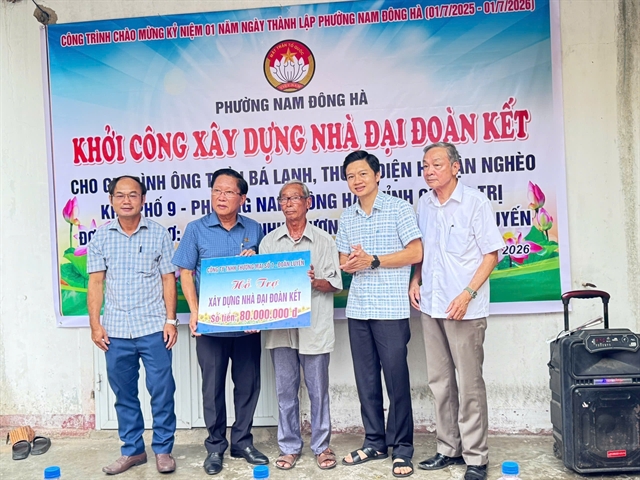 |
| Đoàn Xuân Luyến (second, left) contributes to building solidarity houses for disadvantaged families in Nam Đông Hà Ward, the central province of Quảng Trị. — VNA/VNS Photo Tường Vi |
Memories of youth
In 1972 at the age of 18, Luyến joined guerrilla forces in Triệu Phong area, serving as a messenger for main-force military units operating on the eastern front tasked with defending the outer perimeter and supporting the defence of the Quảng Trị Citadel.
Though small in stature, he was quick and agile, repeatedly crossing bomb-cratered fields under dangerous conditions to deliver messages to frontline troops.
The eastern front was defended by the 27th Regiment (also known as the Triệu Hải Regiment), the 320B Division and the 1st Corps.
What began as a role as a messenger evolved into active combat service, with the 18-year-old growing into a seasoned soldier through numerous fierce battles within the ranks of the regiment.
During prolonged deployments on the eastern front, Luyến not only carried messages but also dug bunkers, transported supplies, provided first aid to wounded soldiers and fought under conditions of severe deprivation, with shortages of food and water while facing death on a daily basis.
Even today, recalling those memories leaves him visibly emotional.
“My comrades were young men aged 18 or 20 from every corner of the country who came to Quảng Trị Province to fight,” he said.
“In the morning we would eat together, sharing every piece of a ration biscuit. At night we would go to our positions together, but by the next morning some would never return.
“There are comrades whom I am still searching for today. Only those who experienced such losses can truly understand them.”
In his office, the most prominent items are not certificates of merit or business awards but wartime relics he has preserved for more than 50 years such as a faded backpack, a worn military belt, a thin blanket that accompanied him through cold and rainy nights on the frontline, a water canteen and a chipped porcelain bowl scarred by wartime bombardment.
These mementoes serve as constant reminders never to forget those who sacrificed their lives.
For that reason, much of his energy in recent years has been devoted to commemorating fallen soliders.
He regularly visits war cemeteries throughout the province, participates in efforts to locate the remains of missing soldiers, assists families travelling from across the country in search of relatives and joins fellow veterans in releasing floating lanterns on the Thạch Hãn River to honour those who never returned from the battlefield.
“I always believe that I am alive today because my comrades died in my place,” he said.
“As long as I remain healthy, I must continue contributing.”
For his contributions both during wartime and in peacetime, Luyến has received numerous prestigious honours, including the Second-Class Resistance Order, the Third-Class Labour Order, a Certificate of Merit and several other State distinctions.
Nguyễn Duy Đức, Chairman of the Veterans’ Association of the ward, said that Luyến is one of the organisation’s most exemplary members.
Luyến has achieved considerable success in business, created jobs for hundreds of local workers and has always been at the forefront of social welfare activities.
“Luyến is a truly outstanding role model among the local veterans’ community,” Đức said. — VNS
Society
 Society
 Society
 Society
 Society
 Society
 Society
 Society
 Society
 Society
 Society
 Society
 Society
 Society
 Society