 Society

LANDMARK Launches ‘Destination CENTRAL’: A District-Wide Invitation to Explore the Dynamism, Luxury, and Soul of Central
1.
|
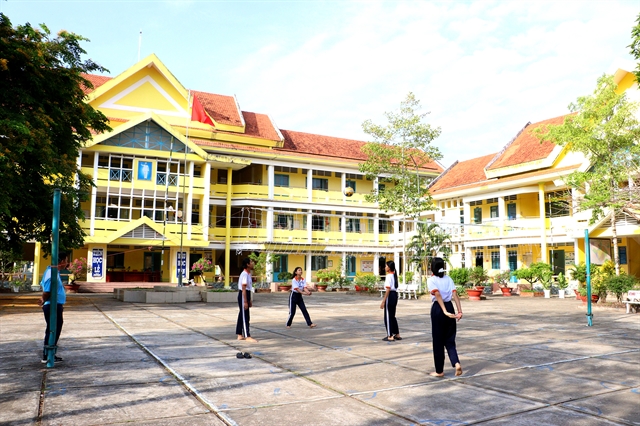
| The Vĩnh Long Province Ethnic Boarding School in Tam Bình Commune is well equipped to meet the learning needs of local Khmer students. — VNA/VNS Photo Lê Thúy Hằng |
VĨNH LONG — Vĩnh Long Province is expanding access to schools and language support for ethnic students as part of efforts to improve standards by 2030.
Under its 2026–30 plan, the Cửu Long (Mekong) Delta province aims for all children of primary and lower secondary school age in these communities to attend school by 2030.
It also seeks to ensure all ethnic children in preschools receive strengthened Vietnamese language support before entering first grade.
It also plans to have more than 12 per cent of all ethnic students in boarding schools.
Besides, all schools in ethnic areas will organise activities to help their students learn about ethnic cultures.
They will also have ethnic language classes in line with regulations issued by the Ministry of Education and Training.
The province is home to more than 373,000 ethnic people, or 11 per cent of its population.
The Khmers are the largest ethnic group, followed by the Hoa and others.

|
| Khmer language classes are provided for students at the Thạch Thia Primary School in Ngãi Tứ Commune. Most children at the school are from the Khmer ethnic community. — VNA/VNS Photo Lê Thúy Hằng |
Nguyễn Thị Bé Mười, deputy chairwoman of the Provincial People’s Committee, said education in these communities would undergo fundamental reform towards standardisation and modernisation by 2030, while preserving and promoting cultural identities.
The province would ensure all residents have access to quality education to raise educational standards and develop human resources that meet developmental needs, she said.
To achieve the goals, the province will review and reorganise the education network in ethnic areas under a suitable roadmap.
It will strengthen the system of ethnic boarding schools and institutions offering ethnic language classes.
It will also offer career guidance and promote student streaming linked to labour market demand.
Thạch Thị Thu Hà, director of the local Department of Ethnic and Religious Affairs, said, in implementing Politburo Resolution No 71 on breakthroughs in education and training development, the province is focusing on reforming the management of educational institutions and effectively implementing the 2018 General Education Programme.
It currently has nine ethnic boarding secondary schools, one Pali-Khmer intermediate school, medical and vocational colleges, and vocational training centres offering various programmes.
Trà Vinh Ethnic Boarding High School in Long Đức Ward has 416 students.
Kim Chan Ta Na, its principal, said the school has an upper secondary graduation rate of more than 99 per cent every year.
Nearly all the graduates go on to university or college, he said.
|
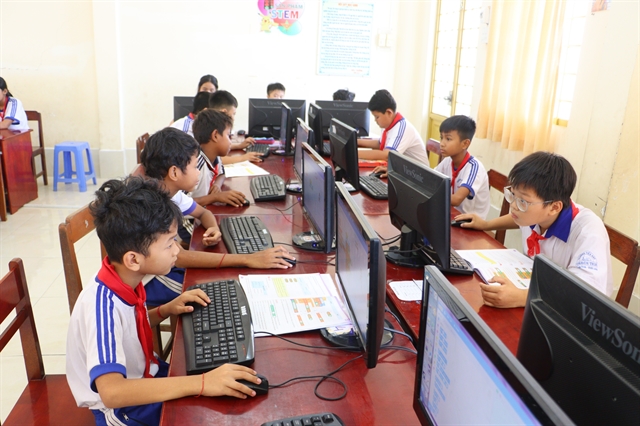
| Pupils at Thạch Thia Primary School have fully equipped classrooms and learning facilities. — VNA/VNS Photo Lê Thúy Hằng |
Many support models for disadvantaged ethnic students have also proven efficient.
Đôn Châu High School in Đôn Châu Commune has implemented the “Friendship House” programme since the 2011–12 academic year to help disadvantaged students stabilise their lives and reduce the dropout rate.
Lư Văn Sa Rinh, secretary of the school’s Youth Union, said the “VNĐ1,000 Piggy Bank” campaign has attracted active participation.
Each class buys a piggy bank, while every student saves VNĐ1,000 (3 US cents) a week and puts the money to it.
The school raises more than VNĐ20 million (US$770) through this each year.
Using the money, it has built nearly 20 “Friendship Houses” for disadvantaged students.
Thạch Thị Sa Quyên, a Grade 10 student, said her family had previously lived in a temporary house and constantly worried during storms and heavy rain.
“When the school gave me VNĐ27 million ($1,020) to build a house, I was very happy because it was a huge source of encouragement that gave me more confidence and determination to overcome difficulties in life.”
In the 2025–26 academic year, the Vĩnh Long Department of Education and Training, Vừ A Dính Scholarship Fund, and “For Beloved Hoàng Sa and Trường Sa” programme, awarded scholarships worth VNĐ1 million ($38) each to 185 students in Càng Long Commune.
Since 2010, the Vừ A Dính Scholarship Fund and “For Beloved Hoàng Sa and Trường Sa” programme have granted scholarships to 1,860 students in the former Trà Vinh and Bến Tre provinces, now part of Vĩnh Long. — VNS
Society
 Society
 Society
 Society
 Society
 Society
 Society
 Society
 Society
 Society
 Society
 Society
 Society
 Society
 Society