 Society
VN-Index ends lower despite liquidity hit over $1 billion
1.
|
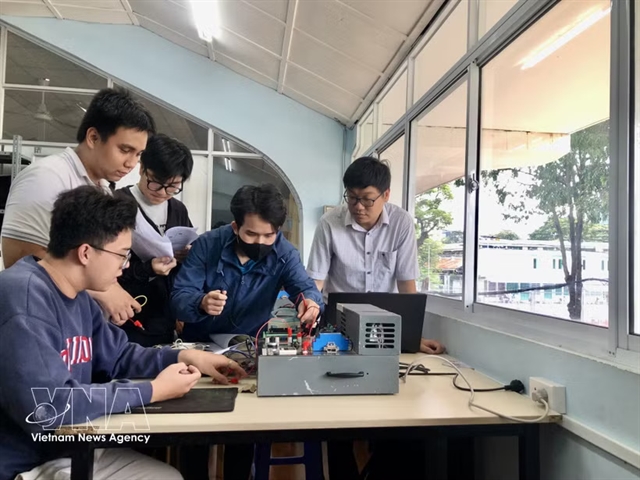
| Students at HCM City University of Technology practice advanced technologies . — VNA/VNS Photo |
HÀ NỘI — The Government has issued a decree channeling scholarships to students in basic sciences, critical engineering and strategic technologies, aiming to build a skilled workforce for the country’s next growth phase.
Spanning five chapters and 17 articles, the decree specifies eligible recipients, qualifying courses, selection criteria and principles, scholarship amounts and duration, authority for approval and disbursement, fund allocation and settlement, and the obligations of all entities and individuals involved.
The policy covers Vietnamese nationals in full-time bachelor’s, engineering, master’s and doctoral courses in the targeted fields. It also extends to educational establishments and administrators handling the scholarships.
Fifteen priority fields are eligible, including biology, mathematics, statistics, physical sciences, earth sciences, computer science, information technology, mechanical engineering, electrical-electronics and telecommunications engineering, chemical engineering, materials, metallurgy and environmental engineering, engineering physics, geological engineering, mining engineering, and construction engineering. These are identified as foundational and strategic for national sci-tech and innovation.
The decree sets specific criteria. Students in talent courses approved by the Ministry of Education and Training automatically qualify. In semiconductor integrated circuits, those admitted to recognised bachelor’s and engineering courses are also eligible.
For basic sciences, key engineering and strategic technology courses, applicants must clear one of two hurdles: a first-, second- or third-place finish in a national or international excellence competition within three years before consideration; or a combined score of at least 22.5 in mathematics plus two subjects from physics, chemistry, biology or English on the national high-school graduation exam, while ranking in the top 30 per cent of admitted students nationwide within the same field group.
For integrated bachelor’s–master’s, master’s and doctoral students, eligibility rests on admission results, academic performance and research output. To keep the scholarship, recipients must avoid formal reprimand or worse and hit academic thresholds. Undergraduates and engineering students need a cumulative GPA of at least “fairly good,” 24 credits after year one, and 28 credits each subsequent year.
Master’s candidates must complete at least 40 per cent of credits after the first year, hold a cumulative GPA of at least 3.0 on a 4.0 scale, and meet their establishment’s research and publication requirements. Doctoral candidates must satisfy research and publication benchmarks.
The decree bars scholarship holders from switching to non-supported majors or courses, except in force-majeure cases defined by educational establishments. If a transfer voids eligibility, recipients must repay all state funds received.
Monthly stipends are set at VNĐ5.5 million (US$211) for talent-course students, VNĐ4.2 million for semiconductor and basic science students, and VNĐ3.7 million for those in key engineering and strategic technology. Master’s scholarships range from VNĐ5.5-7.4 million depending on the field. Doctoral candidates get VNĐ7.4-8.4 million per month.
Undergraduates can draw the scholarship for up to 10 months a year while master’s and doctoral students are eligible for 12 months annually. Total support matches each course’s standard length.
The decree will take effect on July 15, 2026. It applies to students admitted from 2025 onward, with disbursements starting on September 1, 2026. — VNA/VNS
Society
 Society
 Society
 Society
 Society
 Society
 Society
 Society
 Society
 Society
 Society
 Society
 Society
 Society
 Society