 Society

HCM City tops national Chinese chess championship in Bắc Ninh
1.
|
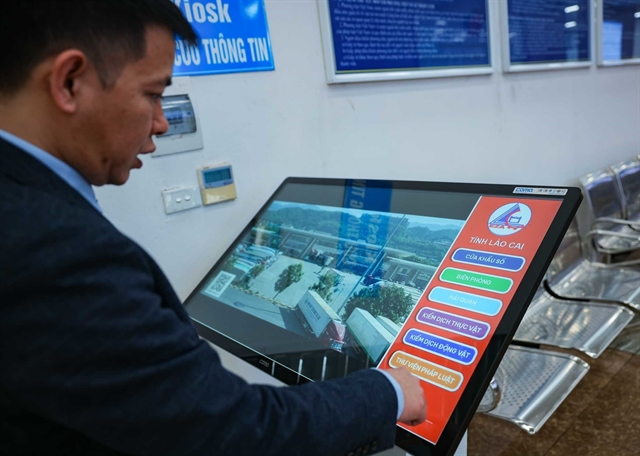
| A man at a smart kiosk at Kim Thành International Border Gate No. 2 in the northern mountainous province of Lào Cai. — VNA/VNS Photo Hoàng Hiếu |
LÀO CAI — What once required multiple systems and long waits is now handled in a matter of minutes as Lào Cai’s digital border gate platform reshapes customs clearance, delivering faster processing and lower costs for businesses while strengthening state management.
After nearly three years in operation, the platform has brought a significant shift to import-export procedures in the northern mountainous province, benefiting both enterprises and government agencies.
Vương Trinh Quốc, head of the Lào Cai Province Economic Zone Authority, said the most visible achievement since the system was deployed at local border gates had been the sharp reduction in customs procedures, fewer administrative steps, lower costs for businesses and the development of a comprehensive data repository that improves management efficiency.
“The most noticeable change has been the speed of processing procedures,” he said.
Previously, businesses had to submit declarations across multiple software systems. Now they are required to complete only a single declaration through the digital border gate platform, according to the official.
Data is stored in a synchronised system and can be reused for future declarations, significantly reducing both time and costs.
All import-export enterprises operating through Kim Thành Border Gate have now connected to the platform.
Statistics underline its effectiveness, with the number of steps in the customs clearance process reduced from 19 to just four while processing time at checkpoints has fallen from between four and six minutes to under two minutes.
A more streamlined mechanism, combined with smart infrastructure, has helped reduce risks and cut operational costs.
Beyond supporting businesses, the digital border gate platform has also transformed state administration.
All data relating to vehicles, cargo and clearance times is updated in real time and shared transparently, ensuring legal validity and accuracy while enabling relevant authorities to exploit the system effectively.
Notably, after nearly three years of operation, the platform has built a large database allowing officials to monitor and analyse trends and forecast import-export activity.
As trade between Việt Nam and China continues to grow, pressure on Lào Cai’s border infrastructure has intensified.
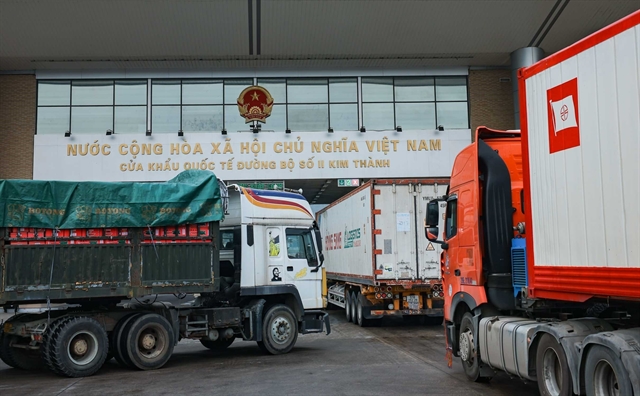
During peak agricultural export seasons, thousands of container trucks arrive at the border gate, creating a constant risk of congestion.
Against this backdrop, the transition from a digital border gate to a smart border gate is increasingly seen as a necessary step to ease bottlenecks and improve long-term efficiency.
|
| Trucks carrying export goods at Kim Thành International Border Gate No. 2 in the northern mountainous province of Lào Cai. — VNA/VNS Photo Hoàng Hiếu |
Smart border gate project
Decision No. 453/QĐ-TTg approving the Smart Border Gate Project at the Kim Thành road bridge customs clearance point and Bản Vược customs clearance point under Lào Cai International Border Gate is fuelling expectations of a technological transformation in the import-export sector and the gradual emergence of an international logistics hub.
Under the Government-approved scheme, the province will deploy a model integrating advanced technologies such as artificial intelligence (AI), 5G connectivity, big data and automated guided vehicles (AGVs) into import-export operations.
Unlike traditional systems, goods that have completed electronic customs procedures will be transported through inspection zones by self-driving vehicles without direct human control.
The entire process of operating, monitoring and identifying vehicles and cargo will be automated.
According to assessments by the Lào Cai Economic Zone Authority, the model could increase customs clearance capacity two to three times while reducing clearance times from several days to around 24 hours.
In particular, logistics costs for businesses could fall by between 20 and 30 per cent.
Quốc said transport using driverless vehicles would allow businesses to reduce immigration procedures for drivers, save fuel costs and most importantly shorten delivery times.
All processes would be automated, transparent and subject to public monitoring, he said.
The smart border gate project will be implemented in two phases.
The first phase will focus on completing legal frameworks, technological infrastructure and investor selection while the second phase will involve operational deployment, expansion of logistics systems and completion of an integrated smart management model.
At the same time, the customs sector is accelerating the development of digital customs and smart customs systems to synchronise data with the border gate network.
“This is regarded as a crucial foundation for minimising paperwork and enhancing supervision and risk management capabilities,” he said.
Trần Anh Tú, head of the Lào Cai International Border Gate Customs Team under Regional Customs Division No. 7, said the combination of smart border gates and digital customs would deliver significant benefits for import-export businesses by making procedures faster, more transparent and more efficient.
Under the roadmap, the smart border gate model in the province is expected to enter commercial operation no later than the first quarter of next year.
At present, the province is focusing on infrastructure investment, pilot operations and inter-agency data connectivity.
More than a technological application, the smart border gate reflects Lào Cai’s ambition to become a major cargo transit hub in northern Việt Nam and a future international logistics centre. — VNS
Society
 Society
 Society
 Society
 Society
 Society
 Society
 Society
 Society
 Society
 Society
 Society
 Society
 Society
 Society