 Society

Bà Đen Mountain’s cloud cap offers a spectacle worth seeing in person
1.
|
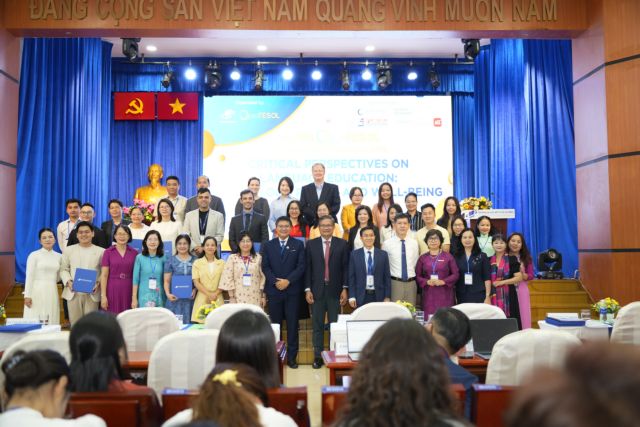
| Delegates and keynote speakers attend the 14th OpenTESOL International Hybrid Conference 2026 held at HCM City Open University on May 23. — Photos Courtesy of HCMCOU |
HCM CITY — The 14th OpenTESOL International Hybrid Conference 2026 officially opened in HCM City on May 23, bringing together hundreds of educators to address the rapidly evolving landscapes of language teaching, artificial intelligence, and educator well-being.
The two-day event, titled "Critical Perspectives on Language Education: Technology, Policy, and Well-Being," organised by the Faculty of Foreign Languages and the Graduate School of the HCM City Open University (HCMCOU), serves as an open academic forum for scholars, researchers, and teachers to share practical experiences and their latest research findings.
The event has attracted over 400 onsite and online participants, including administrators, university lecturers, school teachers, and postgraduate students from Việt Nam and more than 12 countries.
The conference programme highlights the deep intersection between modern educational technology and human elements.
Keynote speeches and 146 presentations focus heavily on the capacity to use artificial intelligence (AI) in language classrooms, alongside evaluating teacher and student well-being from societal and policy perspectives.
Speaking at the event, HCMCOU President Nguyễn Minh Hà said in today’s rapidly changing educational landscape, language educators are facing both new opportunities and challenges.
"Advances in technology and AI are reshaping the ways we teach, learn, and communicate."
The conference provides a crucial nexus for the global teaching community.
“It serves as an important platform for educators and researchers to exchange ideas, reflect critically, and explore innovative practices that can positively impact language education communities locally and globally,” he said.
The presentations cover a wide range of important and timely topics related to TESOL, language teaching and learning, educational technology, artificial intelligence, teacher development, policy, learner well-being, and many other emerging issues in education today.
|
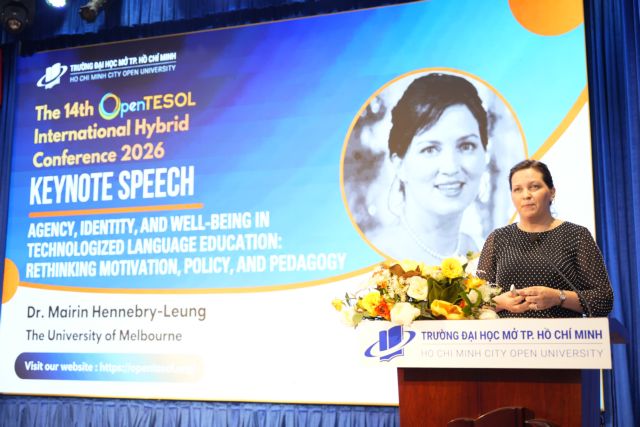
| Dr. Mairin Hennebry-Leung from the University of Melbourne delivers her keynote speech on the critical relationship between technology, motivation, and educator well-being during the main session of OpenTESOL 2026 in HCM City on May 23. |
Putting the human element back in TESOL
A primary highlight of the main sessions was the keynote address by Dr. Mairin Hennebry-Leung, Senior Lecturer in Languages and Literacies Education at the University of Melbourne.
Her presentation, “Agency, Identity, and Well-Being in Technologised Language Education: Rethinking Motivation, Policy, and Pedagogy,” urged educators to look beyond just pedagogical metrics when integrating new tech.
She cautioned that digital environments do not just bring advantages.
"While AI-mediated and digital learning environments promise new opportunities for engagement, personalisation, and creativity, they also introduce pressures associated with surveillance, standardisation, and performativity," she said.
She stressed that motivation should be treated as an essential component of a student's mental health.
"Motivation is not simply a precursor to learning outcomes, but a core dimension of well-being itself, closely tied to individuals' sense of purpose, agency, and identity."
As AI tools automate feedback and content generation, she raised critical questions regarding the day-to-day experience of teachers and students.
"As digital tools increasingly mediate processes of inquiry, feedback, and knowledge construction, questions arise about how opportunities for intellectual challenge, reflective struggle, and professional growth are experienced within technologised environments," she said.
Ultimately, she called for a structural pivot in how institutions view digital transformations, concluding that, "Rethinking motivation as central to well-being offers more sustainable, equitable, and human-centred pathways for language education."
The conference kicked off with a pre-conference featuring specialised sessions on the practical use of AI tools in classroom dynamics and building future-ready competencies.
The main event featured additional keynote speeches from global experts representing Michigan State University, Oxford University Press, The Education University of Hong Kong, and Macmillan Education.
First launched in 2012, the annual OpenTESOL International Conference continues its mission of supporting the foreign language teaching community, maintaining training quality, and innovating teaching methodologies to build a highly competitive human resource base for Viet Nam. — VNS
Society
 Society
 Society
 Society
 Society
 Society
 Society
 Society
 Society
 Society
 Society
 Society
 Society
 Society
 Society