 Society

HCM City tops national Chinese chess championship in Bắc Ninh
1.
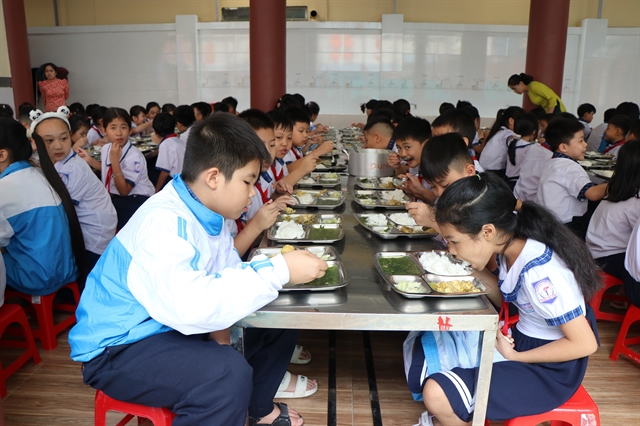 |
| Pupils have lunch at Phan Chu Trinh Primary School in Đắk Lắk Province. Proper school nutrition is considered essential to children’s physical and intellectual development. — VNA/VNS Photo Nguyên Dung |
HÀ NỘI — Improving children’s nutrition and physical fitness is emerging as one of Việt Nam’s key long-term priorities, as the country seeks to build healthier, stronger and more resilient future generations.
In line with this direction, a plan to establish legal regulations on improving school nutrition and physical fitness nationwide was outlined last year.
Ensuring proper nutrition and physical development among children has been identified as a key strategy by the education and health sectors. Special attention is given to the first 1,000 days of life and the school-age period, which are critical foundations for children’s physical, mental and intellectual development.
Statistics from the Ministry of Health (MoH) show that the nutritional status of preschool and school-age children has improved significantly after a decade of implementing the 2011-2020 National Nutrition Strategy.
The rate of stunting among children under five has declined from 29.3 per cent in 2010 to 19.6 per cent, shifting from a high to a medium level under World Health Organisation (WHO) classifications. Among students aged 5 to 19, the stunting rate has dropped to 14.8 per cent, compared to 23.4 per cent in 2010.
One of the most notable achievements is the improvement in the average height of Vietnamese youth. The average height of 18-year-old boys has reached 168.1cm (an increase of 3.7cm compared to 2010), while girls of the same age average 156.2cm (up 2.6cm).
These figures reflect sustained, long-term nutritional interventions across generations, helping Việt Nam move beyond the group of the shortest countries in Southeast Asia. The country now ranks fourth in average height in the region, after Singapore, Malaysia and Thailand.
The proportion of students meeting recommended physical activity levels has also increased. According to the 2019 Global School-based Student Health Survey, 24.1 per cent of Vietnamese students aged 13 to 17 meet the WHO recommendation of at least 60 minutes of physical activity per day on five days per week, up from 20.5 per cent in 2013.
 |
| Students at Đà Bắc Ethnic Boarding Secondary and High School in Phú Thọ Province play volleyball after class as part of efforts to improve physical fitness among young people. — VNA/VNS Photo Nguyễn Thảo |
Rising concerns
However, significant shortcomings remain in nutrition and physical care for school-age children. The rate of overweight and obesity among children under five stands at 7.4 per cent, with higher rates in urban areas (9.8 per cent) than rural areas (5.3 per cent).
Among school-age children (aged 5 to 19), this figure has doubled over the past decade, reaching 19 per cent in 2020, and up to 26.8 per cent in urban and developed areas.
Health experts noted that these statistics reflect an increased risk of metabolic disorders and non-communicable diseases. Micronutrient deficiencies remain widespread, particularly among high-risk groups and in disadvantaged, remote areas.
The quality of school meals is also considered uneven, with imbalances in both quantity and nutritional composition, especially in remote and ethnic community regions.
Meanwhile, unhealthy dietary habits are emerging in urban areas, driven by increased consumption of processed foods, fast food and sugary drinks, contributing to poor nutrition and rising health risks.
Notably, school nutrition programmes still lack standardisation and consistency, limiting effective implementation, management and monitoring.
According to Dr Nguyễn Đỗ Vân Anh from the National Nutrition Institute, Việt Nam is facing a “double burden of malnutrition”, where undernutrition and overweight or obesity coexist within the same population.
This is an increasingly common trend in developing countries undergoing rapid urbanisation, economic growth and shifts in food systems.
Policy push
The Ministry of Education and Training (MoET) and the MoH are taking measures to review physical education programmes, strengthen school nutrition and hygiene, and integrate health education into curricula from early childhood through general education.
In the past year, the education sector has implemented various programmes on school healthcare, nutrition and physical education, gradually building a comprehensive, student-centred learning environment.
Nguyễn Nho Huy, deputy head of the MoET’s Department of Students Affairs, said that these three aspects would be core priorities for the 2025-2035 period to enhance students’ physical fitness and stature.
The MoET and the MoH also plan to work closely with relevant agencies to push forward the programmes on school health and physical education reform during this period.
Key measures include stricter control over the quality and safety of school meals, nutritional assessments, and the rollout of electronic health records in schools.
Standardised school menus are expected to be developed for nationwide use, in addition to increased use of technology in student health management and investment in school kitchens, sports facilities and health infrastructure.
Policies related to school healthcare, nutrition and meals will be reviewed and revised for better coherence, with priority given to disadvantaged and remote areas. Inspection and supervision of school hygiene and food safety will also be strengthened to minimise risks.
Regarding physical education, reforms will focus on greater flexibility, offering diverse sports tailored to local conditions and student preferences, with the goal that every student participates in at least one suitable physical activity.
To ensure effective implementation, a proposal has been submitted to the Government to develop and issue a unified national policy framework integrating school nutrition, physical activity and sports, ensuring consistency across programmes and initiatives.
By strengthening nutrition, physical activity and school healthcare in a more systematic way, Việt Nam aims to build healthier, stronger and more resilient generations capable of supporting the country’s long-term development ambitions.— VNS
Society
 Society
 Society
 Society
 Society
 Society
 Society
 Society
 Society
 Society
 Society
 Society
 Society
 Society
 Society