 Society


Vietnamese exporters look beyond trade fairs to reach Thai buyers
1.
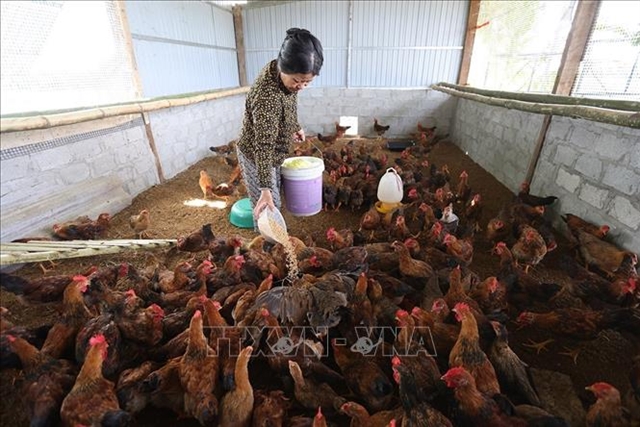 |
| The Hà Tĩnh Province Agricultural Extension Centre transfers commercial poultry-rearing techniques using biological bedding litter in Thạch Lạc Commune, Hà Tĩnh Province. — VNA/VNS Photo Vũ Sinh |
HÀ NỘI — The Prime Minister has issued Directive No. 22/CT-TTg to accelerate implementation of the National Target Programmes on new rural construction, sustainable poverty reduction, and socio-economic development in ethnic minority and mountainous areas for the 2026–2030 period, aiming to ensure a synchronised and effective rollout of programmes central to national development and improvements in living standards.
The directive rests on National Assembly Resolution No. 257/2025/QH15, which approved the investment policy for the three programmes covering the 2026–2035 period, and on Government Resolution No. 424/NQ-CP, which sets out the plan to carry out the assembly's resolution. Ministries, sectors and localities have been active in drafting, issuing or submitting for approval a range of mechanisms, policies and guidance documents to support implementation.
However, the Government has assessed the pace of implementation as slow and falling short of established requirements. Some ministries and sectors have yet to issue comprehensive guidance on the National Criteria Set on New Rural Areas for the 2026–2030 period, or on the specialised content falling under the programmes. Disbursement of state budget funds has also not met requirements. The principal causes have been identified as insufficiently resolute leadership at some ministries, agencies and localities; lax administrative discipline in certain areas; and the transition from three separate national target programmes covering the 2021–2025 period to a single integrated programme from 2026, which has generated many new implementation requirements.
To ensure the programmes are delivered on schedule, in line with their objectives, targeting the right beneficiaries and within the proper scope of authority, the Prime Minister has called on ministers, heads of ministerial-level and central agencies, and chairpersons of provincial and municipal People's Committees to treat this as one of the central and urgent political tasks of the current period. Agencies must commit to resolute, regular and continuous direction, and must assign specific responsibilities – linked to the accountability of agency heads – for each task, project and concrete schedule requirement.
The Prime Minister has also called for priority to be given to completing unfinished tasks and projects, particularly those that can be finalised in 2026, so they can be brought into use promptly and investment effectiveness maximised. Implementation must ensure openness, transparency, quality and efficiency, and must avoid duplication of expenditure, overlapping beneficiary groups, the spreading of capital allocations too thinly, the accumulation of construction debts, and waste or wrongdoing. At the same time, decentralisation and delegation of powers must be strengthened, with greater responsibility placed on provincial and commune levels and less tolerance for the passing on of responsibilities that delays implementation and disbursement.
On completing institutional frameworks and implementation guidance, the Prime Minister has required the Ministry of Science and Technology and the Ministry of Education and Training to issue guidance documents on the criteria falling under the National Criteria Set on New Rural Areas before May 30, 2026, ensuring clarity of content, clear evaluation methods and ease of application for localities in organising implementation, inspection and recognition of results.
The ministries of Home Affairs, Construction, Education and Training, and Science and Technology have also been required to issue guidance on programme content before May 30, 2026, ensuring consistency, feasibility and the absence of unnecessary procedures or duplication. Heads of ministries and central agencies must be personally accountable to the Prime Minister for the progress and quality of guidance documents within their management scope.
At the local level, chairpersons of provincial People's Committees must urgently reorganise Programme Steering Committees and their supporting bodies before June 10, 2026, and should consider establishing commune-level steering committees in line with local conditions, without creating additional organisations or staffing positions.
Among the directive's notable requirements is a push to concentrate resources on communes and hamlets facing exceptional difficulties, including ethnic minority and mountainous areas, border areas, islands and secure zones. Localities must develop principles, criteria and norms for state budget allocation for the 2026–2030 period that give the highest priority to disadvantaged areas, in order to address pressing needs such as residential land, housing, productive land, electricity, domestic water and essential social infrastructure, thereby helping to stabilise living conditions for ethnic minority and mountainous communities.
The Prime Minister has also required a concentrated effort to accelerate disbursement of central government budget funds carried over from 2025 for use in 2026. Chairpersons of provincial and municipal People's Committees must directly oversee disbursement and bear full responsibility before the Government and the Prime Minister for results in their areas. No later than May 30, 2026, localities must complete a review of unfinished tasks and clearly identify what can be implemented and disbursed within 2026, to be handled in accordance with regulations.
Localities, ministries and sectors are required to prioritise the use of carried-over funds to complete outstanding tasks without delay, while accelerating the completion of documentation, acceptance, payment and settlement of projects. On a monthly basis, before the 20th of each month, localities and central agencies must report on implementation progress, disbursement, difficulties and obstacles, and accountability for resolution to the Ministry of Agriculture and Environment, with copies sent to the Ministry of Finance and the Ministry of Ethnic and Religious Affairs for consolidation within their respective management scope.
Under the directive, the Ministry of Agriculture and Environment has been assigned to lead co-ordination with the Ministry of Ethnic and Religious Affairs to monitor, urge and inspect implementation and capital disbursement, and to consolidate results, disbursement progress and any difficulties for reporting to the Government and the Prime Minister. The Ministry of Finance is responsible for consolidating information on state budget disbursement for the national target programmes and for providing guidance on resolving difficulties related to the allocation, payment and settlement of public investment funds.
The issuance of the directive has been assessed as a resolute step by the Government to remove obstacles in the implementation of the national target programmes, while driving progress in public investment disbursement and improving the effectiveness of rural development policies, sustainable poverty reduction, and socio-economic development in ethnic minority and mountainous areas in the new period. — VNS
Society
 Society
 Society
 Society
 Society
 Society
 Society
 Society
 Society
 Society
 Society
 Society
 Society
 Society
 Society