 Society

European higher education week opens new opportunities
1.
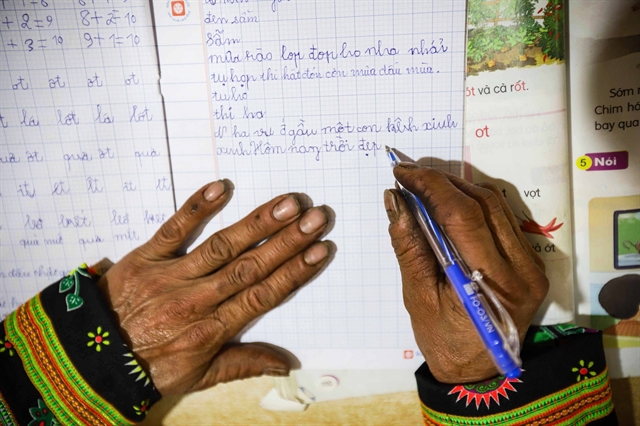 |
| Hands that were used to hoes and machetes now fumble awkwardly with pens. — VNA/VNS Photo Trọng Đạt |
SƠN LA — In Làng Sáng Village, an evening literacy class is opening new opportunities for people who have spent their lives working the fields without ever learning to hold a pen.
Hidden deep within the protected forest of Tà Xùa Commune in Sơn La Province, the road into Làng Sáng narrows in places to little more than the width of a motorbike.
Each night, however, the remote village fills with the hesitant sounds of local Mông women learning to read and write for the first time.
For many of the learners, the adult literacy class represents more than education. It offers hope to people whose lives have long revolved around farming and who never previously had the opportunity to study.
Special students
From the centre of Tà Xùa Commune, the journey to Làng Sáng takes more than two hours along winding forest slopes. There, at 7.30pm on weeknights from Monday to Thursday, 29 learners, all Mông women, gather in a small classroom at the village school to practise their first pen strokes.
The class is remarkable in many ways. Some learners are grandmothers, some arrive carrying babies in slings and most follow the same demanding daily routine, taking their children to school in the morning, tending the fields during the day, collecting their children in the afternoon and then attending literacy lessons together in the evening.
The young children who accompany their mothers are pupils in the village primary classes.
Hands accustomed to hoes and machetes now carefully grip pens.
In the stillness of the mountain forest, the hum of insects blends with the sound of spelling lessons drifting from the brightly lit classroom, creating scenes that teachers say are difficult to forget.
For the learners, reading and writing mean more than signing a name or understanding paperwork. They symbolise hope for a better life and the confidence to move beyond barriers that have existed for generations.
The class is held at the village branch of Háng Đồng Primary and Junior Secondary School, where two teachers have been assigned to lead the lessons.
Lường Văn Dương, a teacher at the Làng Sáng site, said he and fellow teacher Lò Văn Huấn were tasked by the school with teaching the villagers when the class was established.
He said the learners were initially shy and hesitant, but attendance gradually became more regular as enthusiasm grew. The teachers remained committed to helping villagers build confidence and improve educational opportunities in Làng Sáng.
Trần Việt Cường, headmaster of Háng Đồng Primary and Junior Secondary School, said the literacy class was established following directives from the commune Party Committee and People’s Committee and in response to local demand.
He said the main aim was to help residents read and write so they could access knowledge and better understand Party guidelines as well as State laws and policies. Evening classes were arranged to fit around daytime agricultural work.
Sowing letters, kindling hope
The literacy class at Làng Sáng was officially established by the Tà Xùa People’s Committee in March this year. Since then, learners have attended regularly and developed a growing enthusiasm for studying.
Among them is nearly 50-year-old Sồng Thị Ly, the oldest learner in the class. From childhood through marriage and becoming a grandmother, her life revolved around the fields and the narrow paths of the village. Like many Mông women in Làng Sáng, she said she never imagined she would have the opportunity to study.
Unable to read or write and with limited Vietnamese language skills, her interactions had largely been confined to family members and neighbours. In class, her calloused hands tremble slightly as she carefully forms each letter.
“Not being able to read is a real hardship; you have to ask others for help with paperwork. Now I only wish to be able to read and write so I can do simple tasks myself, read books and watch TV,” Ly said.
Another learner, Sồng Thị Khua, carries her young child on her back to class each evening because she has no one to care for the child at home. The child is calm and rarely cries during lessons. With guidance from the teachers, she can now read more confidently and sign her own name.
Khua said life in Làng Sáng had changed significantly since the village was connected to the power grid and roads were improved. She hopes learning to read will further improve her family’s future.
Having worked at the Làng Sáng site for more than 15 years, teacher Lò Văn Huấn said many learners initially did not know how to hold a pen and struggled with Vietnamese pronunciation, requiring lessons to begin with the basics.
“When learners can write their names, copy sentences from textbooks or fluently read a short passage, the teachers feel immense joy and emotion,” he said.
Huấn said what moved teachers most was the villagers’ dedication. After long days working in the fields, many women still travel through the forest to attend class in the evening. Some walk kilometres through cold mountain mist while others carry small children on their backs, yet they rarely miss a lesson.
From literacy class to change
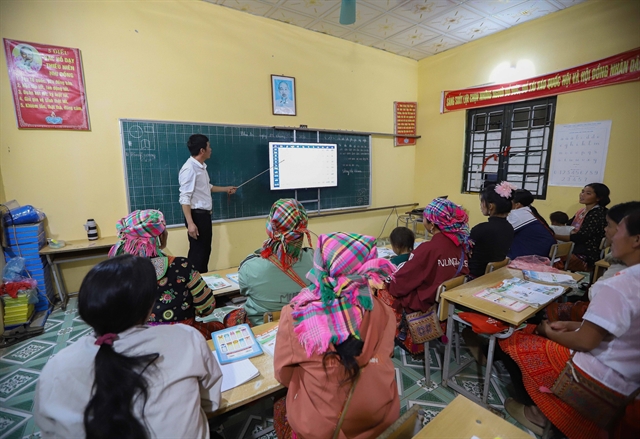 |
| The class becomes all the more special because some learners are grandmothers and others come to class with their babies carried on their backs. — VNA/VNS Photo Trọng Đạt |
Làng Sáng was once an isolated mountain village where life was harsh and travel difficult. Education was rare in many households, particularly for women.
Thào Thị Dâu, head of the Làng Sáng Women’s Union, said a literacy class had previously been organised in 2018, but participation remained limited because of long-held attitudes. Many men believed women did not need schooling and should focus solely on farming and raising children.
Commune officials, members of the Women’s Union and teachers visited households to encourage participation and explain that literacy could help change mindsets and living conditions, support childcare and improve livelihoods.
In recent years, State investment has brought significant changes to the village. A concrete road now connects Làng Sáng to the main Tà Xùa–Háng Đồng route, electricity has reached the area, more children are attending school and awareness among villagers has gradually improved.
Đỗ Văn Xiêm, chairman of the Tà Xùa People’s Committee, said the literacy classes had helped villagers recognise that reading and writing gave them greater access to information, helped them apply scientific and technical knowledge to production, improved living standards and created better opportunities for their children.
According to Xiêm, the growing number of Mông women joining the literacy class reflects a positive shift in awareness. Educational standards are improving step by step, contributing to the implementation of Party and State policies and local economic development.
To maintain the programme, the commune has worked with the education and training sector, the Women’s Union and teachers to strengthen outreach efforts and encourage wider participation.
Local authorities have also allocated funding to sustain the class and are continuing to assess the possibility of opening similar classes in other remote hamlets where illiteracy rates remain high.
In the quiet nights of the vast Tà Xùa highlands, the lights of the Làng Sáng literacy class continue to shine and the sounds of spelling lessons still echo through the mountains. The tentative letters traced by calloused hands are quietly nurturing hope, hope for change among highland women and for a brighter future for the people of Tà Xùa. — VNS
Society
Society
 Society
 Society
 Society
 Society
 Society
 Society
 Society
 Society
 Society
 Society
 Society
 Society
 Society