 Society
VN-Index ends lower despite liquidity hit over $1 billion
1.
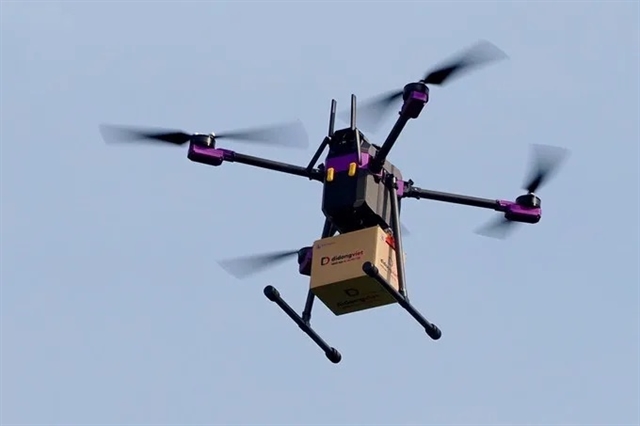 |
| A drone in flight carrying a parcel for delivery during trials in HCM City in January. — Photo www.sggp.org.vn |
HCM CITY — Southern metropolis HCM City aims to become Việt Nam’s first hub for low-altitude economy development, focusing on the research, production, and services of unmanned aerial vehicles (UAVs) and related technologies.
The municipal People’s Committee has officially issued a development plan for the low-altitude economy through 2030, positioning the city as a leading centre for this emerging high-tech sector.
The "low-altitude economy" refers to an economic model that utilises airspace below 1,000 metres.
It integrates advanced aviation technology, artificial intelligence (AI), big data, next-generation telecommunications, new materials, and digital business models.
City authorities view this as a vital new growth driver in the digital era, paving the way for faster, greener, and smarter transportation and service delivery.
The ambitious plan builds on recent successful experiments.
On January 5, 2026, the HCM City Department of Science and Technology, in collaboration with the Saigon Hi-Tech Park Management Board and local tech companies (including Saolatek, Real-Time Robotics Vietnam, and Di Động Việt) officially launched a controlled drone delivery trial programme.
Conducted under a regulatory sandbox framework enabled by the municipal People's Council's Resolution 20/2024, the trials saw domestic UAVs perform fully automated multi-point deliveries of actual consumer goods, such as coffee and mobile phones.
Flying pathways ranged from 200 to over 400 metres within the high-tech park, demonstrating real-time monitoring and fully automated takeoff and landing.
Permitted by the Ministry of National Defence's Operations Department, these trials provided vital practical data to help evaluate urban logistics capabilities, safety standards, and operational stability for short-haul transport.
Following the success of these urban short-range trials, local authorities plan to test longer-distance routes, including a projected route connecting the coastal areas of Cần Giờ with Vũng Tàu.
To achieve its long-term goals, the city aims to master core technologies, build a comprehensive industrial ecosystem, and establish a permanent controlled testing framework for UAVs.
Key measures outlined in the plan through 2030 include:
Enterprise Support: Creating favorable policies to help businesses research and manufacture low-altitude aircraft.
Public-Private Partnerships (PPP): Promoting collaborations, commissioning research projects, and supporting startups, institutes, and universities to develop core technologies.
Dual-Use Technology: Developing solutions that serve both national defence and economic needs, while encouraging technology transfer and commercialisation in UAV-related industries.
The development plan details major infrastructure initiatives.
The city will establish a UAV monitoring and management centre, build low-altitude airspace control systems integrated with 5G/6G networks, and install drone takeoff/landing pads, charging stations, and logistics hubs.
Priority pilot applications will span various sectors, including logistics, transport, healthcare, tourism, urban management, rescue operations, security, agriculture, and public administration.
The city has designated specific pilot zones for testing, including: Saigon Hi-Tech Park (SHTP), HCM City Agricultural Hi-Tech Park, the northern HCM City Hi-Tech Urban Area, and selected industrial zones.
According to the roadmap, from 2026 to 2027, the city will focus on finalising the controlled testing mechanisms and building an Unmanned Aircraft System Traffic Management (UTM) system.
Between 2028 and 2030, the project will scale up commercialisation and expand automated management systems across the region. — VNS
Society
 Society
 Society
 Society
 Society
 Society
 Society
 Society
 Society
 Society
 Society
 Society
 Society
 Society
 Society