 Society

Vietnamese Prime Minister meets Cambodian National Assembly President
1.
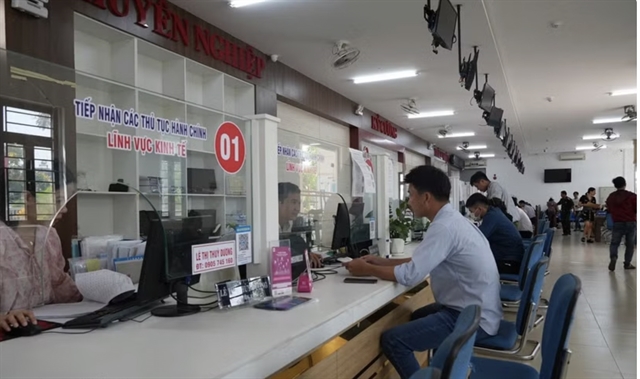 |
| People do public services in Đà Nẵng City. VNA/VNS Photo |
ĐÀ NẴNG — After nearly a year of officially operating the two-tier local government model, Đà Nẵng City has recorded positive results in administrative reform and streamlining the state apparatus.
However, practical experience at the grassroots level has revealed a major challenge: the mismatch between the promotion of decentralisation, delegation of power and authorisation of tasks, and the allocation of resources and implementation capacity at commune and ward levels.
The two-tier local government model requires commune and ward administrations to function as independent, multi-tasking administrative units, shifting strongly from a management role to a service role.
To operate this model, a series of State management tasks previously handled at district level have been decentralised and directly delegated to the grassroots level.
The workload has increased sharply and pressure on local authorities has intensified, while mechanisms for allocating financial and human resources have exposed numerous bottlenecks.
For example, An Hải Ward was established through the merger of the three wards of Phước Mỹ, An Hải Bắc and An Hải Nam, covering an area of 7.38sq.km and serving a population of more than 82,600 people.
Following the implementation of the new model, the People’s Committee of An Hải Ward received responsibility for 203 tasks across 20 groups of fields under 22 Government decrees, covering almost all areas of State management.
Among these, several fields carry particularly heavy workloads, including internal affairs, justice, urban planning and construction, land management, as well as finance, health, culture, environment and education.
This represents a deep and comprehensive level of decentralisation, clearly reflecting the policy of strengthening the autonomy and accountability of local governments.
However, reality has also exposed a degree of imbalance between delegated authority and the conditions required for implementation.
Although the locality has invested in IT equipment for 100 per cent of officials and civil servants and is gradually improving internal network infrastructure and digital platforms, several limitations remain during the initial implementation phase.
Some technological equipment remains outdated or unsynchronised and does not meet the increasing demands of management and operations in the digital environment.
In addition, while some officials and civil servants have access to technology, they have not received comprehensive and in-depth training in information technology and digital transformation.
Regarding this issue, ward Party Secretary Phùng Phú Phong said: “Decentralisation is not simply about transferring documents and tasks, but about restructuring the entire governance method, requiring a very high degree of synchronisation from the apparatus to resources.
“Without synchronisation, we can easily fall into the situation of ‘granting authority but lacking the conditions for implementation’, causing overload at the grassroots level.
“The ward’s budget surplus is limited while there are many breakthrough tasks, creating immense pressure on allocating financial resources for implementation.”
Another major shortcoming lies in personnel allocation and the quality of grassroots staff.
Following the mergers and reorganisation of the administrative apparatus, the city faced localised staffing imbalances, with surplus personnel in some areas and severe shortages of civil servants with the specialised expertise needed to handle new responsibilities.
This imbalance has created significant obstacles in personnel deployment and arrangements.
In particular, under strong decentralisation, the grassroots level lacks specialised personnel with expertise in information technology, digital transformation, land management, construction, agriculture and accounting.
This has led to situations in which officials struggle to handle and resolve complex cases falling under their new jurisdiction.
The shortage of highly specialised personnel comes as city departments and agencies are themselves under pressure to streamline operations and cope with rising workloads, making it difficult to second or reinforce specialised staff from the city to support communes and wards over the long term.
For example, in the financial sector: “The consolidation of the financial-budgetary system has created an extremely large workload in a short period of time. Meanwhile, the capacity of financial-planning staff at the commune level is uneven,” said Trần Thị Thanh Tâm, director of the city’s Department of Finance.
“Many officials are new to budget management tasks under the two-tier local government model, so they are still very confused and hesitant about making mistakes, leading to dependence on direct guidance from superiors,” Tâm said.
Improved local administration's effectiveness
Hồ Kỳ Minh, vice chairman of the People’s Committee, said the city had issued 14 decisions on decentralisation and 56 decisions on the delegation of authority across multiple sectors, creating a legal framework for communes to carry out their duties more proactively.
Under this framework, commune-level governments have been assigned around 100 decentralised tasks and more than 800 additional responsibilities transferred from former district-level authorities following the restructuring process.
According to city authorities, despite important initial results, the implementation of decentralisation and delegation of authority at commune and ward levels continues to face major pressures, including work overload, shortages of qualified personnel, a lack of synchronisation and guidance from ministries and sectors, and overlapping or unclear authority.
Communes and wards must process large volumes of administrative procedures within short timeframes while the administrative apparatus and human resources are still being refined following the transition to the two-tier model. This has created a need for additional time to review and arrange personnel to ensure they meet the required standards and criteria.
To improve the effectiveness of the two-tier local government model, the city has proposed that central ministries and agencies accelerate the completion and issuance of guiding documents, organise professional training, and, in particular, build and update a shared database system to ensure seamless data connectivity and sharing between sectors and levels of government. — VNS
Society
 Society
 Society
 Society
 Society
 Society
 Society
 Society
 Society
 Society
 Society
 Society
 Society
 Society
 Society