 Society

Việt Nam, China seek stronger substantive parliamentary cooperation
1.
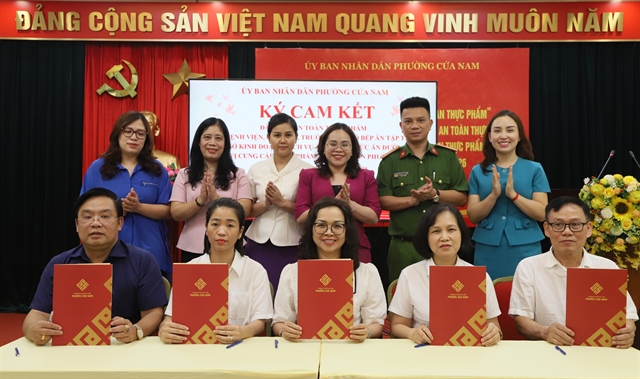 |
| Organisations in Hà Nội's Cửa Nam Ward sign commitments to ensure food safety and hygiene. — VNA/VNS Photo Nguyễn Cúc |
HÀ NỘI — Amid persistent concerns about unsafe food entering daily meals, Hà Nội has stepped up efforts during this year’s Action Month for Food Safety, rolling out new controls and local models aimed at protecting public health and rebuilding trust.
Food safety has been identified as one of five key challenges facing the capital, alongside traffic, the environment, flooding and urban order, under Resolution No. 02 issued on November 25 last year by the municipal Party Committee for the 2025–30 term.
Tightening from the grassroots
The Cửa Nam Ward People’s Committee has selected Quang Trung Street to pilot a food safety control street model to address long-standing problems.
Based on initial results, the ward plans to expand the model across its entire area. It aims for 100 per cent of dining and street food businesses on the street to be surveyed, listed for management, granted food safety certificates and required to sign commitments to comply with regulations.
Businesses must also publicly display their food safety certificates and written commitments.
Deputy Chairwoman of the Cửa Nam Ward People’s Committee Trịnh Ngọc Trâm said the ward is a political, administrative, economic, cultural and tourism centre of Hà Nội, where dining services play a key role in development.
“Ensuring food safety is always identified as a central task, carried out regularly, continuously and with high determination,” she said.
“With the effective food hygiene and safety assurance during the Lunar New Year and spring festivals just past, the trust of the people and tourists has been increasingly consolidated. The ward always determines that food safety assurance needs to be maintained continuously, without neglect or complacency.”
During the Action Month, activities will be deployed across all 28 residential groups, with communication efforts targeting members of the ward’s Food Safety Steering Committee, socio-political organisations, businesses and consumers.
Phạm Ngọc Thúy, head of the ward’s Culture-Society Division, said: “We require food production, processing, trading and retail units in the locality to be responsible in ensuring food safety to serve people's lives.”
“We raise awareness and clarify responsibilities of food producers and traders as prescribed by law, clearly disseminate unlawful acts and corresponding penalty levels, so that they can change unhygienic habits to ensure food safety at all stages.”
Việt Hưng Ward, with 62 residential groups, nine historical and cultural relics and eight traditional festivals held after Lunar New Year, faces heavy pressure from large-scale dining activities involving thousands of participants.
In response, the ward has built, maintained and expanded several food safety models. It continues to supervise 85 dining establishments across four streets, Việt Hưng, Lưu Khánh Đàm, Bùi Thiện Ngộ and Trường Lâm, recognised as controlled food safety streets.
The food safety model at Thượng Thanh Market has also received positive feedback and is set for expansion.
Deputy Chairwoman of the Việt Hưng Ward People’s Committee Nguyễn Thanh Thủy said the ward will continue applying digital tools to improve oversight, including publicly displayed QR codes containing information on food businesses, as well as planting area codes and cashless QR payments at markets.
Decisively tackling violations
Vũ Cao Cương, deputy director of the Hà Nội Department of Health, said recent efforts had led to clear improvements in food safety management, particularly in slaughter control and the removal of informal markets.
Police have prosecuted five cases involving 10 defendants for producing and trading counterfeit food products.
Deputy Chairwoman of the municipal People’s Committee Vũ Thu Hà said food safety must be enforced consistently through coordinated measures, stronger use of information technology and greater public awareness.
She called on food producers and traders to install camera systems linked to monitoring networks and to be ready to provide full records during inspections.
Transparency in enforcement, from assigned authorities to evaluation results, must be clearly recorded and reflected in digital data, she said.
The Action Month, which began on April 15, is being implemented across 126 communes and wards. Authorities will carry out comprehensive inspections and evaluations, assessing results after one month.
Findings will be used to adjust policies and expand effective models, contributing to more sustainable food safety control across the capital. — VNS
Society
 Society
 Society
 Society
 Society
 Society
 Society
 Society
 Society
 Society
 Society
 Society
 Society
 Society
 Society