 Society
Lotte, Phát Đạt combine strengths in Thu Thiem project
1.
HÀ NỘI — Officials used a conference on Thursday to outline sweeping updates to religious law, a new national image strategy and government priorities as Việt Nam begins a fresh term on the United Nations Human Rights Council.
Religion law revised
A proposed overhaul of the Law on Belief and Religion would, for the first time, establish a legal framework for religious practice conducted online, a senior government official said.
Trần Minh Thu, head of the General Affairs Division at the Government Committee for Religious Affairs under the Ministry of Ethnic and Religious Affairs, told the conference that the draft law introduces a formal definition of online religious activity, broadly covering any use of digital networks by individuals or organisations to carry out religious or belief-based practice, and devotes a standalone article to governing it.
Under the proposal, individuals or organisations conducting religious activities online would still be required to file notifications, registrations or formal requests as mandated by law.
Thu said the provision addresses a real and growing gap. Religious preaching, ritual content, community organising, fundraising and even impersonation of religious figures can now occur on digital platforms, she noted, and without legal coverage a significant regulatory vacuum would remain.
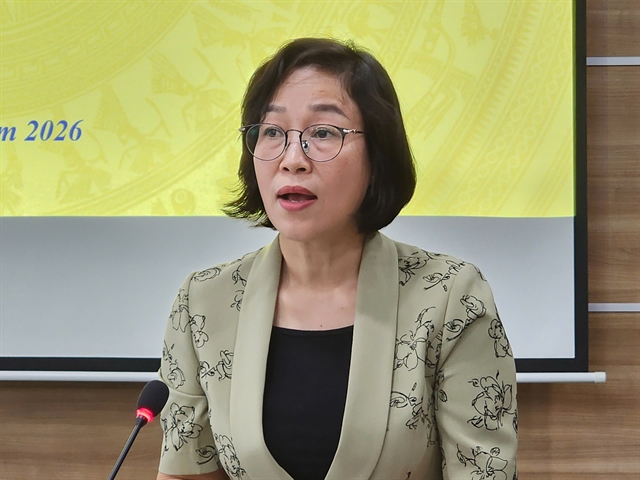 |
| Trần Minh Thu, head of the General Affairs Division at the Government Committee for Religious Affairs under the Ministry of Ethnic and Religious Affairs, speaks during the conference on Thursday. — VNS Photo Lê Việt Dũng |
The draft law also proposes decentralising authority, with eight administrative procedures currently handled by the Ministry of Ethnic and Religious Affairs to be transferred to provincial-level People’s Committees.
If passed, the revised law would include 53 administrative procedures in total, 15 at ministerial level, 30 at provincial level and eight at commune level, and would take effect on March 1, 2027.
Rebranding Việt Nam
Việt Nam has unveiled a long-term strategy to overhaul how it projects itself internationally, framing the effort as a core instrument of national development rather than routine promotion.
Nguyễn Văn Thuật, deputy head of the Department of Grassroots and External Information under the Ministry of Culture, Sports and Tourism, outlined the strategy, which the Prime Minister signed into effect on January 27 and which runs through 2030 with a vision extending to 2045.
A central feature of the plan is the creation of a unified national branding and messaging system at strategic level, Thuật said.
Rather than allowing different agencies and sectors to promote Việt Nam separately and inconsistently, the strategy calls for a coherent, integrated image that can still be tailored to specific markets, regions and international audiences.
The image Việt Nam aims to project is that of a politically stable and economically dynamic country with a rich cultural identity, a drive for innovation, an attractive investment climate and a reputation as both a safe, welcoming destination and a reliable and responsible partner in the international community.
Vietnamese people themselves, described in the strategy as modern yet rooted in tradition, creative yet humane, globally integrated yet culturally grounded, are positioned at the centre of the branding effort.
By 2045, Việt Nam aims to rank among the top three countries in Southeast Asia and the top 30 globally on the Soft Power Index while establishing itself as a sought-after destination for tourism, investment, creativity and cultural exchange.
To get there, the strategy calls for a wholesale modernisation of communications methods, combining traditional and digital media, direct and online outreach and leveraging artificial intelligence, big data and digital ecosystems to research audiences, craft messages, produce content and measure results.
The plan also emphasises broad societal participation. Beyond government agencies, businesses, academics, artists, creative communities and notably the Vietnamese diaspora abroad are encouraged to amplify Việt Nam’s image through their own voices, credibility and lived experiences. Cross-sector coordination and public-private partnerships are identified as essential to sustaining the effort over the long term.
Building a communications workforce fluent in international standards, digital platforms and multiple languages is also identified as a key investment priority.
A fresh UN term
Việt Nam enters its 2026–2028 term on the UN Human Rights Council (HRC), with the highest vote total among candidates in the Asia-Pacific regional group, and officials say the country plans to play an active and assertive role.
Nguyễn Vũ Minh, deputy director of the Department of International Organisations at the Ministry of Foreign Affairs, told the conference that the UN General Assembly re-elected Việt Nam to the council on October 14, 2025, with 180 votes.
For the new term, Việt Nam plans to actively engage in all regular and special council sessions, co-chair working groups reviewing Universal Periodic Review reports from member states and take on the position of HRC vice president in 2028.
The country also intends to serve as ASEAN coordinator at the council and strengthen ties between the ASEAN Intergovernmental Commission on Human Rights and the HRC.
The official also said Việt Nam would continue pushing 12 initiatives it championed during its 2023–2025 term, covering issues that include the Universal Declaration of Human Rights, climate change, equitable vaccine access and the integration of human rights education into school systems. — VNS
Society
 Society
 Society
 Society
 Society
 Society
 Society
 Society
 Society
 Society
 Society
 Society
 Society
 Society
 Society