 Society

Vietnamese Prime Minister meets Cambodian National Assembly President
1.
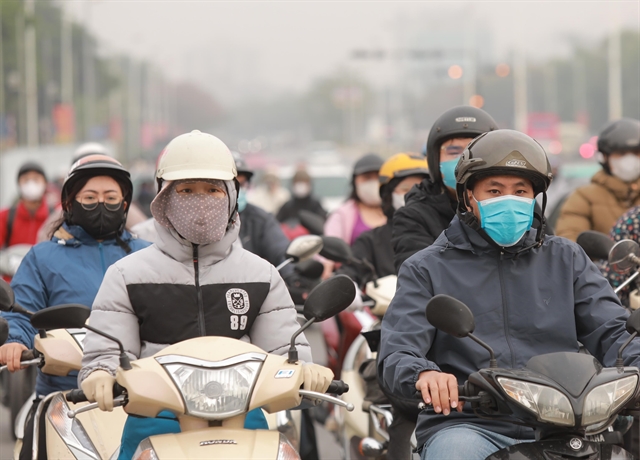 |
| People wearing masks while travelling in Hà Nội. — VNA/VNS Photo Phan Phương |
HÀ NỘI — Under the draft proposal for a "Low Emission Zone within Ring Road 1, Hà Nội City", the capital will from July 1, 2026, pilot a low emission zone (LEZ) in certain areas inside Ring Road 1, which will see time-based ban on fossil-fuel vehicles in a bid to address chronic pollution issues.
Phase one will run from July 1 to December 31, with the pilot implemented in Hoàn Kiếm Ward.
The core zone is bounded by 11 streets in the Old Quarter area: Tràng Tiền, Hàng Khay, Lê Thái Tổ, Hàng Đào, Hàng Ngang, Hàng Buồm, Mã Mây, Hàng Bạc, Hàng Mắm, Nguyễn Hữu Huân and Lý Thái Tổ. It covers 0.5sq.km with a perimeter of 3.5km and a population of about 20,000.
The buffer zone has a perimeter of 5.5km and an area of 1.65 sq.km, bounded by streets including Hàng Đậu, Phùng Hưng, Tràng Thi, Hàng Khay, Tràng Tiền, Trần Quang Khải, and Trần Nhật Duật.
Interactive map illustrating the core LEZ zone and buffer zone.
Phase two will run throughout 2027, expanding the pilot to cover Hoàn Kiếm and Cửa Nam wards – spanning 3.6sq.km with a perimeter of 8.3km and a population of about 136,947.
The expanded core zone will be bounded by 14 streets, including Nguyễn Du, Hàn Thuyên, Trần Hưng Đạo, Trần Khánh Dư, Trần Quang Khải, Trần Nhật Duật, Hàng Đậu, Cửa Đông, Lý Nam Đế, Tôn Thất Thiệp, Điện Biên Phủ, Hàng Bông, Cửa Nam, and Lê Duẩn. The city will assess pilot results between October and December 2027.
Phase three, from 2028 to 2029, will see the low emission zone rolled out across the entire area within Ring Road One, covering 26.07 sq.km and comprising nine wards of the city's populous urban core. The area is bounded by streets including Hoàng Cầu, Đê La Thành, Ô Chợ Dừa, Xã Đàn, Đại Cồ Việt, Trần Khát Chân, Nguyễn Khoái, Trần Khánh Dư, Trần Quang Khải, Trần Nhật Duật, Yên Phụ, Nghi Tàm, Âu Cơ, An Dương Vương, Lạc Long Quân, Bưởi and Cầu Giấy.
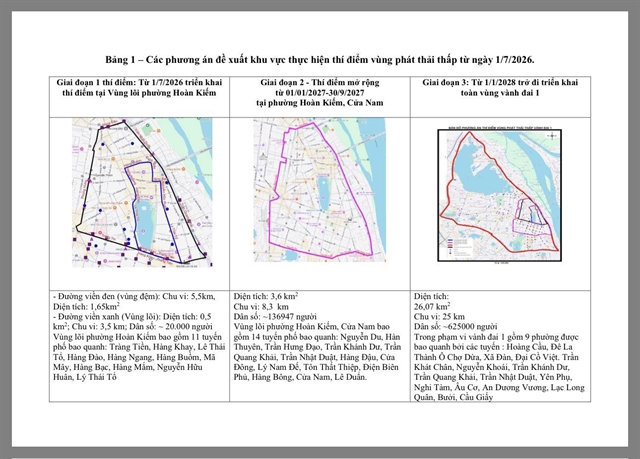 |
| A map of the zones where LEZ is piloted in three phases. — Photo from the Hà Nội's authorities |
Within the zone, Hà Nội will develop green transport infrastructure including electric and green-energy bus fleets, urban railways, bicycles, electric bicycles, public electric motorbikes, charging stations, battery-swap points and transfer hubs. The city will progressively restrict vehicles running on fossil fuels while giving priority to clean energy, public transport and non-motorised transport.
An automatic number plate recognition (ANPR) camera system, signage, traffic monitoring infrastructure and a data management system will be set up to monitor vehicles entering and leaving the zone. Support policies will also be rolled out to help residents and businesses switch to clean-energy vehicles.
From July 1, motorcycles and mopeds running on fossil fuels used for app-based ride-hailing services will be encouraged to switch to clean energy and will not be permitted to operate within the zone.
Other fossil-fuel motorcycles and mopeds will be barred from the zone between 6pm and midnight on Fridays, and between 6am and midnight on Saturdays and Sundays.
Standard trucks under two tonnes must meet Euro 4 emission standards and will only be allowed to operate outside peak hours. Trucks between two and under 3.5 tonnes must meet Euro 4 standards, will be restricted to operating between 9pm and 6am, and must obtain written approval from the municipal police. Trucks with a total design weight of over 3.5 tonnes, as stated on their registration certificates, will be banned from the zone altogether. — VNS
Society
 Society
 Society
 Society
 Society
 Society
 Society
 Society
 Society
 Society
 Society
 Society
 Society
 Society
 Society