 Society

Vietnamese Prime Minister meets Cambodian National Assembly President
1.
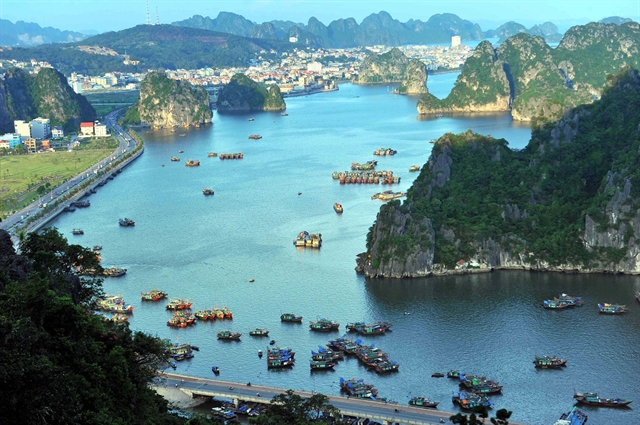 |
| A view of the Hạ Long Bay. — VNA/VNS Photo |
HÀ NỘI — The Vietnamese government has issued a plan to draw up a comprehensive conservation and restoration strategy for Hạ Long Bay, one of Việt Nam’s most iconic natural landmarks, as authorities seek to balance preservation with long-term development.
Under Decision 704 released on April 21, the government endorsed a scheme to develop a detailed planning framework covering the bay’s landscape, ecosystems and surrounding cultural spaces.
The initiative will guide preservation efforts through 2035, with a longer-term vision extending to 2050.
The study area spans both land and sea, encompassing parts of eight administrative units in the northern province of Quảng Ninh, including Tuần Châu, Bãi Cháy and Hồng Gai Wards, as well as the Vân Đồn Special Zone.
It also covers adjacent marine areas bordering Cát Hải, part of Hải Phòng City, particularly zones already designated for heritage protection.
The planning area totals roughly 676sq.km, matching the core and buffer zones of the Hạ Long Bay–Cát Bà Archipelago World Heritage site. These boundaries are consistent with earlier UNESCO dossiers from 1994 and 2000, as well as the 2023 submission currently held at the UNESCO World Heritage Centre.
The government said the plan aims to safeguard Hạ Long Bay’s defining features, from its marine ecosystems to its biodiversity and cultural heritage, while reinforcing its role in regional economic growth.
The government also plans to build a more complete system of documentation and data to support site management, as well as clarify the legal boundaries of protected zones within the broader Hạ Long Bay–Cát Bà heritage complex.
The move comes as Quảng Ninh steps up efforts to integrate conservation priorities into wider development strategies, including provincial planning for 2021–2030 and urban expansion plans for Hạ Long City through 2040.
The government said the new framework will help 'affirm the role' of the site in shaping development across Việt Nam’s northeastern region, while promoting sustainable tourism – a key economic driver for the province. — VNS
Society
 Society
 Society
 Society
 Society
 Society
 Society
 Society
 Society
 Society
 Society
 Society
 Society
 Society
 Society