 Society
Vietnamese Prime Minister meets Cambodian National Assembly President
1.
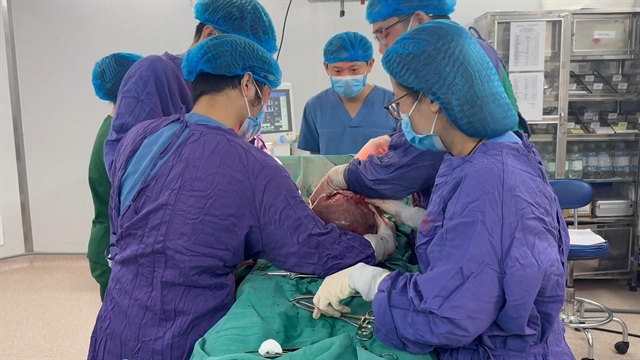 |
| Doctor team of the Hà Nội Oncology Hospital perform the surgery to remove a tumor weighing nearly 9kg. — Photo courtesy of the hospital |
HÀ NỘI — Doctors at Hà Nội Oncology Hospital have successfully performed life-saving surgery on a female patient with a rare, giant uterine tumour, weighing nearly 9kg.
The tumour occupied almost the entire abdominal cavity, compressing many internal organs and severely affecting her breathing and daily activities.
According to doctors, previously, the 45-year-old female patient, P.H.L, residing in Hà Nội, was completely healthy and had never been diagnosed with any unusual medical conditions.
About six months ago, the patient began experiencing dull abdominal pain, mainly at night, accompanied by weight loss. However, thinking it was not a serious issue, the patient did not seek medical attention.
In recent months, the patient's abdomen rapidly enlarged, pain became more frequent, appetite decreased, and shortness of breath progressively worsened. The pressure made it impossible for her to lie on her back. She could only lie on her side to alleviate the feeling of heaviness. Only when the symptoms became severe did the patient start to go to the hospital.
The CT scan revealed a large mass in the right hypochondrium, periumbilical region, and hypogastric area, measuring 22.7 cm x 29 cm. The huge tumour was in contact with and compressing several vital organs, such as the liver, gallbladder, right kidney, pancreas, and was also adherent to the uterine fundus. In addition, the patient had significant abdominal fluid and bilateral pleural effusion.
During the surgery, the team determined that the tumour originated from the base of the uterus, occupying almost the entire abdominal cavity, and was adherent to the colon, the mesentery of the small intestine, and many adjacent structures. This was considered a complex surgery, requiring the surgeon to operate with exceptional caution to dissect the tumour without rupturing it, while also carefully controlling the blood vessels supplying the tumour to minimise blood loss and preserve surrounding organs.
After approximately two hours of surgery, the doctors removed the entire tumour along with the entire uterus and both adnexa to minimise damage. During the surgery, the patient received four units of blood and intensive care.
Following surgery, the patient's health has recovered well. The surgical wound was dry, and the patient was able to eat, drink, and walk normally, being discharged after seven days. Pathology results confirmed the patient had stage III uterine leiomyosarcoma. The patient was prescribed continued adjuvant chemotherapy to reduce the risk of recurrence.
Dr. Lê Văn Thành, Deputy Director of Hà Nội Oncology Hospital and Head of the General Surgery Department, said: "This is a typical case of neglecting initial symptoms, allowing the tumour to develop silently to a late stage, increasing the risk of complications and threatening the patient's life."
"Unfortunately, to ensure complete removal of the tumour and patient safety, we were forced to remove the entire uterus, affecting future fertility," Dr. Thành added.
Dr Thành advises people not to ignore unusual signs, such as prolonged abdominal pain, rapid abdominal enlargement, poor appetite, or difficulty breathing. Early examination helps detect the disease at a stage where effective intervention is possible, reducing the invasiveness of treatment and increasing the chances of preserving organs. — VNS
Society
 Society
 Society
 Society
 Society
 Society
 Society
 Society
 Society
 Society
 Society
 Society
 Society
 Society
 Society