 Economy



Cultural industry product 'The Moment' debuts to bring new staging experience to theatregoers
1.
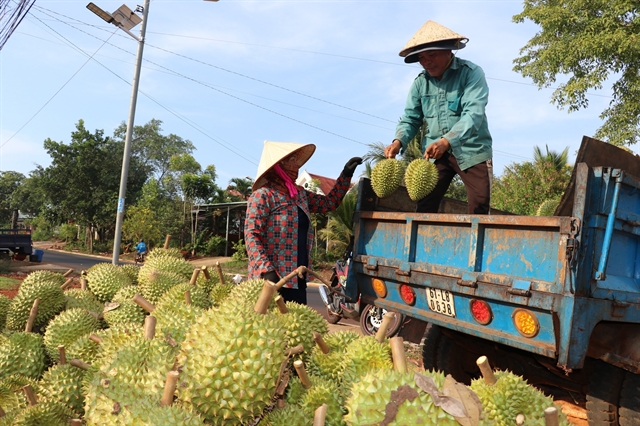 |
| Farmers transport Ri6 durians in Phước Long Ward, Đồng Nai City. Agricultural products remained the largest export category, generating almost $16.4 billion. — VNA/VNS Photo |
HÀ NỘI — Agriculture, forestry and fisheries exports rose 9.2 per cent year-on-year to nearly US$30.7 billion in the first five months, helping the sector generate a trade surplus of $8.4 billion despite stronger import growth, the Ministry of Agriculture and Environment reported on Monday.
Imports increased 12.6 per cent from a year earlier to nearly $22.3 billion in the January-May period, while the trade surplus edged up 1.1 per cent, according to ministry data released at a press briefing.
The figures underscore the resilience of one of Việt Nam's key economic sectors as authorities seek to maintain growth, strengthen food security and expand export markets amid an uncertain global trade environment.
Agricultural products remained the largest export category, generating almost $16.4 billion, up 6.1 per cent from a year earlier.
Forestry products brought in $7.65 billion, up 4.5 per cent, while seafood exports rose 10.6 per cent to $4.65 billion.
Several smaller export categories recorded faster growth.
Exports of production inputs rose 83 per cent to $1.7 billion, while livestock product exports climbed 43.2 per cent to $308 million and salt exports increased 45.8 per cent to $6.7 million.
China remained Việt Nam's largest export market for agricultural, forestry and fishery products, accounting for 20.5 per cent of total export turnover and posting growth of 28.4 per cent from a year earlier.
The United States ranked second, representing 18.5 per cent of exports, although shipments to the market declined 3.6 per cent.
The European Union accounted for 11.8 per cent of exports and recorded growth of 4.2 per cent, while Japan represented 6.8 per cent and expanded 3.5 per cent.
The ministry attributed the export growth to trade promotion efforts, market diversification and the effective use of free trade agreements, which helped businesses expand overseas sales while reducing dependence on individual markets.
Deputy Minister of Agriculture and Environment Đặng Ngọc Điệp said the sector was targeting growth of 3.7 per cent this year and striving to reach 4 per cent.
"Key indicators are broadly in line with the plan, creating favourable conditions for achieving this year's growth target," Điệp said.
Domestic production also remained broadly stable during the period.
Domestic production remained stable, with winter-spring rice output reaching nearly 14 million tonnes and forestry output continuing to grow.
Livestock production expanded as pig and poultry herds increased, while fisheries output rose 3.1 per cent, supported by stronger aquaculture production.
Điệp said the ministry had prepared monthly and quarterly growth scenarios from the beginning of the year and assigned specific responsibilities to individual departments and officials to ensure implementation of development targets.
The ministry plans to continue restructuring production towards greener, more sustainable and higher-value models while strengthening food safety and quality controls to improve the competitiveness of Vietnamese agricultural products in international markets.
Authorities will also monitor global market developments, support businesses in making greater use of free trade agreements and expand export opportunities, Điệp said.
He added efforts to develop agricultural by-product markets and strengthen product traceability systems will also continue.
The ministry is preparing measures to mitigate risks from geopolitical tensions, developments in the Middle East and US reciprocal tariff policies that could affect production and exports in the months ahead.
In addition, Điệp said the ministry would continue promoting digital transformation and improving land and environmental databases, while reviewing environmental protection taxes and fees and strengthening measures to address natural disasters, disease outbreaks and IUU fishing. — BIZHUB/VNS
Economy
 Economy
 Economy
 Economy
 Economy
 Economy
 Economy
 Economy
 Economy
 Economy
 Economy
 Economy
.jfif) Economy
Economy
.jfif) Economy
Economy
 Economy