 Society
VN-Index ends lower despite liquidity hit over $1 billion
1.
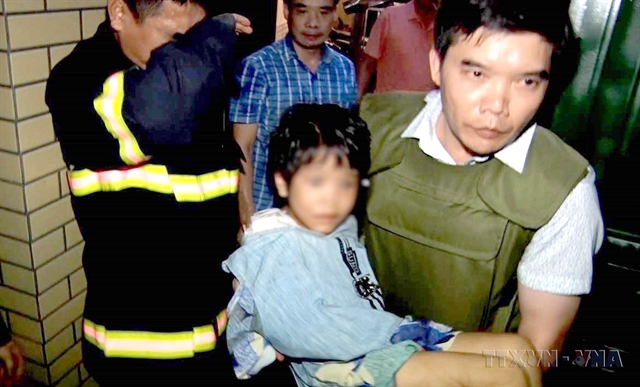 |
| A police officer rescues a six-year-old girl in the northern province of Bắc Ninh after she was abused by her biological father, September 2020. — VNA/VNS Photo |
HÀ NỘI — A four-year-old girl in Hà Nội died recently after showing signs of prolonged abuse.
The suspects were her own mother and the mother's boyfriend. The case shocked the public, but experts say it should not have surprised anyone.
"These are not isolated incidents. They are the visible tip of the iceberg," said Đỗ Cảnh Thìn, deputy director of the Institute of Non-Traditional Security Studies at the Vietnam National University, Hanoi, and a specialist in criminology.
Việt Nam has seen a string of such cases in recent years. A few years before the case in Hà Nội, an eight-year-old girl in HCM City died after being beaten by her stepmother.
Before that, a three-year-old in Hà Nội was brought to a hospital with nails driven into her skull. In case after case, the abuse had gone on for months before anyone intervened, if intervention came at all.
The numbers behind the cases
Government data suggests the problem is worsening. In April 2026, the national child protection hotline, known as Line 111, received 46,111 calls, an increase of 9,519 over the previous month.
Reports received through Zalo, a widely used messaging app, and a dedicated child protection mobile application added another 724 contacts that month.
Most striking, physical and psychological abuse cases handled by the hotline jumped nearly 22 per cent compared to March 2026. Close to three-quarters of all reported incidents occurred within the home, perpetrated by parents, grandparents, relatives or caregivers.
Thìn said the pattern of abuse originating within families reflects specific social and psychological dynamics that have intensified in recent decades.
Economic pressure, the rising rate of divorce and the proliferation of blended family arrangements - stepparents, live-in partners and reconstituted households - have complicated the bonds that once protected children.
"Many parents endure prolonged stress but lack the emotional regulation skills to manage it. They take out that pressure on the most vulnerable person available – the child," he said.
Beyond stress, he pointed to a persistent cultural attitude in which children are regarded as parental property rather than rights-bearing individuals.
The traditional Vietnamese saying roughly translated as 'spare the rod, spoil the child' has, in his view, been distorted over time, blurring the line between discipline and violence. Some perpetrators, he argued, use the language of child-rearing to mask deeper psychological problems.
The criminologist reserved particular concern for cases involving biological parents who enter new romantic relationships.
After divorce or separation, he explained, adults often become emotionally dependent on a new partner to a degree that overrides their protective instincts toward their own children.
"Many are afraid that if they defend their child, their partner will leave them," he said.
"The fear of abandonment gradually overwhelms even the parental instinct."
In such cases, he described a psychological progression: a parent first looks the other way when a partner disciplines the child harshly, then becomes gradually complicit, and eventually may participate in or conceal the abuse.
Meanwhile, stepparents or partners with no biological tie to the child may come to view the child as an obstacle, a burden, or, in his words - 'a relic of the past'.
"The child sometimes becomes a living reminder of the previous relationship. That can generate resentment, even hatred," he said.
A crime no one sees
The structural obstacles to intervention are significant. Nguyễn Thị Nga, deputy director of the Administration of Maternal and Children's Affairs under the Ministry of Health, said child abuse functions as what she called 'a hidden crime', one that goes unreported almost by definition.
"By the time we receive a call on Line 111, the abuse has almost always already been happening," she said.
The silence, she and other officials noted, stems from multiple sources. Neighbours and community members who suspect abuse frequently do not report it, citing an ingrained reluctance to interfere in what is perceived as a family's private business.
Cohabiting couples who are not legally married tend to live in closed, rented quarters with little contact with extended family on either side, creating conditions in which abuse can remain hidden for extended periods. Some abusers further isolate their victims by keeping children out of school and away from any social contact.
Law enforcement, Nga emphasised, is not the bottleneck.
"When police receive a report, they move quickly. The problem is that they don't receive the information," she said.
The legal framework for child protection is, by most accounts, substantively complete. The 2013 Constitution explicitly prohibits the mistreatment, abuse and neglect of children.
The 2016 Law on Children enumerates 25 groups of prohibited conduct and establishes a duty to report suspected abuse. The 2022 Law on Domestic Violence Prevention covers not only physical harm but psychological harm as well.
Government Decree 98 sets administrative fines of up to VNĐ20 million (roughly US$760) for acts of physical or psychological abuse, and up to VNĐ15 million ($570) for failing to report known abuse to authorities.
"Việt Nam has a relatively comprehensive legal framework for addressing child abuse. In terms of criminal sanctions, the penalties are, on the whole, serious," said Nguyen Thị Mai Thoa, a member of the National Assembly's Committee on Culture and Social Affairs.
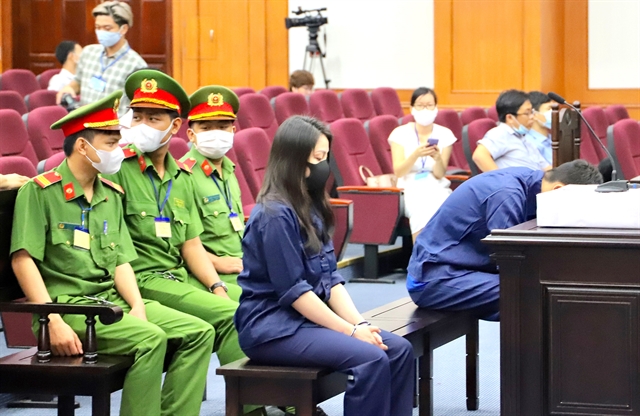 |
| The stepmother who beat an eight-year-old girl to death in HCM City was sentenced to death, April 2023. — VNA/VNS Photo |
But Thoa acknowledged that the law has not prevented the pattern of cases now alarming the public. She identified a structural gap: while the Law on Children mandates a three-tiered protection system – prevention, support and intervention – the first two tiers carry no binding obligations for schools, local authorities, healthcare facilities or community organisations.
"The victims are often very young children, some too young to speak, some too frightened, some who simply don't know that what is being done to them is wrong and that they can be helped," Thoa said.
"If communities, schools, healthcare providers and local government don't identify the warning signs, abuse goes undetected or continues unchecked."
What needs to change
Officials agree that the problem is not the strength of laws, but the architecture of the system meant to enforce them. Thìn framed the solution as a 'three-legged stool' requiring the simultaneous engagement of families, communities and government agencies.
Within families, he said parents entering new relationships must prioritise their child's safety from the outset, observing how a new partner treats children and other vulnerable people, and teaching children age-appropriate self-protection skills, including how to call emergency lines such as 111 or 113.
Equally important, Thìn argued, is resisting isolation: families that maintain active connections with grandparents, relatives and friends create what he called 'a natural surveillance network' that is far harder for an abuser to dismantle than any formal monitoring system.
At the community level, he called for a cultural shift away from treating family violence as a private matter. Neighborhood associations should proactively flag high-risk households – those with unmarried cohabiting couples, substance abuse problems or known domestic conflict.
Schools and teachers must watch for behavioral warning signs: withdrawal, fearfulness, declining performance or concealed injuries.
For government agencies, rapid-response capability is essential – the ability to remove a child from a dangerous environment immediately upon receiving a credible report, and stronger population monitoring in rental housing clusters where transient relationships and minimal community oversight create elevated risk.
Nga stressed that many perpetrators are not predators but struggling parents, often very young, financially stressed, isolated, and in some cases dealing with unaddressed mental health problems.
Parenting education, she said, must be at the heart of any solution. Materials developed with support from UNICEF, Save the Children, and other international organisations exist, but their reach remains limited. She called for the Women's Union and other mass organisations to dramatically expand parenting skills programmes.
On the legislative side, Thoa called for expedited legal procedures in child abuse cases, tighter regulations on guardians and childcare facilities and long-term psychological support for survivors. But she was careful to separate punishment from prevention.
"The issue is not only about increasing penalties. More importantly, we need a protection mechanism that is strong enough, fast enough and effective enough, starting from the moment a risk is first detected," she said.
That, in the end, is where every expert consulted in this report pointed: not to the courtroom, but to the stairwell, the classroom, the neighborhood – the places where a child in danger might first be seen, if anyone is paying attention. — VNS
Society
 Society
 Society
 Society
 Society
 Society
 Society
 Society
 Society
 Society
.jfif) Society
Society
 Society
 Society
 Society
 Society