 Society
European higher education week opens new opportunities
1.
|
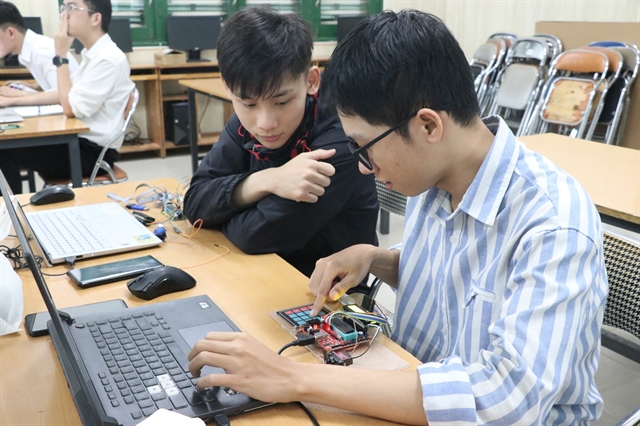
| Students working on a project to create an AI traffic light system. — VNA/VNS Photo |
ĐÀ NẴNG — A model emitting smoke due to a battery problem, an experiment halted midway due to unresolved technical issues, or students debating for hours because their product doesn't function as planned – these are closer to the true spirit of STEM (science, technology, engineering and mathematics) education than projects that only appear for a few days at a competition.
When STEM education is introduced in schools, teachers and experts say that the most important thing is not students creating new products or winning awards, but rather gaining the opportunity to experiment, experience and learn how to solve real-world problems.
However, the gap between that goal and the reality in schools remains quite large.
Working in groups
STEM is an integrated, interdisciplinary educational approach that helps students apply theory to practice through projects and real-world experiments.
It not only teaches students pure scientific and technical knowledge, but also trains them in critical thinking, problem-solving, creativity and, perhaps most importantly, teamwork.
In Trần Phú High School in Đà Nẵng City, a group of students working on a project to create an AI traffic light system had to reassemble their models several times, because it wasn't working consistently.
Group member Trần Nguyên Nguyên said: “The hardest part was not coming up with the idea, but turning that idea into a working product in real life.”
“There were times when we thought we had succeeded, but then the test runs kept failing. Each time that happened, the whole team had to sit down, find the cause and fix each part,” Nguyên added.
Nguyễn Ngọc Quốc, a member of another student group working on producing herbal-scented sachets, said that the group had spent months looking for the best way to process raw materials.
“Sometimes, we thought we would have to give up because we could not get the desired results, no matter how hard we tried,” Quốc said.
The failed tests themselves were important parts of STEM learning, according to their teachers.
However, not all schools have the facilities or the environment needed for their students to fully experience STEM learning.
In Đà Nẵng City, only three high schools have invested in standard laboratories for STEM learning.
The majority of the remaining schools still face a lack of equipment, practice space and teaching staff with interdisciplinary expertise.
This means that STEM activities in many places are limited to small groups or competition teams, rather than becoming a skill commonly taught to the majority of students.
Trịnh Thị Hồng Linh, a teacher at Nguyễn Bỉnh Khiêm Gifted High School, said that some projects are beyond high-school students’ capabilities and knowledge.
“If we only focus on grand projects, we will inadvertently put pressure on students. It is therefore crucial to help students experience and choose projects that match their abilities,” Linh said.
“STEM should not be just for a group of tech-savvy students or those participating in competitions, but should help high school students access problem-solving thinking, teamwork skills and self-learning abilities,” the teacher noted.
Technological thinking
|
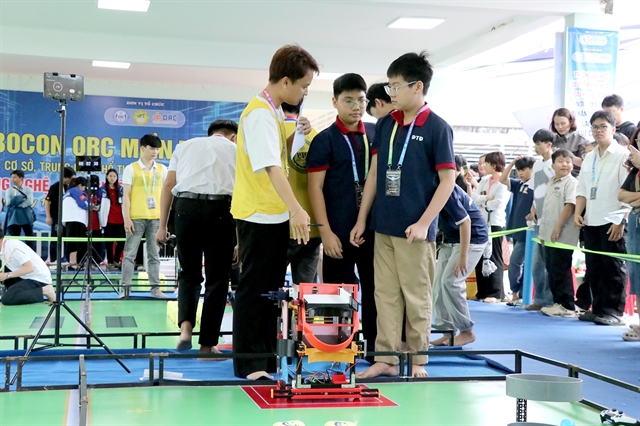
| Student take part in a robot competition at a high school in Đà Nẵng City. — VNA/VNS Photo |
Lê Thánh Tông Gifted High School teacher Lê Bá Lân, who has spent several years tutoring students in STEM competitions, said that some schools are inadvertently turning STEM into a race for achievement.
“There are projects with grand names, involving AI or advanced technology, but in reality, high school students may not fully participate in the research process,” Lân said.
“The worrying thing is that when too much focus is placed on the final product or awards, students easily become mere supporting actors for the project, instead of truly learning from the process of creating the product."
“The core of STEM is to allow students to experiment with ideas, make mistakes, correct them and learn teamwork. It is not necessary to create a complete or highly specialised product,” the teacher added.
Associate Professor Dr Hồ Viết Thắng, vice dean of the Chemistry Department at Đà Nẵng Technology University, said that learning STEM at the secondary and high school levels should focus on guiding students, sparking their passion, and introducing them to basic research processes.
“Students should not be pressured into creating highly specialised projects like those at university. More importantly, education should encourage students to think outside the box, take initiative and solve problems effectively," Thắng said.
Rebo Company director Võ Nguyễn Đình Trí spoke about what businesses are looking for in future workers. Trí said that companies need workers who can not only grasp technology, but also self-study and update their skills to keep pace with rapidly changing technology.
“If STEM learning is just for competitions or for giving small groups of students the skills to use modern equipment, it will be difficult to create a qualified and skilled workforce in the future,” Trí said.
“Students do not necessarily need to delve too deeply into STEM from an early age, but they need to develop technological thinking, self-learning skills and adaptability,” the businessman noted.
“In reality, what students need may not be a state-of-the-art lab or overly complex products, but rather opportunities to experiment, work together, learn from failures and find effective solutions to problems." — VNS
Society
Society
 Society
 Society
 Society
 Society
 Society
 Society
 Society
.jfif) Society
Society
 Society
 Society
 Society
 Society
 Society