 Politics & Law
Cultural industry product 'The Moment' debuts to bring new staging experience to theatregoers
1.
|
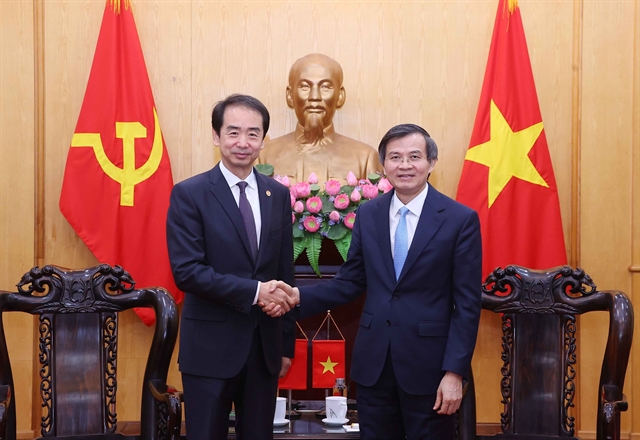
| Politburo member and Director of the Hồ Chí Minh National Academy of Politics (HCMA) Đoàn Minh Huấn (right) receives Chinese Ambassador to Việt Nam He Wei in Hà Nội on Mond Photo |
HÀ NỘI — Politburo member and Director of the Hồ Chí Minh National Academy of Politics (HCMA) Đoàn Minh Huấn had a working session with Chinese Ambassador to Việt Nam He Wei at the academy on Monday.
The two sides discussed measures to implement the agreements and common perceptions reached by the top leaders of the two countries during Party General Secretary and State President Tô Lâm’s recent visit to China.
Huấn and He shared the view that both sides should strengthen cooperation to translate high-level common understandings into practical outcomes. Cooperation, they agreed, should focus on two key pillars: theory research and the training and capacity building of officials.
Regarding theory work, both sides underscored the importance of joint research efforts to enrich the theoretical foundations underpinning the development of the two countries. As the two socialist nations enter a crucial stage of development, they agreed to intensify studies on key issues, including the transitional period towards socialism, the development of new productive forces and ecological civilisation.
They also highlighted the significance of theoretical exchanges between the two Parties, agreeing on the need to enhance their quality and renew their formats to create a more open platform for substantive and in-depth discussions among experts from both countries.
On official training and development, Huấn stressed that cooperation should be based on mutual exchange and interaction to enhance the capacity of officials on both sides, thereby meeting the development requirements of each country in the new context.
The HCMA is interested in expanding access to training curricula offered by the Central Party School of China and other leading Chinese institutions specialising in political and theoretical education. The Vietnamese side also showed interest in applying experiential learning models at revolutionary heritage sites to strengthen Party spirit and ideological training.
In addition, the academy proposed organising specialised training courses for Vietnamese officials in areas where China has considerable expertise, including urban governance, science and technology development, talent attraction and heritage-based economic development.
He expressed his support for the proposals put forward by the academy. He affirmed his commitment to serving as a bridge between the two sides by promoting exchange mechanisms between the academy and the Chinese Embassy, with a view to establishing joint research groups in the future.
The Chinese ambassador also pledged that the embassy will support efforts to advance cooperation agreements between the academy and its Chinese partners, helping ensure that collaboration delivers tangible results and contributes to the broader development of bilateral relations. — VNA/VNS
Politics & Law
 Politics & Law
 Politics & Law
 Politics & Law
 Politics & Law
 Politics & Law
 Politics & Law
 Politics & Law
 Politics & Law
 Politics & Law
 Politics & Law
 Politics & Law
 Politics & Law
 Politics & Law
 Politics & Law