 Society

Vietnamese Prime Minister meets Cambodian National Assembly President
1.
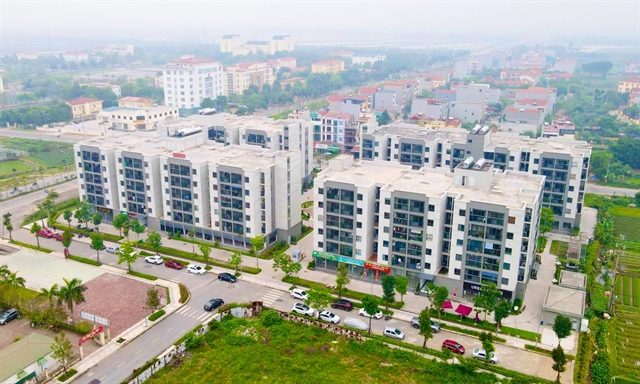 |
| Social housing apartment blocks in Hà Nội. — Photo hanoimoi.vn |
HÀ NỘI — The Government Inspectorate has found that Hà Nội repeatedly failed to set aside legally required land for social housing development, according to a newly released inspection report on the capital’s land use and construction management practices.
The inspectorate identified shortfalls and legal violations in how Hà Nội has planned and managed the 20 per cent land quota that developers are required to reserve for social housing units intended for low-income residents.
Between 2011 and 2022, city authorities approved development plans for eight urban and residential projects of 10ha or more without designating the mandated 20 per cent land allocation for social housing, the report found.
In four other cases, developers had received Prime Minister approval to pay cash in lieu of land on the condition that equivalent plots be identified elsewhere, but Hà Nội had yet to follow through by the time inspectors arrived. Three additional projects of the same scale failed to set aside enough land to meet the requirement.
Inspectors flagged one project in particular, the Xuân Phương Ecological Residential Zone, where the city allocated roughly 6,900sq.m of land zoned for eco-villas as its social housing contribution. The inspectorate called the move impractical and unsuitable for low-income residents.
Inspectors also took issue with a commercial housing development built to serve high-ranking officials. In 2014, the city amended its detailed zoning plan and reclassified the project under the 20 per cent social housing quota, a move inspectors said was inconsistent with the project’s original approved purpose and design plan.
The inspection also found that from 2011 through August 13, 2019, Hà Nội failed to separately track or account for developer payments equivalent to the value of the required 20 per cent social housing land quota. The city also failed to issue adequate guidelines or effectively press developers to fulfil their obligation to channel those payments into the local budget for affordable housing construction.
Perhaps most strikingly, Hà Nội has not used state budget funds to build social housing on 10 plots already set aside for that purpose, even as the city reportedly collected substantial sums from those same projects. Inspectors said the situation has wasted land and slowed the delivery of much-needed housing supply for low-income residents.
Based on its findings, the Government Inspectorate has recommended that the Prime Minister direct Hà Nội to secure adequate land for social housing construction across all 15 flagged projects by the end of 2026.
The inspectorate also called on authorities to press commercial housing developers to move forward on their required social housing components on schedule. If developers fail to comply, the report recommends reassigning those projects to other investors or using the collected cash-equivalent funds to build the units directly.
More broadly, inspectors urged Hà Nội to review and update its urban and industrial zone master plans to ensure sufficient affordable housing land is preserved and to streamline administrative procedures to attract private investment in social housing development.
For the Xuân Phương project, the inspectorate recommended either finding a replacement plot elsewhere or, if land remains available within the project, reclaiming the 20 per cent allocation from the developer to build social housing on site. VNS
Society
 Society
 Society
 Society
 Society
 Society
 Society
 Society
 Society
 Society
 Society
 Society
 Society
 Society
 Society