 Society

Vietnamese Prime Minister meets Cambodian National Assembly President
1.
|
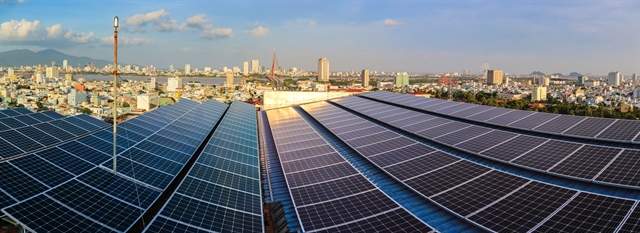
| A roof-top solar power project at a shopping centre in Đà Nẵng City. The beach hub has been speeding up 'green' transformation in building it an 'eco' and liveable city. Photo courtesy of SolarBK |
ĐÀ NẴNG – Green transformation has been identified as an inevitable base for long-term sustainable growth in the city’s Master Plan 2021-30, with a vision towards 2050, that would help Đà Nẵng become a global smart and eco-urban centre.
Vice chairman of the city’s people’s committee Trần Nam Hưng stressed at a conference on green transformation promotion that the green standard has been included in the strategic plan on building Đà Nẵng into an environmental city since 2008.
He said a series of positive action programmes have been implemented as part of the city’s agenda along with regular green growth policies over the past two decades.
“Đà Nẵng has mapped out key poles of green core industries in fostering low-carbon hi-tech industries, green traffic and smart urban management. The city has maintained its position as a leading urban centre in Việt Nam in terms of strict environment protection in line with sustainable development targets,” he said.
"The beach city has been gearing up for an ambitious long-term vision to become a smart, liveable urban centre and a key national hub for logistics, start-up innovation, finance, free trade and sea-based economic growth by 2050, with a goal of becming a global eco-city by 2075.”
|
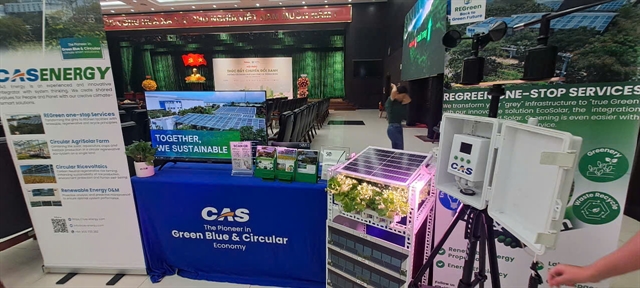
| A demonstration of a rooftop solar power combined with a green farm using recycled organic waste project by CAS Energy company. The solution had helped reduce 14,000 tonnes of carbon emissions into the environment each year. VNS Photo Công Thành |
The conference, which was held by the Tiền Phong (Vanguard) Newspaper, gathered expert insights and recommendations in reaching the green targets.
Phùng Công Sưởng, Editor-in-Chief of the newspaper, also shared that the country’s ambitious Net Zero target will be challenging due to a series of difficulties including hi-tech industry structure change, finance, policy making and joint actions by mass organisations, local communities and businesses.
He said the conference offered a rendezvous for experts, policy makers and environment protection organisations to share feasible solutions in balancing economic targets and environment conservation.
Nguyễn Đình Thọ, deputy head of Institute of Strategic and Policy on Natural Resources and Environment, said Việt Nam had achieved a remarkable economic growth of 8.02 per cent, but it has been listed among nations with high emission of greenhouse gas (GHG).
It requires accounting for all factors related to GHG and over-exploitation of natural resources.
“We should rethink the blue economy that sets higher and strictẻ standards and control measures on environmental protection among investors and businesses,” he said.
“Eco industry zones, smart and eco-urban areas must be listed in the development policy and plans of any industry-based provinces and cities. Coastal zones should focus on Marine Spatial Planning (MSP) in ocean management, energy saving solutions as well as renewable energy development.”
He added that Việt Nam needs an investment of nearly US$400 billion to achieve key Net Zero goals by 2050 and green transformation is one of the key solutions for reaching double-digit growth and sustainable development.
Lê Nguyệt Viên, a project manager of CAS Energy company, a pioneer in green, blue and circular economy in Đà Nẵng, shared that it has invested in green solutions for trade centres and industrial parks with a total capacity of 25 MW.
|
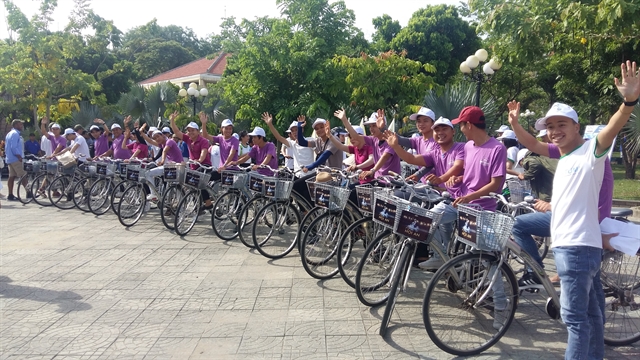
| Bicycle tour service in Hội An ancient town is an environment friendly lifestyle among local commuters and tourists visiting the town. Đà Nẵng has urged boosting 'green' transformation in building a global eco city and a liveable urban centre in Việt Nam. VNS Photo Công Thành |
“We have built rooftop solar power solution in combination with green farms using organic waste recycling at industrial parks and shopping centres. These projects had helped reduce emissions of 14,000 tonnes of carbon per year, while businesses save on power use from 10 to 20 per cent,” Viên said.
“The company has been offering roof-top solar power projects for both domestic households and industrial zones in supporting businesses in achieving ESG (Environment, Social and Governance) standards for global market access.”
A report from the city’s industrial zones authority unveiled that enterprises and some industrial parks have applied the Regional Comprehensive Economic Partnership (RCEP) standards.
It said 238 solutions had been implemented, resulting in saving VNĐ14 trillion ($560 million), reducing 50,000 cubic metres of water use and 2,700 tonnes of solid waste, while cutting 7,000 tonnes of carbon emissions into the environment.
Vice chairman of the city’s Tourism Association Phan Xuân Thanh said that Đà Nẵng, in cooperation with the Swiss Tourism for Sustainable Development project in Việt Nam, promotes green tourism services, including Đà Nẵng Green Stay, Green lifestyle destination and circular economy in tourism management.
He said electric vehicles and bicycles are offered in rural experience tour services in Hội An ancient town and suburban areas, while organic farms are fertilised from kitchen waste.
Đà Nẵng has issued green standards for luring renewable energy and hi-tech investment, building economic links with neighbouring provinces and cities in the region.
The Liên Chiểu Industrial Zone (IZ) has asked businesses to apply environmentally-friendly technologies in reducing GHG emissions by five per cent.
Đà Nẵng was one of 20 Asia-Pacific Economic Cooperation (APEC) cities chosen to carry out a Low-Carbon Model Town Project involving smart grids and renewable power generation. VNS
Society
 Society
 Society
 Society
 Society
 Society
 Society
 Society
 Society
 Society
 Society
 Society
 Society
 Society
 Society