 Society
HCM City honours fallen soldiers with solemn musical tribute
1.
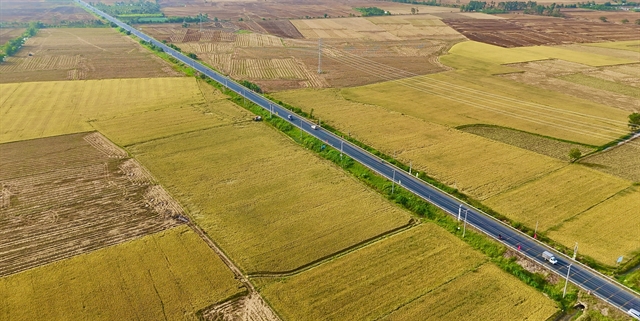 |
| Rice fields in An Giang Province that are participating in the “Sustainable Development of One Million Hectares of High-Quality and Low-Emission Rice Associated with Green Growth in the Mekong Delta by 2030” project. — VNA/VNS Photo Thanh Sang |
MEKONG DELTA — Farmers in the Cửu Long (Mekong) Delta are adopting greener rice farming methods under Việt Nam’s one-million-hectare rice project, reducing emissions while boosting productivity and incomes.
In November 2023 the Government approved the “Sustainable Development of One Million Hectares of High-Quality and Low-Emission Rice Associated with Green Growth in the Mekong Delta by 2030” programme to address challenges facing rice farming in the region.
The programme has produced encouraging results, according to the Ministry of Agriculture and Environment.
The area of high-quality, low-emission rice cultivation has reached 354,839ha as against the initial target of 180,000ha for the first phase in 2024–25.
Farmers are gradually adopting production methods that reduce emissions, increase value and protect the environment.
Speaking at a recent conference in Cần Thơ reviewing the project’s implementation, Deputy Minister of Agriculture and Environment Trần Thanh Nam acknowledged this, saying the most notable change has been farmers’ new approach to production.
Pilot models under the project have delivered better results than traditional rice farming. Seed use has fallen by 45 per cent, fertiliser use by 30 per cent and pesticide spraying by two to three applications per crop.
Water use has dropped by 20 per cent thanks to irrigation techniques that drain rice fields two or three times during the growing season.
All this has cut production costs by 40 per cent, while rice yields have increased by 12 per cent on average.
Farmers’ profits have risen by VNĐ6 million (US$228) per hectare per crop compared with traditional farming methods.
These models also cut emissions by three to four tonnes of carbon dioxide per hectare per crop, contributing to achieving green agriculture and greenhouse gas reduction goals.
All project areas apply at least one sustainable farming practice, such as the “One Must – Five Reductions” method or irrigation techniques that periodically drain water from rice fields.
The “One Must – Five Reductions” practice requires farmers to use certified seeds while reducing seed, fertiliser, pesticide, and water use and post-harvest losses.
Alongside technical changes, value-chain production models are gradually taking shape.
At present 1,129 co-operatives and co-operative groups, along with more than 210 businesses and organisations, are participating in the project.
Some 600 co-operatives and co-operative groups covering 60–70 per cent of the project area have signed agreements with companies to produce and sell rice.
Mechanisation in rice production has also increased sharply.
In pilot models, all land preparation and harvesting are carried out using machinery. Rice planting is done using transplanting machines, row seeders, drones, or cluster-seeding methods.
Irrigation is fully mechanised, while more than 40 per cent of the area uses machines for applying fertilisers as do 90 per cent of fields for pesticides.
These help reduce labour costs and improve production management.
In Cần Thơ, the project is further expanding.
The city has more than 319,000ha of rice farmland and plans to develop over 170,000ha of high-quality, low-emission rice under the project by 2030 with the participation of 171 co-operatives and co-operative groups.
By 2025 104,000ha had been covered.
Trương Cảnh Tuyên, Chairman of the Cần Thơ People’s Committee, said the city would continue working closely with the Ministry of Agriculture and Environment, central agencies, international organisations, and businesses to carry out the project effectively.
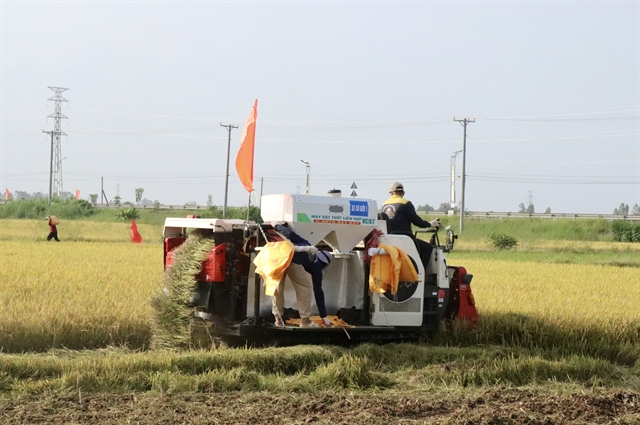 |
| Rice fields in An Giang Province under the “Sustainable Development of One Million Hectares of High-Quality and Low-Emission Rice Associated with Green Growth in the Mekong Delta by 2030” project being harvested by machines. — VNA/VNS Photo Thanh Sang |
The project has seen 18,086ha of rice fields certified under the “Gạo Việt xanh phát thải thấp” (Low-emission Green Vietnamese Rice) label, producing 75,060 tonnes of the grain, according to the ministry’s plant production and protection department.
Of this amount, 500 tonnes have been exported to Japan, a market known for its strict quality and environmental standards.
About 70 per cent of rice farming area under the project in the 2025–26 winter–spring crop saw straw collected to produce mushrooms, fertilisers and other products.
Minister of Agriculture and Environment Trần Đức Thắng said handling rice straw after harvest was key to reducing emissions and promoting circular agriculture.
He said the project was an important step in restructuring the delta’s rice industry towards greener and more sustainable agriculture while increasing farmers’ incomes.
“With the results so far, the target of one million hectares of high-quality, low-emission rice could be achieved within the next one to two years.”
He called on ministries, local authorities, businesses, co-operatives, and farmers to continue working together to implement the project, helping build greener agriculture, increasing farmers’ incomes and strengthening the position of Vietnamese rice in international markets.
The Mekong Delta is the country’s largest rice production region, with more than 1.8 million hectares of rice fields and an annual output of over 20 million tonnes.
It accounts for 50 per cent of the country’s rice production and more than 90 per cent of exports.
Rice exports topped 1.3 million tonnes worth $599.3 million in the first two months of the year, a 5 per cent increase in volume but an 11.2 per cent drop in value from the same period last year, according to the Ministry of Agriculture and Environment. — VNS
Society
 Society
 Society
 Society
 Society
 Society
 Society
 Society
 Society
 Society
 Society
 Society
 Society
 Society
 Society




