 Society

Việt Nam, Belgium seek to deepen bilateral cooperation
1.
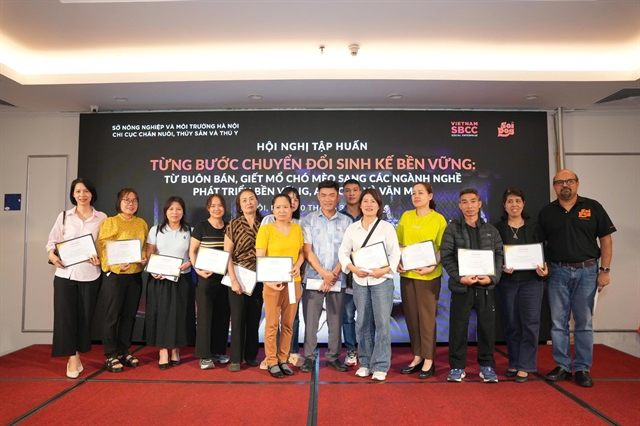 |
| The organisers presented certificates of participation in the training course to the owners of dog and cat slaughtering businesses. — Photo courtesy of the organiser |
HÀ NỘI — Dog and cat traders, slaughterhouse owners in four wards of Hà Nội, including Xuân Phương, Dương Nội, Từ Liêm, and Hà Đông, were trained on how to change their livelihoods sustainably at a conference on March 20.
The event, entitled "Sustainable Livelihood Phased-Transition: From Dog and Cat Meat Trade to Sustainable, Safe and Civilised Occupations," was jointly organised by the Hanoi Sub-Department of Livestock, Fisheries and Veterinary Medicine and Soi Dog Foundation and the Vietnam Social and Behaviour Change Communication for Sustainable Development Company (SBCC Vietnam).
The conference is a core activity of the project "Piloting a Model for Rabies Prevention and Sustainable Economic Development - Phased Transition of Dog and Cat Meat Trade Activities in Selected Wards of Hà Nội," approved by the municipal People's Committee on July 24, 2025. This marks the 2nd training session in the programme series.
The project targets two parallel objectives: contributing to the national goal of zero human rabies deaths by 2030, while strengthening disease management and control capacity and gradually implementing animal welfare standards aligned with international practices.
This represents a significant step forward for Hà Nội city in charting a civilised and safe path for the community, in harmony with the global trend towards humane treatment of animals. Through this project, the city demonstrates its proactive commitment to accompanying and supporting residents in making a sustainable livelihood transition - a long-term direction implemented systematically.
 |
| Mr. Cấn Xuân Minh, a speaker from the Hanoi Sub-Department of Livestock, Fisheries and Veterinary Medicine. — Photo courtesy of the organiser |
At the event, experts presented updates on the current situation and new 2026 regulations, highlighting the direct link between dog and cat slaughter and trading activities and the risk of rabies transmission, particularly in the context of Hà Nội having just recorded two local outbreaks.
The city is tightening control over food traceability, eliminating street vending stalls and makeshift markets on pavements and roadways, and conducting multiple unscheduled and periodic inspections of business licenses, invoices and documentation proving product origin and facility hygiene conditions throughout 2026.
According to statistics from the beginning of 2026 to date, the country has recorded 10 suspected cases of rabies and deaths from rabies across 10 provinces and cities. Notably, Hà Nội has recorded animal rabies outbreaks in three hamlets across Hòa Lạc and Hạ Bằng communes, with a total of 28 animals culled (27 dogs and one cat), and a significant number of people have required post-exposure prophylaxis treatment. These figures reflect a still-complex disease situation, calling for more coordinated and decisive intervention measures.
Mr Nguyễn Đình Đảng, Head of the Hanoi Sub-Department of Animal Husbandry, Aquaculture and Veterinary Medicine, stated: "Recent rabies outbreaks occurring within Hà Nội itself serve as a stark warning that the rabies pathogen remains an active public health threat, necessitating the coordinated implementation of comprehensive prevention and control measures, including the regulation of the trade and slaughter of dogs and cats. The proper management of dog and cat meat processing and commercial activities contributes to upholding urban civility and public order, safeguarding the lives of residents, and advancing the vision of Hà Nội as a civilised, modern, and disease-safe capital city."
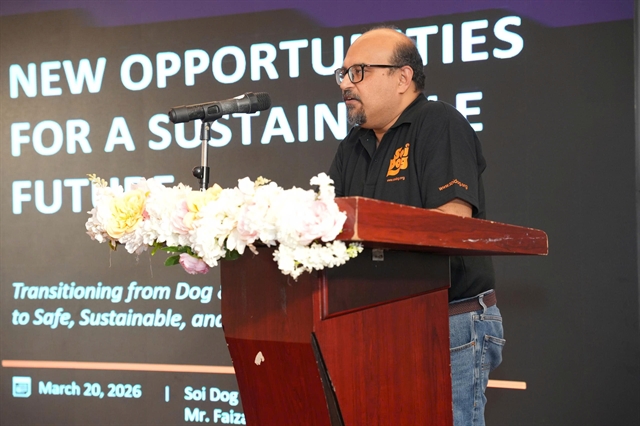 |
| Mr Faizan Jalil, Senior Manager of the Soi Dog Foundation, speaks at the event. — Photo courtesy of the organiser |
Mr Faizan Jalil, Senior Manager at Soi Dog Foundation, emphasised: "Market data shows that Hà Nội's pet services industry is growing strongly, creating numerous career opportunities with stable income and a more professional working environment. From our experience in Thailand and in the region, we can confirm that when people are provided with viable livelihood alternatives - with a concrete, step-by-step roadmap, and meaningful accompanying support - the vast majority are willing and successful in transitioning to new, safer, and more sustainable occupations, with income equal to or even higher than before."
 |
| Ms. Bùi Thị Duyên, Director of SBCC Vietnam, speaks at the event. — Photo courtesy of the organiser |
Ms Bùi Thị Duyên, Director of SBCC Vietnam, shared that after the first livelihood training session, the first owner of a dog and cat meat business in Xuân Phương Ward completely stopped selling dog meat, while nearly ten others proactively registered to join the transition programme.
"We hope that after today's training, even more dog and cat slaughter and trading business owners will register for the transition programme. We are committed to providing the most dedicated and comprehensive support to those who register early, so that we have more time to walk this journey together, address challenges collaboratively, and make the most of every available resource," said Duyên.
The project encourages dog and cat slaughter and trading establishment owners to voluntarily participate in the programme and receive free support, including vocational skills training, startup assistance, business consulting, market and partner linkages, and legal procedure support.
The conference marks an important milestone in the city’s effort to integrate disease prevention with sustainable socio-economic development. — VNS
Society
 Society
 Society
 Society
 Society
 Society
 Society
 Society
 Society
 Society
 Society
 Society
 Society
 Society
 Society