 Society

ONYX Hospitality Group Wins Best Local Hotel Brand – Thailand for the Second Consecutive Year at the TTG Travel Awards 2026
1.
HCM CITY — A renovation project for Thanh Đa residential area in Bình Quới Ward, HCM City is set to pick up pace following the agreement of 165 local households to relocate as part of a compensation and resettlement plan.
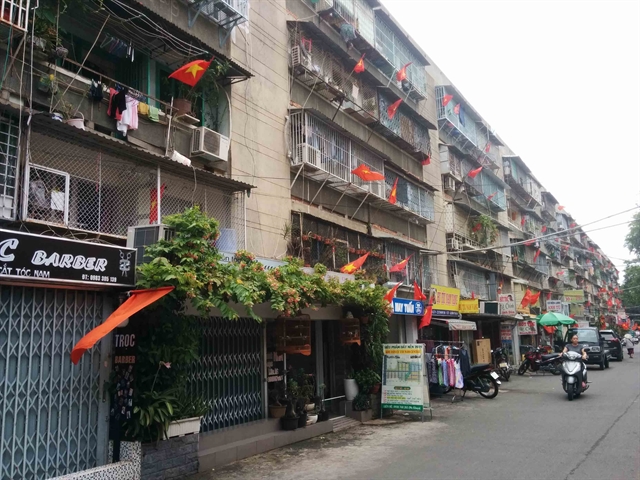
Thanh Đa residential area is home to a cluster of old apartment buildings in poor condition in Bình Quới Ward.
|
| Old Thanh Đa residential area. The plan renovating the area will be accelerated soon. — Photo courtesy of baodautu.vn |
Out of the eligible households, 165 households have agreed to hand over their premises, with 81 opting for on-site resettlement and 84 choosing compensation as announced by the project developer.
The compensation rate is VNĐ52 million (US$1,900) per one square metre, excluding the K factor for different floors, with additional support provided by the developer amounting to VNĐ300 million ($11,400) per household for ground floor units and VNĐ200 million ($7,600) per household for upper floors.
For households opting for on-site resettlement, those with larger areas will pay an extra VNĐ16.8 million per square metre, while those with smaller areas will receive corresponding refunds.
Additionally, each household will receive temporary residence support of VNĐ12 million ($458) per month while awaiting relocation.
In addition to the general policies, the developer also offers additional support to specific groups, such as those with revolutionary contributions, people with disabilities, near-poor households, and disadvantaged households identified by the ward's People's Committee, who are offered additional support according to their circumstances.
According to the plan, two on-site resettlement buildings will be constructed on the two blocks previously cleared, comprising 1,750 apartments. The construction is expected to be completed within three years. The design, landscaping, and amenities will be similar to commercial housing.
Houses along rivers should be removed
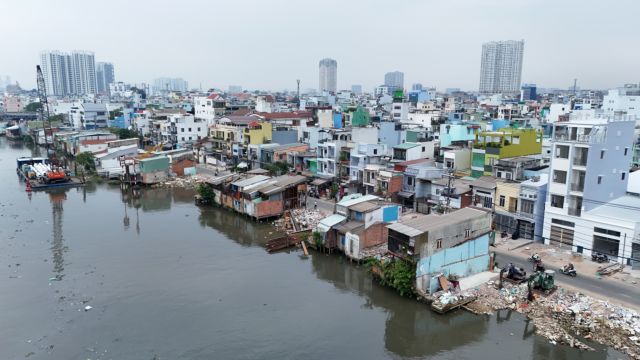
The People's Committee of HCM City has issued document No 1328/UBND-ĐT concerning the survey of properties along rivers, canals, and waterways within the city's (former) boundaries as part of urban renovation and restructuring initiatives.
Accordingly, the chairman of the city People's Committee has approved the survey report conducted by the HCM City Institute for Development Studies and requested this unit to take full responsibility for the content, data, and proposed results.
By March 20, the Institute must complete the handover of survey documents and data to the People's Committee of relevant wards and communes to serve the management, planning, and implementation of projects. In cases of adjustments and expansion of the renovation scope, localities need to actively review and conduct additional surveys. The report by last December outlined a total of 42,790 properties within the former city area eligible for relocation, with a notable proportion already surveyed and analysed.
|
| Houses in poor condition along a canal in HCM City. HCM City guides relevant agencies and sectors to fulfill plans to remove houses. — VNA/VNS Photo An Hiếu |
Legally, the rate of households with land use rights certificates is relatively high. However, the situation of unauthorised construction and land without proper legal documentation still accounts for a significant proportion, reflecting the difficulties and complexities in urban management.
The survey results on compensation needs show that 65.7 per cent of households require cash compensation based on market prices at the time of clearance. The demand for resettlement with land, land-attached houses, or apartments accounts for 21.2 per cent, primarily desiring on-site resettlement with apartment sizes ranging from two to three bedrooms.
Additionally, 13.1 per cent of households express the desire to be considered, supported reasonably, and have their rights ensured throughout the implementation of compensation, support, and resettlement policies.
Moreover, the survey also notes related issues regarding post-relocation support needs, the level of consent, and the concerns of residents during the project implementation process.
Based on these results, the HCM City Institute for Development Studies suggests that the HCM City People's Committee direct departments, sectors, and localities to focus on implementing urban rehab projects along the rivers, canals, and waterways in a coordinated manner, especially in corridors passing through multiple wards and communes, to enhance the effectiveness of improving the landscape and quality of life.
For the Department of Construction, it is necessary to prepare funds for resettlement housing and social housing with an appropriate structure, ensuring technical standards, safety, utilities, and implementing the principle that new residences are equal to or better than the old ones.
The Department of Planning and Architecture is recommended to review and adjust the 1/2000 planning scheme in areas along rivers, canals, and waterways to ensure harmony between economic development and environmental improvement.
The People's Committees of wards and communes are required to intensify dissemination and transparency of project information, establish mechanisms for dialogue, and receive and address people's proposals, contributing to reaching consensus in the urban restructuring process. — VNS
Society
 Society
 Society
 Society
 Society
 Society
 Society
 Society
 Society
 Society
 Society
 Society
 Society
 Society
 Society