 Society
Lotte, Phát Đạt combine strengths in Thu Thiem project
1.
|
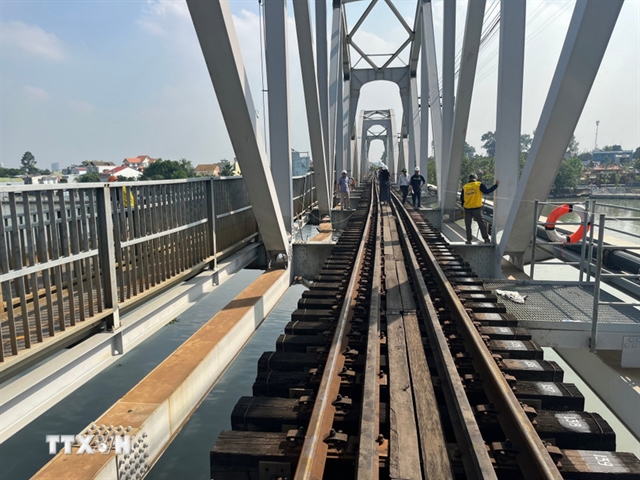
| Workers are repairing tracks that were damaged by the accident. VNA/VNS Photo |
ĐỒNG NAI — A barge collision with Ghềnh Bridge in southern Việt Nam has caused extensive disruption to rail transport and damage to national infrastructure, with losses already estimated at VNĐ40 billion (US$1.6 million) and projected to reach about VNĐ140 billion ($5.5 million) by March 20, according to the Ministry of Construction Vietnam.
The accident has caused serious damage to national assets and infrastructure, particularly disrupting the railway sector, business operations of companies, the movement of goods and the rights and interests of many customers.
Deputy Minister Nguyễn Danh Huy requested agencies and local authorities to urgently implement measures to restore operations of the North–South railway line across Ghềnh Bridge as soon as possible.
Huy requested the Đồng Nai Provincial People’s Committee and the Đồng Nai Provincial Police to initiate a criminal case to investigate and clarify the violations.
Huy also assigned the railway sector, together with the Vietnam Inland Waterways Administration, to closely coordinate with Đồng Nai Provincial Police during the investigation.
This was the second similar accident on the Đồng Nai River at Ghềnh Bridge and the cause was believed to be related to the operator of the vessel, Huy said.
Previously, on March 6, an accident occurred at the bridge. A barge with a capacity of 3,339 tonnes was travelling downstream when it directly collided with compartment five of span two of Ghềnh Bridge.
The accident injured one motorcyclist travelling on the pedestrian lane of the bridge. The bridge structure and railway infrastructure were deformed and bent, joint plates were damaged and bridge bearing bolts were broken, causing the bearings to shift by about 25mm and the railway track alignment on the bridge to deviate by about 320mm.
The incident forced the suspension of passenger and freight trains on the Biên Hòa–Dĩ An section, directly affecting the entire railway timetable and requiring adjustments to train operations.
As of March 8, more than 10,000 tickets had been returned for trains on the Hà Nội–Hồ Chí Minh City route, with an average of 2,000 cancellations per day. Freight volume is estimated to have fallen by about 6,000 tonnes per day.
Three proposed repair options
After the accident, the railway sector blocked the Biên Hòa–Dĩ An section, organised site monitoring and protection, established an on-site steering committee and mobilised experienced design and construction consultants to implement recovery measures.
The on-site steering committee has developed three remedial plans.
The first option is to dismantle the damaged N2 span, relocate the N3 span to the N2 position and manufacture and install three temporary bridge spans at the N3 position. The estimated time to reopen the line is 25 days.
The second option is to redirect vessel traffic through span N1. Temporary piers would be constructed and the N2 span reinforced to ensure safe train operations. The railway line could be temporarily reopened in 15 days.
The third option is that based on inspection results, reinforce the deformed beams caused by the barge collision in compartments four, five and six of span two using 8m steel beams connected with gusset plates using high-strength bolts and welded directly to the nodes at the ends of the compartments to increase load-bearing capacity.
Under this option, the railway line could be temporarily reopened before 10am on Thursday (March 12).
According to all options, a new beam would be produced and installed to ensure absolute railway safety and restore the section’s operating speed. This would take about 60 days from approval of the plan by competent authorities.
For passenger transport, the railway sector has arranged staff at Biên Hòa and Dĩ An stations to assist passengers and organise bus transfers between the two stations. Ticket refunds are being processed without fees for passengers wishing to cancel their journeys.
For freight trains, additional staff and equipment have been deployed to organise cargo handling at Trảng Bom and Hố Nai stations.
Additional personnel have also been assigned at Biên Hòa, Dĩ An, Trảng Bom and Hố Nai stations to organise train operations, shunting and train formation.
The incident has caused very significant damage to national railway infrastructure assets and disrupted railway transport operations. Repair work is extremely difficult, complex and costly.
Vietnam Railways Corporation requested the ministry to quickly allocate sufficient funding to carry out the work.
Ghềnh Bridge, located on the Hà Nội–HCM City railway line, was built in 2016 with three steel arch spans.
The bridge was put into operation in June 2016 after a previous accident had caused the earlier Ghềnh Bridge to collapse. — VNS
Society
 Society
 Society
 Society
 Society
 Society
 Society
 Society
 Society
 Society
 Society
 Society
 Society
 Society
 Society