 Society
84 individuals investigated for transnational online frauds
1.
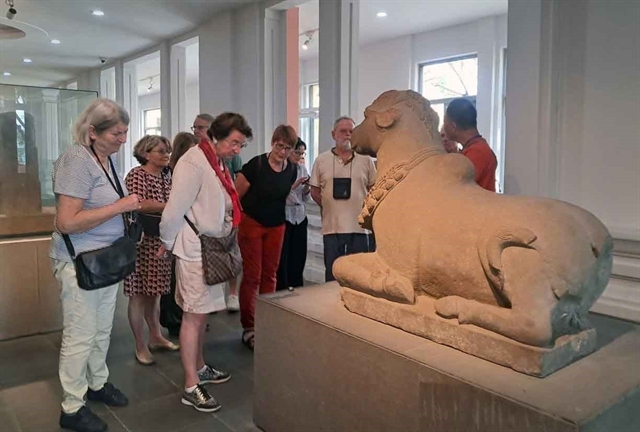 |
| International tourists look at a guardian statue at Đà Nẵng's Museum of Chăm Sculpture, March 7. — VNA/VNS Photo |
HÀ NỘI — Việt Nam received nearly 4.7 million international visitors in the first two months of 2026, up 18.1 per cent year-on-year, according to the National Authority of Tourism (VNAT).
Tourist arrivals by air accounted for the largest share with more than 3.83 million visitors, representing 81.8 per cent of the total. Arrivals by land made up 15.8 per cent while sea travel accounted for 2.4 per cent.
In February alone, the country welcomed more than 2.2 million foreign visitors, marking the third consecutive month that the number of international arrivals exceeded the two-million mark, following 2.45 million in January 2026 and 2.02 million in December 2025.
Asian tourists continued to dominate the market structure, with around 3.4 million arrivals during the two-month period, accounting for 73 per cent of the total and increasing by over 10.2 per cent compared with the same period last year.
The Republic of Korea (RoK) remained Việt Nam’s largest source market with about 971,000 visitors, up around 10 per cent year-on-year.
The market has maintained stable growth, reflecting the continued popularity of Việt Nam’s beach destinations, golf tourism and family travel, as well as convenient air services between the two countries.
Mainland China ranked second with around 923,000 arrivals, while visitors from Taiwan (China) reached more than 220,000 during the period. Together with Japan, these markets continued to reinforce Northeast Asia’s role as a key source of international tourists to Việt Nam.
India emerged as one of the fastest-growing markets, with about 158,000 visitors in the first two months of the year, up more than 71 per cent year-on-year. The strong increase reflected Việt Nam’s efforts to diversify its visitor sources, alongside the expansion of direct flights, stronger tourism promotion and rising outbound travel demand among India’s growing middle class.
Within Southeast Asia, several markets recorded robust growth. Visitor numbers from the Philippines surged by 72 per cent, Singapore by 35 per cent, Indonesia by 27 per cent and Malaysia by 16.5 per cent.
Cambodia posted the highest growth rate in the region at 95.1 per cent compared with the same period in 2025. The VNAT attributed the increases to stronger intra-ASEAN tourism cooperation, geographical proximity and convenient transport links.
The European market also saw a strong recovery, with 847,000 arrivals in the two-month period, rising 67.4 per cent year-on-year. Major markets posting positive growth included the UK (17.1 per cent), France (19.8 per cent) and Germany (17.5 per cent).
Russia remained the largest European source market with 247,000 visitors, soaring 212.5 per cent year-on-year. Russian tourists are particularly drawn to Việt Nam’s warm coastal destinations such as Nha Trang, Phú Quốc and Phan Thiết–Mũi Né, where they often spend extended holidays.
 |
| International tourists take photos at the Nguyên Tiêu Festival in HCM City, March 3. — VNA/VNS Photo |
According to the VNAT, Việt Nam’s growing appeal among European travellers is supported by favourable visa policies, including extended visa exemptions, more convenient e-visa procedures and expanded direct air routes.
Visitor numbers from other regions also recorded positive growth. The Americas saw 278,000 visitors during the period. With 210,000 arrivals, the US remained among Việt Nam’s 10 largest source markets, up 6.3 per cent year-on-year, while Canada recorded around 50,000 visitors, an increase of 22.9 per cent.
Australia and New Zealand together contributed about 130,000 visitors, up nearly 15 per cent compared with the same period last year, while Africa recorded about 12,100 arrivals, rising more than 32 per cent.
The VNAT said the strong growth from Northeast Asia, ASEAN and Europe shows that Việt Nam’s international tourism market structure is becoming increasingly diverse and balanced, creating a solid foundation for the tourism sector to sustain growth momentum and strengthen competitiveness in the region and the world. — VNA/VNS
Society
 Society
 Society
 Society
 Society
 Society
 Society
 Society
 Society
 Society
 Society
 Society
 Society
 Society
 Society