 Society

Amendments to bidding law aim to boost project owners’ autonomy and ensure transparency
1.
|
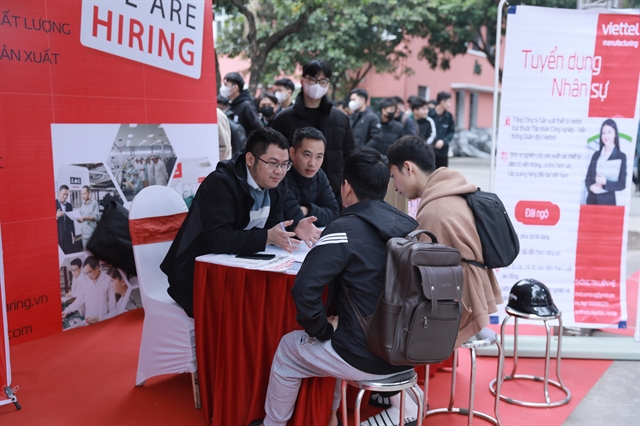
| Job seekers receive career advice at a job fair in Hà Nội on Feb. 1. — Photo daibieunhandan.vn |
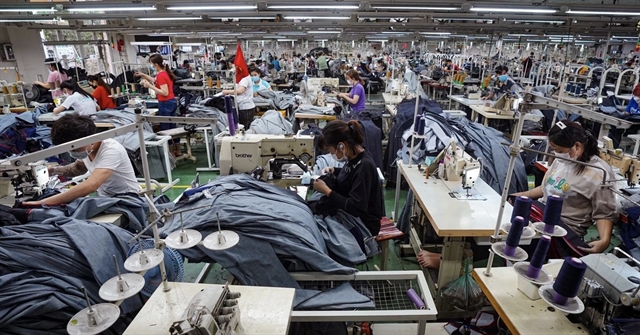
HÀ NỘI — Việt Nam’s labour market is regaining momentum after the Lunar New Year holiday, with manufacturers ramping up recruitment, even as workers grow more selective about their employment choices.
But the rebound is unfolding alongside a deeper shift in worker behaviour, as employees become more concerning about where and why they work.
According to a labour market bulletin released by the Ministry of Home Affairs, employment in the first quarter of 2026 is expected to rise by around 300,000, bringing total employment close to 53 million.
Average monthly income rose to VNĐ8.7 million ($334), suggesting gradual improvements in living standards.
Demand is strongest in manufacturing, particularly in food processing, which is forecast to see a 3.1 per cent increase in hiring compared with the previous quarter.
Food producers, closely tied to domestic consumption and essential goods, are ramping up output to clear order backlogs built up during the holiday period.
In major industrial zones, companies are recruiting hundreds, sometimes thousands, of workers to staff processing lines and operate production systems.
Yet, employers say the challenge is no longer just finding enough people.
Many firms report shortages of workers with basic technical skills, the ability to adapt quickly to modern production processes and the discipline required to meet food safety and factory standards.
Other manufacturing segments are facing similar pressures. Demand for labour in the production of transport equipment is projected to rise by 2.6 per cent, while motor vehicle manufacturing is expected to grow by 1.6 per cent.
These industries are highly sensitive to export demand and regional supply chains, and companies are racing to add workers as overseas orders recover.
Recruitment is concentrated in mechanical trades, welding, assembly and maintenance as well as engineering and production management roles.
Competition for labour within industrial zones has intensified, pushing employers to adjust wages and offer additional incentives such as attendance bonuses, housing support and transport allowances to retain workers after Tết.
Not all sectors are expanding. Hiring demand has eased slightly in chemicals manufacturing and in machinery repair and installation, reflecting efforts by some firms to streamline operations and increase automation to control costs.
Despite signs of recovery, labour market risks remain.
In the final quarter of 2025, more than 784,000 people were underemployed and about 1.07 million were unemployed, according to official figures.
|
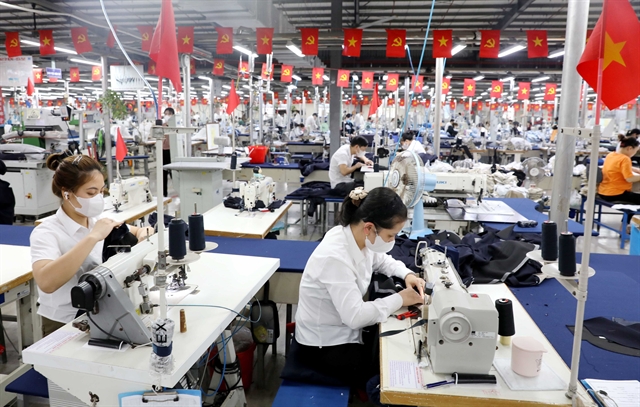
| Factory workers return to their regular work routines after the Tết holiday in the northern province of Hưng Yên, Feb. 23. |
A majority of those applying for unemployment benefits lacked formal qualifications, underscoring the vulnerability of low-skilled workers as companies restructure and upgrade technology.
A nationwide survey by Cốc Cốc Research found that 77 per cent of workers consider themselves open to work. Unlike earlier waves of job-hopping, however, the current shift appears more cautious.
Nearly half of respondents said they would only change jobs for a genuinely better opportunity, while just over a quarter were actively seeking an immediate move.
Pay and benefits remain central, with 40 per cent of workers defining a stable job primarily in terms of clear and reliable wages and insurance coverage.
Attitudes, however, are evolving. More than one in five said a respectful, non-toxic workplace and work–life balance were decisive factors in long-term commitment, while others highlighted the importance of employer-funded training to keep pace with technological change.
Notably, more than three-quarters of respondents said they would choose a healthier and more balanced working environment even at the cost of higher pay.
Among Generation Z workers, around 61 per cent were willing to accept a pay cut of between 1 per cent and 10 per cent in exchange for a better workplace fit.
The findings suggest that stability is no longer synonymous with remaining in one job for decades. Instead, workers increasingly define it as a combination of sustainable income, psychological security and continuous opportunities to develop skills.
For employers facing labour shortages, particularly in skilled and technical roles, the challenge in 2026 extends beyond recruitment. Retaining staff will require transparent management, respectful workplace cultures and credible long-term development pathways.
For workers, meanwhile, the divide between those with adaptable skills and those without is becoming more pronounced.
As the manufacturing sector moves deeper into automation and higher-value production, access to stable employment is tilting steadily towards those able to retrain, upskill and adapt.
The post-Tết labour rebound is real, but whether it proves durable will depend on how effectively job creation is matched with investment in workforce quality rather than simply filling vacancies in the short term. — VNS
Society
 Society
 Society
 Society
 Society
 Society
 Society
 Society
 Society
 Society
 Society
 Society
 Society
 Society
 Society