 Society

Việt Nam, Switzerland to turn education, sci-tech, innovation into cooperation focus
1.
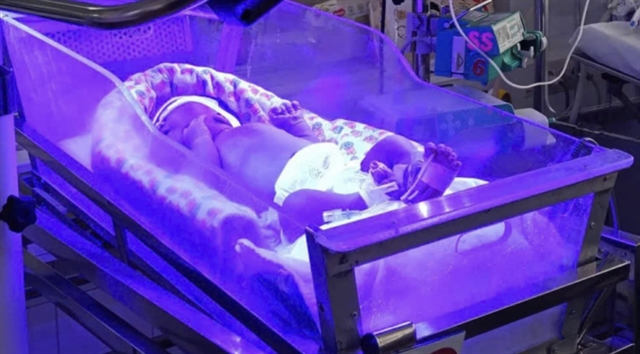 |
| A newborn receives phototherapy treatment for severe jaundice at Children’s Hospital 2 in HCM City. — Photo courtesy of the hospital |
HCM CITY — Doctors at Children’s Hospital 2 have successfully saved a 30-hour-old newborn boy suffering from a rare blood group incompatibility, the hospital announced on March 14.
The baby, weighing 3.8 kilograms, was born full-term in good condition. However, within the first 24 hours after birth, his skin began to turn unusually yellow. He was transferred to the hospital when he was only 30 hours old.
By the time he arrived, his condition had become severe as jaundice had spread to his palms and soles, while his blood bilirubin levels had risen beyond the dangerous threshold.
Test results showed that the infant was suffering from immune haemolysis caused by a combination of three factors: incompatibility in the ABO blood group system, a very rare incompatibility involving the Rh (Rhesus) factor, and the mother not having received preventive Anti-D treatment during pregnancy.
Facing the risk of irreversible brain damage, doctors determined that an exchange transfusion was the most effective treatment.
However, preparing for the procedure proved extremely challenging. Several cross-matching tests produced clots because the antibodies in the baby’s blood were too strong, making it very difficult to find a compatible blood unit.
An emergency consultation involving the hospital’s Neonatal Department, Oncology-Haematology Department and Blood Bank was quickly organised to identify the safest solution.
Doctors then carried out a double-volume exchange transfusion combined with immunoglobulin (IVIG) infusion and intensive phototherapy.
Following treatment, the infant’s critical indicators gradually declined. After seven days, his neurological condition stabilised and he was discharged from hospital.
Doctors from the Neonatal Department warned that parents should not overlook jaundice in newborns. Warning signs requiring immediate medical attention include jaundice appearing within the first 24 hours after birth; deepening jaundice spreading to the thighs, legs, palms or soles; and symptoms such as lethargy, poor feeding or unusual body stiffness.
Experts also advised pregnant women to undergo blood group and Rh factor testing early in pregnancy. If the mother has Rh-negative blood, she should be closely monitored and receive preventive Anti-D injections under the guidance of obstetric specialists.
According to doctors, modern neonatal medicine can treat many life-threatening conditions. However, early detection and proper screening during pregnancy remain the most important factors in protecting newborns in their first hours of life. — VNS
Society
 Society
 Society
 Society
 Society
 Society
 Society
 Society
 Society
 Society
 Society
 Society
 Society
 Society
 Society