 Society
Vietnamese scientist wins ASEAN-US Science Prize for Women
1.
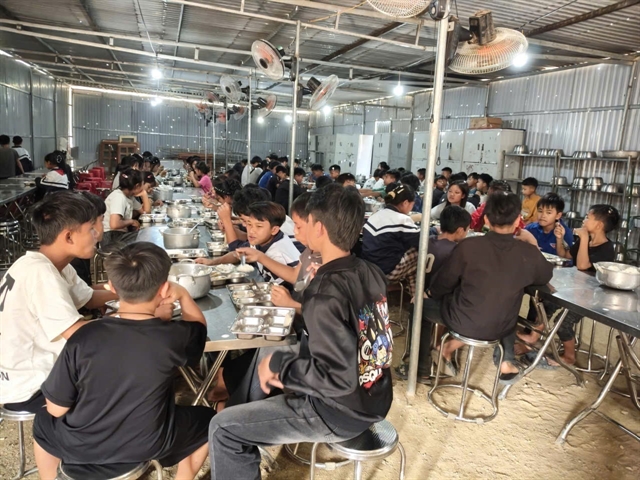 |
| A makeshift dining room serves semi-boarding students at Bắc Lý Lower Secondary School. VNA/VNS Photo Bích Huệ |
NGHỆ AN — Construction sites in remote border communes of Nghệ An Province have grown increasingly busy in early March as authorities accelerate work on a network of new boarding schools aimed at improving education for students in mountainous ethnic minority communities.
Provincial authorities are mobilising resources to resolve land clearance and funding issues, seeking to ensure the schools are completed by 2026 and provide modern learning environments for students in disadvantaged areas.
The programme is part of efforts to strengthen the highland education system and create modern learning environments for students from ethnic communities. The province expects the new schools to significantly improve learning conditions and meet the aspirations of local families by 2026.
More than four months after construction began, the multi-level boarding school projects have become a priority across the local political system.
In order to provide cleared land for contractors, many local residents have voluntarily relocated, demonstrating strong community support for the initiative.
 |
| Construction progresses at Bắc Lý Primary and Lower Secondary School in Nghệ An Province. VNA/VNS Photo Bích Huệ |
One notable example comes from Bắc Lý Commune, Nghệ An Province, an especially disadvantaged border area where steep slopes account for most of the terrain.
To make way for the Bắc Lý Ethnic Boarding School for primary and lower secondary students, teacher Hồ Minh Dung and his wife Vy Thị Thương voluntarily moved from the home where they had lived for nearly 20 years.
“Relocating has caused considerable disruption to our family life,” Dung said. “But as teachers working in remote villages, we understand that giving up land is necessary so students can soon study in a modern school.”
Their decision inspired other affected households to cooperate with the project. The remaining three families in the area subsequently handed over their land, allowing the project site to be fully cleared.
Rush to completion
The spirit of cooperation has also been evident among teachers.
Since late 2025, 14 teachers at Bắc Lý Semi-boarding Lower Secondary School have moved out of their staff residential area and rented accommodation elsewhere so the space can temporarily serve as living quarters for students and the school’s leadership board.
Phạm Sỹ Trường, the school’s principal, admits that daily operations are currently very challenging, as teaching, accommodation and other activities must be arranged under makeshift conditions.
More than 300 students now attend classes in the afternoon and borrow classrooms from a nearby primary school for additional study sessions.
Despite these difficulties, Trường says teachers and students are willing to endure temporary hardship while waiting for the new campus to be completed.
Bắc Lý is one of Nghệ An’s most disadvantaged border communes, sharing a 3.5-kilometre border with Houaphanh Province of Laos. Around three-quarters of the commune’s land consists of steep slopes and barren hills.
The commune currently has two primary schools and one lower secondary school with around 1,200 students, most of whom come from ethnic families studying under limited conditions.
Given these realities, local authorities and residents have strongly supported the new boarding school project and are working together to ensure it can be completed as soon as possible.
Phạm Viết Phúc, chairman of Bắc Lý People’s Committee, says relocating residents and arranging new housing in remote mountainous areas is a challenging task. However, he notes that compensation and land clearance procedures have been carried out transparently to safeguard the legitimate rights of affected households.
Although the rainy season is approaching, local authorities remain hopeful that with strong cooperation from local residents and relevant agencies, the school will be completed by the end of August.
A similar effort is underway in Quế Phong Commune, where the local authorities are rapidly implementing relocation plans and clearing public facilities for construction.
Lưu Văn Hùng, chairman of the commune’s People’s Committee, says land from nine households in Cỏ Nong and Ná Phày villages has been reclaimed for the project, while additional land from a former forestry station and an old health clinic is also being utilised.
To ensure safety during construction, the commune plans to relocate students from Mường Nọc Primary School to a new campus during the second semester of the 2025–2026 academic year.
Expanding education
According to the provincial Civil and Industrial Construction Investment Project Management Board, all 10 multi-level ethnic boarding school projects launched in November 2025 have completed approval of compensation and resettlement plans as of early March.
Contractors are currently focusing on site levelling and foundation work. In order to meet the target completion date this year, many construction teams have mobilised workers and machinery to continue work even during the Lunar New Year holiday.
The project management board has also worked with the provincial Department of Agriculture and Environment to complete procedures related to material sources such as sand and soil under special mechanisms designed to reduce costs and speed up construction.
However, the projects still face considerable challenges. Nguyễn Tiến Dũng, deputy head of the planning division of the provincial project management board, says construction in remote mountainous areas encounters shortages of building materials and damaged transport infrastructure caused by natural disasters, which often disrupt deliveries.
To address these challenges, the board is coordinating with relevant agencies to exploit construction material sources under special mechanisms while working to resolve issues related to investment capital allocation.
“These projects are important for improving the school network and enhancing teaching and learning conditions,” Dũng says. “We will continue working closely with local authorities and relevant agencies to ensure the projects are implemented on schedule and in line with regulations.”
Beyond the ongoing projects, Nghệ An plans to break ground on 11 additional multi-level boarding schools in March in other border communes.
Under the province’s plan, more than VNĐ5 trillion (US$200 million) will be invested to build 21 multi-level boarding schools across border communes, opening better learning opportunities for tens of thousands of students from various ethnic minority communities in disadvantaged areas. — VNS
Error: Please check your e-mail and password in the settingsError: Please check your e-mail and password in the settings
Society
 Society
 Society
 Society
 Society
 Society
 Society
 Society
 Society
 Society
 Society
 Society
 Society
 Society
 Society