 Society

AIMCONNECT 2026 Held in Singapore, Bringing Global Automotive Leaders Together to Explore the Future of AI, Trust and Connected Mobility
1.
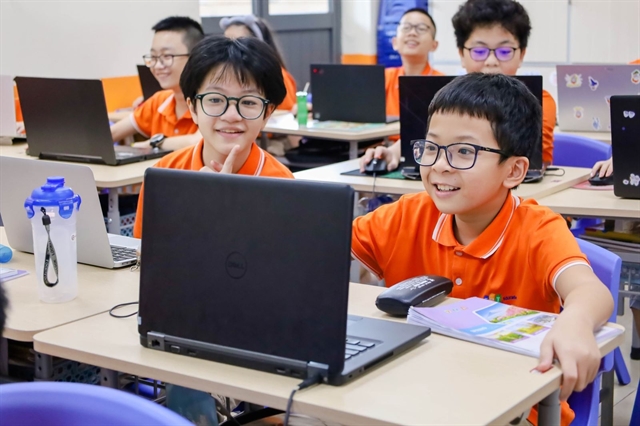 |
| Students study on computers with AI support. Photo baochinhphu.vn |
HÀ NỘI —Artificial intelligence (AI) is entering classrooms much faster than previously predicted.
AI has already become part of how students search for information, complete assignments and access knowledge in their daily learning.
The question is no longer whether AI should be introduced into schools, but how the education system should approach this technology so that it can both harness its advantages and maintain the fundamental goal of human development.
According to Professor Dr Lê Anh Vinh, director of the Việt Nam Institute of Educational Sciences, AI integration into education should answer a fundamental question: what are the goals of teaching and learning?
If AI can write essays, solve mathematical problems and synthesise information in seconds, is requiring students to submit a complete product still sufficient to prove they understand the subject matter?
"Previously, providing a solution could be seen as proof of understanding. Now, AI can provide solutions without needing to understand. If we only look at the final product, it is very difficult to know whether students are truly learning or not," Vinh said.
The problem is not only a concern about academic cheating, but also reshaping the current models for teaching, practice and testing that have been in use in schools for decades.
When students' answers are no longer closely linked with the cognitive process, assessment methods must change. This pressure opens up an opportunity for education to shift its focus from measuring outcomes to observing the learner's thinking process, Vinh told the Government news portal baochinhphu.vn.
According to the expert, technology should not lead education; on the contrary, education should pose problems for technology to solve.
Risks of misuse
According to Associate Professor Dr Trần Thanh Nam, vice director of the Hà Nội University of Education, AI is expected to create a turning point in education. However, if integrated hastily, without direction and control mechanisms, technology can create consequences contrary to the goal of developing learners' skills.
This is a systemic issue, not one that is limited to the classroom level.
“If the education system does not readjust its goals and methods of measuring learning outcomes, the learning process risks being reduced to optimising tools to complete tasks,” Nam said.
“In that case, students may achieve better-looking products, but their independent thinking skills and ability to construct knowledge are unlikely to improve."
“The greatest risk is not a few instances of abuse, but a silent shift in the focus of education from developing competencies to achieving tangible results,” he added.
Another manifestation of uncontrolled deployment is the integration of AI in a way that merely introduces new technology and software into the classroom, training students on tools and digitising lectures.
According to the vice director, this approach may create the impression of innovation, but it does not change the fundamental nature of the learning process.
Numerous studies in education science indicate that lasting knowledge is only formed when students actively participate in the process of deep learning: questioning, critical thinking, trial and error, and self-correction. If AI is used to mainly shorten the process, learning may be faster but not deeper.
AI integration thus cannot begin by questioning what new tools are available, but rather by questioning which skills learners need to develop. When this sequence is reversed, technology will lead education, instead of serving educational goals.
“Without proper pedagogical design, the system can fall into a self-contradictory state that, on one hand, claims to develop critical and creative thinking, while on the other hand, allows tools to largely replace the thinking process,” Nam said.
Meanwhile, Hà Nội University of Education lecturer Dr Kiều Phương Thùy said that if there is no clear orientation, AI could easily be used as a shortcut. The advantage could be speed, but a disadvantage might be the lack of development of critical thinking skills.
According to a survey conducted by the lecturer, 100 per cent of teachers want students to know how to use AI as a learning tool. However, only 33.3 per cent are interested in teaching students to deeply understand the programming, models or operating mechanisms of AI.
"This disparity reflects a reality that society is focusing more on exploitation than mastery," Thuỳ said.
If students are only taught how to use tools to create products faster, education will struggle to achieve the goal of forming digital citizens with independent thinking and the ability to adapt in a rapidly changing technological environment, according to Thuỳ.
AI should therefore not only be used as a convenient way to finish assignments, but should be fully integrated into the curriculum as appropriate for each age group.
Students need to understand the operating principles, limitations and risks of the technology, and then use it consciously and responsibly.
Standards and governance
Setting up a standard of use will help ensure that AI will not be overused in the education environment.
As the tool becomes stronger and easier to access, the boundary between using it for support and relying on it becomes more blurred than ever.
This requires schools to clearly define the boundaries of AI for each learning activity. In what areas is AI allowed to assist? What level of intervention is appropriate? When should the use of AI tools be transparent? And how should testing and evaluation be organised to ensure they accurately reflect individual abilities?
Bringing AI into schools should not stop, but a clear policy and roadmap as well as specific supervision mechanisms should be put into place.
According to Vinh, when technology can quickly create results, the assessment system must adjust to ensure it reflects the learning process, not just the final outcome.
Meanwhile, Nam said that any AI policies for education must create clear boundaries for responsibility of use.
Without common standards, inconsistencies among educational institutions would affect equity and increase the risk of technological dependence, he said.
Investment in teaching should be considered a key pillar of the process of AI integration.
The AI competency framework for teachers should not only focus on using tools, but also include the ability to design learning activities in an AI-assisted environment and the ability to help students use technology in a controlled manner, he said.
Integrating AI into schools is not just a technological decision, but a decision about educational governance in the digital age.
Technology can change very quickly, but how the system designs standards, assessment mechanisms and teacher training is a decisive factor in whether AI becomes a tool to support development or degrades the quality of learning in the long run.
At the management level, the Ministry of Education and Training has already prepared for the topic before AI became a larger part of public discourse.
In 2024, guidelines were finalised on teaching and learning with AI in schools. By the end of 2024, the AI competency framework for general education students was officially issued.
In 2025, an AI competency framework for teachers continued to be developed alongside detailed educational content.
Starting in the second semester of the 2025-2026 academic year, an AI programme was piloted before being reviewed, evaluated and adjusted.
“We should not create excessive pressure or implement it as a mass campaign. It is necessary to follow a scientific roadmap with periodic evaluations to ensure substantive effectiveness,” Vinh said.
According to the expert, schools that have already implemented basic computer science courses have several advantages when introducing AI into teaching.
However, this is only one part of the equation. The decisive factor remains the teaching workforce.
Surveys conducted after training sessions show that most teachers have already learned about and started using AI in their work. What is needed now is a unified and well-structured programme to ensure coordinated implementation, avoiding a situation in which each locality adopts a different approach.
"Three factors need to be ensured simultaneously: a curriculum framework flexible enough to adapt to rapidly changing technology, the skillset of the teaching staff, and the technical infrastructure that meets the requirements of teaching and learning," Vinh said.
“If any of these three pillars are missing, integration will be difficult to achieve sustainably," he said. VNS
Society
 Society
 Society
 Society
 Society
 Society
 Society
 Society
 Society
 Society
 Society
 Society
 Society
 Society
 Society