 Society
Hà Nội student arrested after allegedly assaulting teacher in classroom
1.
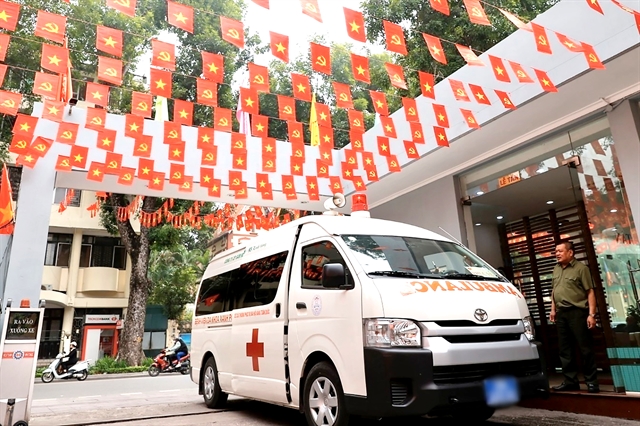 |
| An ambulance parked at St Paul General Hospital in Hà Nội. — VNA/VNS Photo |
HÀ NỘI — To enhance timely healthcare access for residents across the capital, Hà Nội has introduced financial policies covering at least 80 per cent of out-of-hospital emergency service costs, alongside a major expansion of its emergency response network.
The policy is detailed in the recently adopted Resolution 61 of the Hà Nội People’s Council, which sets service fees for out-of-hospital emergency care and stipulates patients’ co-payment rates.
Under the resolution, which took effect at the beginning of 2026, the State budget will cover 100 per cent of costs for on-site emergency standby services at events and conferences, as well as cases where an ambulance arrives at the scene but is unable to transport a patient.
Full funding will also be provided for patients affected by accidents, natural disasters or catastrophes; highly dangerous infectious diseases; children under six; and homeless psychiatric patients.
For other emergency cases outside of these categories, the State budget will subsidise 80 per cent of the cost, with patients co-paying the remaining 20 per cent.
Dr Nguyễn Thành, director of Hà Nội’s 115 Emergency Centre said: “This is a highly humane resolution, reflecting the city’s responsibility towards its residents as well as its out-of-hospital emergency system, ensuring that everyone has the opportunity to access timely emergency services when necessary.”
Going beyond subsidies and co-payment policies, the city also expanded its emergency response network with 42 new hospital-based emergency stations to meet citizens’ demand.
Hà Nội now counts a total of 53 emergency stations under the municipal health system, including those of the three central- and ministerial-level hospitals located in the city.
The stations operate ambulances around the clock and are equipped with essential medicines and specialised medical devices in accordance with regulations.
Each emergency team consists of three to four well-trained medical workers capable of handling complex situations such as cardiac arrest, respiratory failure, stroke and traffic accidents. The average response time is around 15 minutes.
Previously, Hà Nội’s out-of-hospital emergency system met only about 10 per cent of demand.
With the emergency network now expanded nearly sevenfold, authorities expect that response capacity will increase accordingly to around 70 per cent of demand.
“This is expected to eliminate existing emergency ‘blind spots,’ enabling faster and more timely access to services and increasing patients’ chances of survival, particularly in critical situations,” Thành added. — VNS
Society
 Society
 Society
 Society
 Society
 Society
 Society
 Society
 Society
 Society
 Society
 Society
 Society
 Society
 Society