 Society
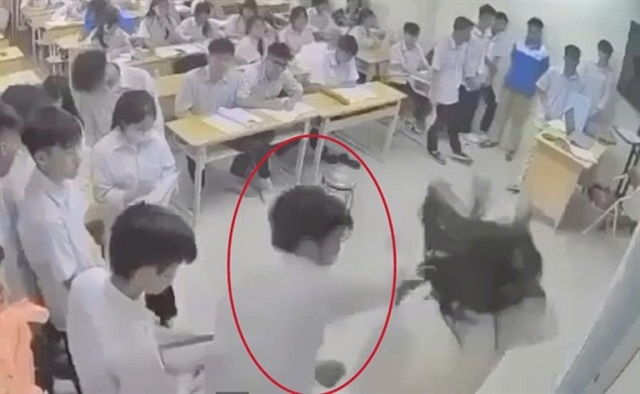
Hà Nội student arrested after allegedly assaulting teacher in classroom
1.
|
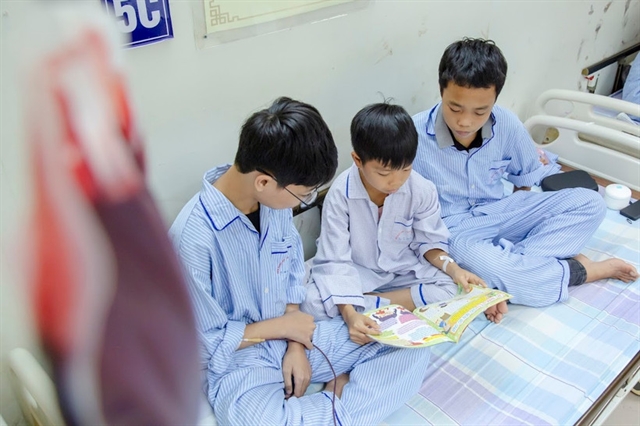
| H.V.A. (middle) reads comic books with two other young patients at the National Institute of Hematology and Blood Transfusion. — Photo nhandan.vn |
HÀ NỘI — As Lunar New Year approaches, Việt Nam is on the move. Buses are booked solid, markets grow crowded and families begin the annual migration back to their hometowns.
At a hospital in Hà Nội, the countdown to Tết looks very different.
For people living with congenital hemolytic anaemia, a genetic disorder that destroys red blood cells faster than the body can replace them, the holiday is not measured in days or nights, but in blood units.
Without regular transfusions, many become too weak to walk, study or even speak. Patients have a phrase for these last hospital visits of the year. They call it 'going shopping for Tết.'
What they are really shopping for is blood.
At the National Institute of Haematology and Blood Transfusion, the wards get busier as the holiday draws near. Some patients arrive before dawn, wrapped in coats against the winter chill, after long overnight journeys from northern mountain provinces.
At around 3am, C.T.D., a small girl from Tuyên Quang Province, slept fitfully in her mother’s arms after several hours on the road. Pale and slight for her age, she has been coming to the hospital since early childhood.
When her blood levels drop, she grows listless. School is often interrupted. Play becomes impossible.
“I just want to be healthy enough to go back to school,” she said softly after waking, rubbing tired eyes.
This trip matters more than most. She has never spent Tết in the hospital, and her family hopes that with enough blood, she can go home in time.
Elsewhere in the ward, H.V.A. from Phú Thọ Province waited quietly. He has received transfusions for nearly a decade. When his younger sister was born, doctors discovered the same condition.
Both children began hospital visits before they were old enough to understand why.
“When they don’t have enough blood, they become weak and stop eating,” their mother said. “As a parent, watching that feels unbearable.”
Some patients have travelled even farther.
T.T.N., a young woman from the Thai ethnic minority in Điện Biên Province, journeyed hundreds of kilometres to Hà Nội. When her haemoglobin levels fall, she said, exhaustion takes over completely.
“I don’t feel like doing anything. I don’t even want to talk,” she said.
Her wish for the new year is simple.
“I hope people will donate blood so that we can go home for Tết,” she said.
Nearby, H.K.H. from Cao Bằng Province had just finished her transfusion. Colour had returned to her face. She smiled as she described the difference.
“After I get blood and leave the hospital, everything feels easier,” she said.
“Even washing dishes or sweeping the floor feels enjoyable again.”
In another room, two brothers from a remote village in Sơn La Province sat waiting, already well known to staff. For 13 years, their family has travelled nearly 250km to Hà Nội every month so the boys can receive blood.
Missing an appointment is not an option.
“If transfusions are delayed, their health declines very quickly,” a doctor said.
“They grow exhausted, and the risk of serious complications rises.”
As Tết approaches, the strain is greatest for patients whose cases are more complicated.
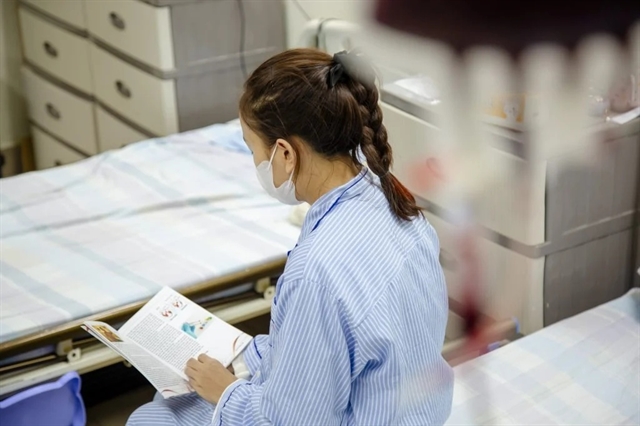
Vũ Thị H. is three months pregnant and requires three to four units of blood each month. Years of transfusions have caused her body to develop rare antibodies, making it difficult to find compatible blood.
|
| Vũ Thị H. reads a book after completing a blood transfusion. — Photo danviet.vn |
Doctors are now searching for units that match as her haemoglobin levels continue to fall.
“This year, I don’t wish for anything else. I just want enough blood to protect my baby,” she said.
While much of the country prepares to return home, she remains in the hospital, watching the days pass and waiting.
Hospital officials say the pattern repeats every year. In the weeks before and after Lunar New Year, demand rises as patients seek to stabilise their condition so they can spend the holiday with family.
This year, the need is particularly high.
The institute estimates it will require about 40,000 units of blood in February 2026 alone to supply more than 180 hospitals across northern Việt Nam and support facilities in the south.
Of that, at least 10,000 additional units are urgently needed during the Tết period, including around 5,000 units of type O blood.
The holiday itself adds pressure. Many community blood drives pause during the extended break, even as the institute’s donation centre remains open throughout Tết.
“For our patients, Tết isn’t about celebration. It’s about being strong enough to go home,” one nurse said.
Every donated unit, hospital officials say, buys something precious: time. Time to recover. Time to travel. Time to sit at a family table instead of beside a hospital bed.
And so, while many in Việt Nam shop for flowers, sweets and gifts, thousands of patients wait quietly for blood and a chance to welcome the new year at home. — VNS
Society
 Society
 Society
 Society
 Society
 Society
 Society
 Society
 Society
 Society
 Society
 Society
 Society
 Society
 Society