 Society

"Thai Night Busan 2026" Makes a Grand Return, Connecting Thai Content with Global Partners to Create Business Opportunities and Strengthen Industry Collaboration
1.
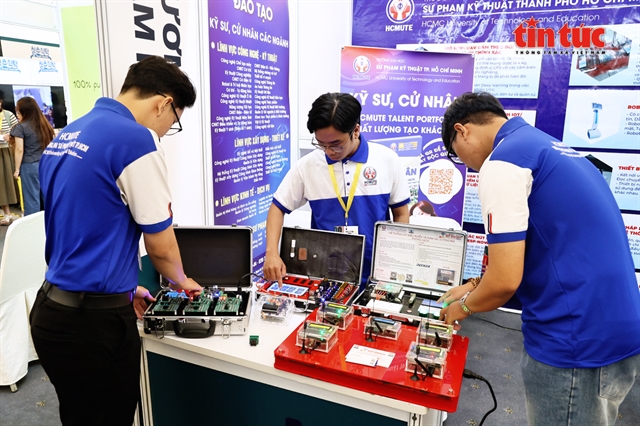 |
| HCM City takes the lead in implementing the national semiconductor industry strategy. — VNA/VNS Photo |
HÀ NỘI — The Ministry of Science and Technology has opened a public consultation on draft lists of high technologies and strategic technologies, a move aimed at sharpening Việt Nam’s technological priorities in an era of rapid digital transformation.
The draft includes four categories, including high technologies prioritised for investment and development; high-tech products encouraged for development; strategic technologies; and strategic technology products.
According to the ministry, the initiative is intended to define key technological directions, strengthen technological self-reliance and boost national competitiveness, while providing a foundation for the development of a knowledge-based economy.
The drafting is being carried out under a Prime Ministerial decision issued on December 31, 2025, assigning ministries to prepare detailed regulations to implement laws and resolutions adopted by the National Assembly of Vietnam at its 10th session. The Ministry of Science and Technology is leading the process in coordination with other ministries and agencies.
The draft is organised into two appendices. Appendix A sets out the list of high technologies prioritised for investment and development, along with high-tech products encouraged for development. It also identifies technologies that are not expected to be rolled out immediately in the next phase.
Appendix B focuses on strategic technologies and products considered critical to national competitiveness and technological security.
In total, the draft proposes 90 high technologies to be prioritised for investment and development and 139 high-tech products to be encouraged. The scope spans core pillars of the digital and knowledge economies, from artificial intelligence (AI), big data, cloud computing and blockchain to next-generation telecommunications networks, semiconductors, robotics, automation, advanced materials, new energy technologies, biotechnology and biomedical technologies.
Highlighted technologies include the design and manufacture of components and integrated circuits (ICs), flexible electronics, high-resolution display technologies, synthetic biology, molecular biology and neurotechnologies, fields viewed as foundational to global value chains and cross-sector industrial development.
The high-tech product list features software, equipment and integrated solutions for AI, blockchain, the Internet of Things (IoT), virtual reality (VR) and augmented reality (AR), as well as simulation control systems for machinery and vehicles and high-efficiency photovoltaic panels.
Notably, the draft also identifies 32 technologies and products categorised as not slated for immediate implementation. These include aviation, aerospace and remote sensing technologies; the design and manufacture of small and micro satellites; cognitive radio; and information systems developed for lease.
The ministry said the classification reflects a pragmatic approach, concentrating resources on technologies with strong feasibility and near-term impact, while maintaining long-term preparation for strategic sectors requiring significant investment in infrastructure, research capacity and skilled human resources.
Experts believe the lists will serve as a key policy instrument to align science, technology and innovation strategies, shape investment incentives, support research and development and foster high-tech enterprises and emerging industries.
They are also expected to guide State budget allocation and attract private and foreign capital into priority sectors, helping to build a competitive national technology ecosystem.
Public feedback is being collected until February 15. The ministry will then review and finalise the draft before submitting it to the Prime Minister for consideration and promulgation. — VNS
Society
 Society
 Society
 Society
 Society
 Society
 Society
 Society
 Society
 Society
 Society
 Society
 Society
 Society
 Society



