 Society

"Thai Night Busan 2026" Makes a Grand Return, Connecting Thai Content with Global Partners to Create Business Opportunities and Strengthen Industry Collaboration
1.
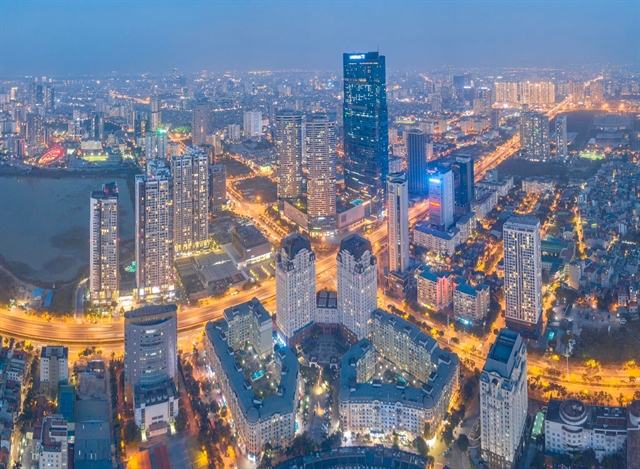 |
| A view of Hà Nội at night. — Photo vtv.vn |
HÀ NỘI — Few cities capture Việt Nam’s transformation as vividly as its capital.
Archival footage from the early 1980s shows Hà Nội marked by scarcity. Rows of state housing with peeling walls, near-empty department stores and residents queuing patiently to exchange coupons for small portions of rice or meat formed the everyday backdrop of the subsidy era.
Luxury, when it existed at all, might have been a locally made bicycle or a second-hand cassette player.
That period left a deep imprint – and helped fuel the sweeping economic reforms launched in 1986, known as Đổi Mới (Renewal), which dismantled central planning and opened the economy to market forces.
The change was gradual but unmistakable. Private stalls appeared at traditional markets. Shopfronts lit up streets that had once gone dark early.
Hà Nội began to look outward, shedding the insularity of a planned economy and reconnecting with global currents.
Over the past decade, the city’s transformation has accelerated. Hà Nội is no longer confined to its historic core. New areas have risen to the west and east, reshaping the capital’s geography and skyline.
Modern urban zones now rival those of regional capitals such as Singapore or Seoul, a contrast that would have been difficult to imagine even a generation ago.
Yet the shift is not defined solely by high-rise towers.
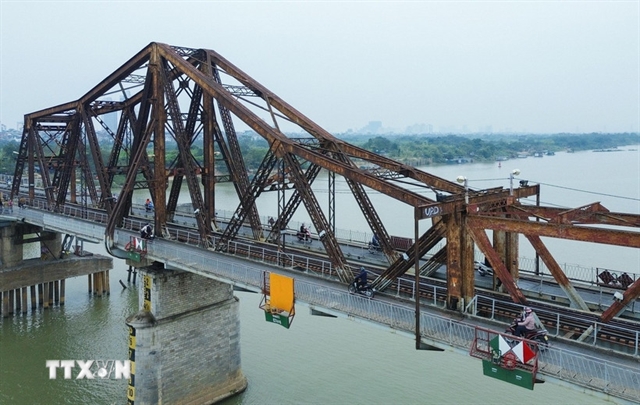
Infrastructure has become a marker of ambition and connectivity. New bridges spanning the Red River and elevated metro lines threading through dense neighbourhoods are altering how residents move – and how they imagine the city itself.
For older generations, the change is practical and emotional.
“Crossing the river used to mean relying on ferries or squeezing across the old bridge,” said Nguyễn Minh Đức, a lifelong Hà Nội resident.
“Now, standing on a modern bridge at night and seeing the city lit up, I feel its new energy. It’s still a city of peace – but one moving very fast.”
That energy is visible in Cầu Giấy and Hòa Lạc areas, where thousands of technology firms and research centres are clustered.
Trần Nam, founder of an artificial-intelligence start-up based in Hà Nội, described the difference bluntly.
“Our parents reformed the system so people could live decently. Our generation is innovating to prove ourselves," he said.
For entrepreneurs like Nam, policy signals matter. Expectations around regulatory flexibility, experimentation and so-called 'sandbox' mechanisms have become closely watched indicators of how far innovation will be allowed to run ahead of regulation.
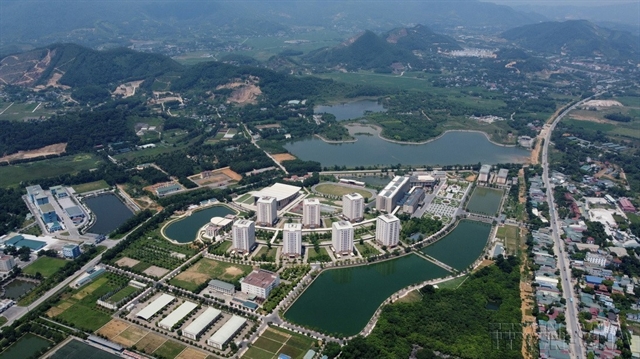 |
| A view of Hòa Lạc, an urban area aiming to become the largest satellite city among the five planned around Hà Nội. — VNA/VNS Photo |
This shift in mindset reflects a deeper transformation. Where factory workers once drove the city’s economy, today’s growth increasingly depends on software engineers, data scientists and designers building systems that shape how cities function, from logistics to public services.
What distinguishes Hà Nội is how often this future overlaps with the past. In the narrow streets of the Old Quarter, start-ups operate out of traditional tube houses.
Highland agricultural products are sold to international consumers via social media platforms. Virtual-reality technology is being used to recreate historical landmarks, blending conservation with commerce.
Economists say this convergence may offer a way out of a long-standing dilemma: how to modernise without erasing heritage. Digital businesses, they argue, can turn preservation into economic value and convert culture into an asset.
The city’s ambitions now extend beyond physical expansion.
Officials increasingly describe Hà Nội not in terms of concrete and steel, but as a system – an 'operating platform' for urban life. Digital transformation has become a central theme, with public services migrating online and smartphones acting as gateways to everything, from civil registration to tax payments.
From a policy perspective, Hà Nội is repositioning itself from a purely administrative capital to a centre of innovation.
The Hòa Lạc Hi-Tech Park, often compared to Silicon Valley in ambition if not yet in scale, is attracting large investments in semiconductors, artificial intelligence and big data.
As national general election approaches, expectations for the capital are rising. Residents speak more about leaders willing to use technology to tackle problems that have long resisted solutions.
Hà Nội’s journey, from a city shaped by constraint to one defined by experimentation, mirrors Việt Nam’s broader trajectory. The tram bells of the 1980s have given way to semiconductor laboratories and software hubs, but the underlying impulse remains familiar: a readiness to break with old limits.
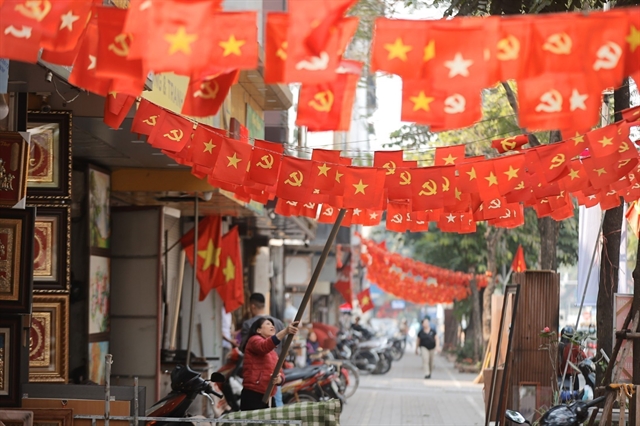 |
| Streets across Hà Nội are decorated with flags to mark the 14th National Congress of the Communist Party. — VNA/VNS Photo |
Today, Hà Nội is no longer simply a repository of monuments and memory. It is becoming a large-scale incubator – a place where young founders and engineers are redefining what 'Made in Vietnam' can mean.
In that sense, the capital’s story is less about spectacle than continuity. The reformist spirit that once dismantled rigid barriers has evolved into a culture of innovation.
As the heart of the country, Hà Nội is beating in step with a new era – one that seeks to carry centuries of identity into a rapidly digitising future. — VNS
Society
 Society
 Society
 Society
 Society
 Society
 Society
 Society
 Society
 Society
 Society
 Society
 Society
 Society
 Society



