 Society
PM orders urgent completion of decree on petroleum trading by November 10
1.
|
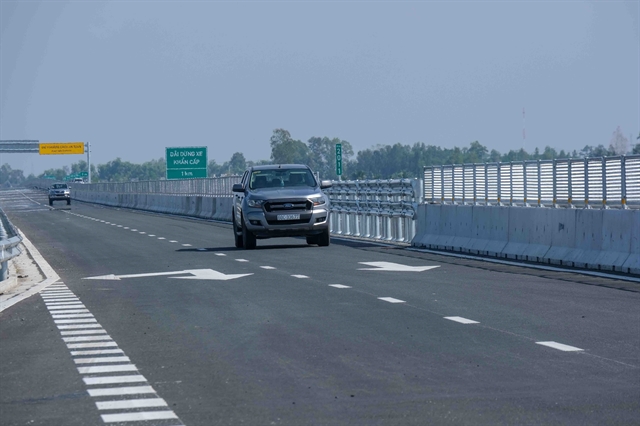
| The Cần Thơ – Cà Mau Expressway in Cần Thơ. — VNA/VNS Photo |
Cần Thơ — Cần Thơ aims to become a pillar of national growth and a leading economic driver of the (Cửu Long) Mekong Delta, with a strong focus on trade, logistics, processing industries and export to international markets.
These objectives are outlined in the revised Cần Thơ Master Plan for the 2021–30 period, with a vision to 2050, recently approved by the city People’s Council.
By 2030, the city is positioned as a comprehensive development engine for the delta, playing a central role in trade, services, logistics, the marine economy, processing industries, science and technology, education and training, and specialised healthcare.
Beyond supporting its own growth, the city is expected to lead and connect the region with domestic and global markets.
Under the plan, average Gross Regional Domestic Product (GRDP) growth in the 2026–30 period is targeted at over 10 per cent per year, alongside labour productivity growth of more than 10 per cent annually.
The digital economy is expected to emerge as a key growth driver, accounting for at least 30 per cent of GRDP by 2030.
The economic structure will continue to be modernised, with services contributing more than 45 per cent of GRDP, industry and construction over 35 per cent, and agriculture, forestry and fisheries falling below 16 per cent.
A strategic highlight of the plan is the development of the marine economy as a major breakthrough.
The city will expand its development space towards the sea by leveraging the Hậu River and the corridor to the East Sea, creating new growth opportunities while strengthening export connectivity for the entire delta.
Central to this vision is the proposed Trần Đề Economic Zone, covering more than 40,000ha and linked to the Trần Đề International Seaport.
Designed as the south-eastern growth pole of Cần Thơ and the delta, the zone will follow a multi-sector development model, encompassing processing industries, energy, port and multimodal logistics, and marine eco-tourism.
|
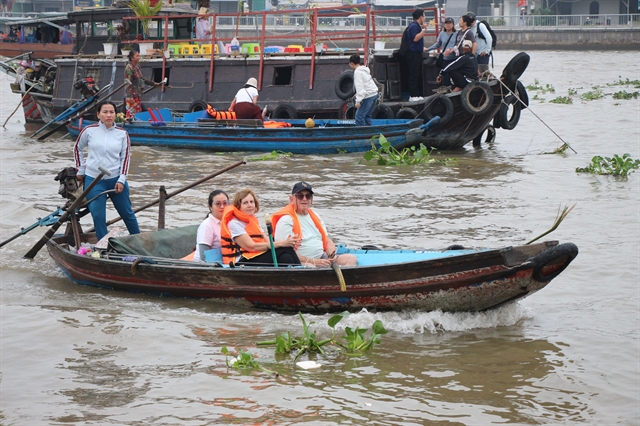
| Foreign tourists visit the Cái Răng floating market in Cần Thơ. — VNA/VNS Photo |
Industry, logistics and services are identified as the city’s three main growth pillars.
Industrial development will prioritise modern, green and sustainable approaches, with a focus on high value-added sectors, particularly agricultural and aquatic processing for export.
The logistics system will be developed on a multimodal basis, integrating road, inland waterway, sea and air transport, with the goal of transforming the city into a regional and national logistics centre.
This is expected to reduce logistics costs and enhance the international competitiveness of delta products.
In spatial terms, the city will adopt a multi-polar urban model linked to strategic economic corridors, notably along the Hậu River and towards the East Sea.
This approach is intended to capitalise on river advantages, ease pressure on the central urban area and foster more balanced development across the city.
People-centred development remains a core principle.
By 2030, the city aims to reach a population of about 3.33 million, achieve a Human Development Index of at least 0.78, and raise average life expectancy to 75.5 years, including at least 68 years of healthy life.
The city will continue to strengthen its role as the delta’s hub for education, training and specialised healthcare, with Cần Thơ University positioned as a regional university and a national key institution for high-quality human resource development.
Looking ahead to 2050, Cần Thơ is envisioned as a modern, green and smart river–sea city of Southeast Asia, serving as a gateway linking the delta with the East Sea and global markets.
It is expected to function as a river–sea logistics hub, a high-quality service centre and an innovation nucleus for the region.
The city will pursue a green, digital and circular economy, build a knowledge-based society, ensure sustainable environmental protection, and safeguard national defence and security.
These efforts are expected to position it as an attractive destination for investment, innovation and international integration, while contributing meaningfully to the long-term sustainable development of the delta and the nation. — VNS
Society
 Society
 Society
 Society
 Society
 Society
 Society
 Society
 Society
 Society
 Society
 Society
 Society
 Society
 Society