 Society
84 individuals investigated for transnational online frauds
1.
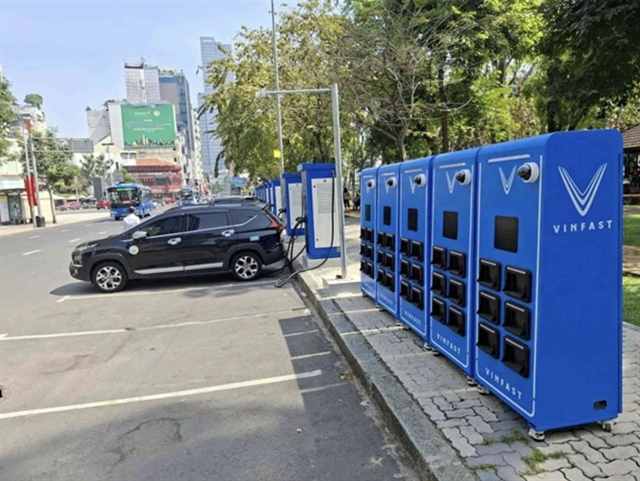 |
| Battery swap sites for electric vehicles are installed along a sidewalk in HCM City. — VNA/VNS Photo |
HCM CITY — HCM City has approved 91 locations for electric battery swap sites on sidewalks and estimates that more than 25,000 public charging points and battery swap sites will be needed by 2030, according to the city's Department of Construction.
The information was released at the city’s socio-economic press briefing on January 29, where the department said it has issued detailed guidance on technical requirements for enterprises installing battery swap sites, as well as criteria for eligible locations.
The Department of Construction has published on its website a list of road sections that meet the conditions for installation, enabling enterprises to develop plans for installation, operation and exploitation of battery swap sites on sidewalks and submit them for approval.
To date, the department has granted licences for 91 battery swap site locations on sidewalks along roads including Hai Bà Trưng, Huyền Trân Công Chúa, Lê Lai, Lê Thánh Tôn, Lý Tự Trọng, Nguyễn Đình Chiểu, Nguyễn Thái Học and Lê Quý Đôn. It has also announced a further 101 locations that are eligible, while continuing to review additional sites for future publication.
At the same time, the department is finalising a report on a transport emissions control scheme, which includes a roadmap from 2029 under which 100 per cent of ride-hailing motorbikes used for passenger and goods transport are expected to switch to electric or green-energy vehicles, estimated at around 400,000 units.
The city is also proposing support policies to encourage residents to shift to electric motorbikes.
By 2030, HCM City is forecast to have about 1.2 million electric motorbikes, requiring the development of more than 25,000 public charging stations and battery swap sites for two-wheelers.
According to the Department of Construction, installation sites must meet strict conditions, including not being located at intersections, entrances and exits, pedestrian crossings, access routes for people with disabilities, or areas with dense existing technical infrastructure. The remaining sidewalk width must be at least 1.5 metres.
The department noted that battery swap sites are designed to be highly mobile and has instructed relevant units to step up inspections of enterprises’ compliance. Any installations that fail to meet the requirements will be required to be removed and withdrawn immediately. — VNS
Society
 Society
 Society
 Society
 Society
 Society
 Society
 Society
 Society
 Society
 Society
 Society
 Society
 Society
 Society