 Society
PM orders urgent completion of decree on petroleum trading by November 10
1.
 |
| Solar power only meets the most basic needs of households in Tia Ma Mủ Village, Tà Tổng Commune in Lai Châu Province. — VNA/VNS Photo Nguyễn Oanh |
LAI CHÂU — Tucked deep in the mountainous terrain of Tà Tổng Commune in Lai Châu Province, Tia Ma Mủ Village remains literally off the grid, without access to the national power network.
Without electricity, daily life for the local Mông community is fraught with difficulties, from basic household needs and education to economic development.
Home to 82 Mông households, Tia Ma Mủ lies some 50 kilometres from the commune centre. Although a concrete road now connects the village and trucks can reach it, electricity has yet to arrive.
Even basic communication is a challenge. From the Tà Tổng Commune People’s Committee, officials cannot reach the village by phone due to the lack of mobile signal.
Not a single household owns a television. When the commune needs to convey information or official documents, the Party cell secretary or village head must climb to higher ground to catch a phone signal. To convene meetings, they strike a metal gong to gather residents.
Money sent home by family members working elsewhere is transferred to the bank accounts of the village head or deputy head. The village head then has to travel to Mường Nhé Ward in neighbouring Điện Biên Province to withdraw the cash and distribute it to villagers.
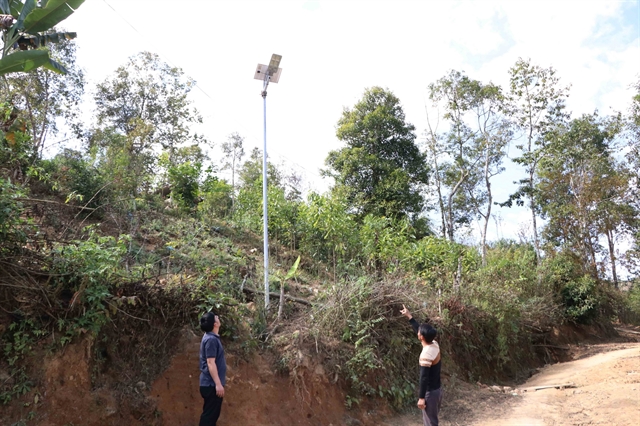 |
| Without access to the national power grid, residents of Tia Ma Mủ Village in Tà Tổng Commune have invested in solar systems for lighting. — VNA/VNS Photo Nguyễn Oanh |
With no access to the national grid, households have had to invest between VNĐ20–40 million (US$767–1,530) each in solar power systems. Currently, about 60 of the village’s 82 households use solar panels, but the electricity generated is only sufficient for basic lighting.
In places with electricity, people can rely on fans, rice cookers, refrigerators, water pumps and televisions. In Tia Ma Mủ, such conveniences remain distant luxuries.
The villagers’ main livelihoods are maize cultivation, upland rice farming and small-scale livestock raising. Without electricity, they cannot use machinery such as water pumps or crop dryers. All production relies on manual labour, which is time-consuming and results in low productivity.
Hạng A Xá, a villager, said he hopes to invest in equipment to improve his work, but without electricity everything has to be done by hand.
“Life here is very difficult,” he shared.
According to Deputy Village Head Giàng A Tịnh, the lack of electricity also hampers communication and dissemination of Party and State policies. More importantly, it severely affects daily life and economic development.
The Tia Ma Mủ Preschool currently has four teachers teaching two classes with 55 children. Beyond the challenges of caring for students in difficult conditions, the absence of electricity and mobile signal makes digital education virtually impossible.
Of the village’s 82 households, 37 are classified as poor and 13 as near-poor. The lack of electricity leaves residents, as many describe it, “bound hand and foot” when it comes to improving their livelihoods. Their greatest wish is for the national power grid to reach the village.
Although some households use solar energy, the supply is limited. Tà Tổng Commune, including Tia Ma Mủ Village, sits high in the mountains, where cold weather and thick fog persist year-round, leaving few sunny days for effective solar generation.
“Our biggest hope is to have electricity. It would solve so many problems and transform our village,” said Hàng Thị Thu, a local resident.
Currently, Tà Tổng Commune still has one village and three residential clusters with about 200 households in total without access to the national grid. Over the years, Tia Ma Mủ residents have repeatedly petitioned authorities for power infrastructure. However, rugged terrain, sparse population and high investment costs have posed major challenges.
Electricity is not just about lighting homes. It is about changing lives. With power, villagers would have greater confidence to invest in production, children would have better learning conditions and information would flow more easily.
Government policies could be implemented more effectively and people could access new knowledge and techniques to lift themselves out of poverty.
Nguyễn Việt Hòa, deputy chairman of the Tà Tổng Commune People’s Committee, said the committee has submitted proposals to provincial authorities and Lai Châu’s power sector to invest in extending the grid to Tia Ma Mủ.
A project is expected to be launched soon, with completion planned for the second quarter of 2026.
For the people of Tia Ma Mủ, electricity is more than a current running through wires. It is a light of trust and hope. That light promises to dispel the darkness of poverty and backwardness, helping the village join the broader path of development.
As the Lunar New Year approaches, villagers hope this will be the last Tết they celebrate without electricity. Tia Ma Mủ is counting down the days to the arrival of the national grid – the light of a future that is less arduous, richer in opportunity and more prosperous. — VNS
Society
 Society
 Society
 Society
 Society
 Society
 Society
 Society
 Society
 Society
 Society
 Society
 Society
 Society
 Society