 Society

AITO Looks Ahead to Europe, Building a Thriving Automotive Ecosystem
1.
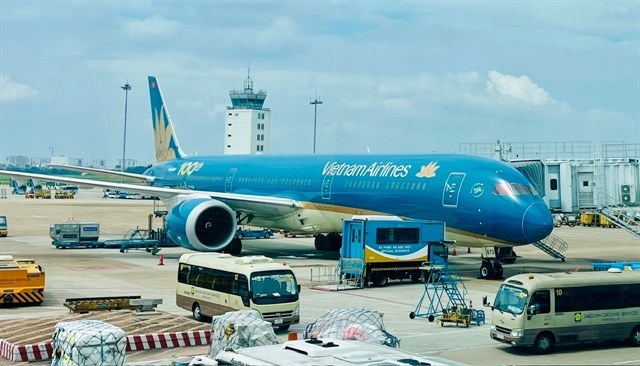 |
| A Vietnam Airlines aircraft at Tân Sơn Nhất International Airport in HCM City. — VNS Photo Bồ Xuân Hiệp |
HCM CITY — Air and rail ticket prices across Việt Nam have surged ahead of the 2026 Tết (Lunar New Year) holiday, even as transport operators roll out record capacity to meet peak travel demand.
Lunar New Year, known locally as Tết, falls in mid-February this year; public employees and many workers will observe a nine-day holiday from February 14 to 22 under national guidelines, spanning both the final days of the old lunar year and the first days of the new year.
Domestic airlines have boosted flight numbers by nearly 30 per cent compared with regular schedules. However, fares on major routes, particularly from the south to the north, remain elevated, especially immediately before Tết.
Three weeks before the holiday, Nguyễn Thảo Linh, a resident of HCM City, found many flights to her hometown of Vinh sold out, while remaining tickets were priced above VNĐ5 million (US$188) one way.
She ultimately booked flights from HCM City to Hà Nội on February 14, then continued by road, paying VNĐ3.6 million per person each way.
A Việt Nam News and Law survey found that northbound flights from HCM City on peak dates, roughly February 11-13, are full or offer only premium economy and business seats. On the HCM City-Hà Nội route, premium economy fares have reached VNĐ5.3 million per leg, while business-class tickets approach VNĐ10 million.
On less popular dates, one-way fares fall to around VNĐ3.7 million, though round-trip costs still hover around VNĐ7-8 million per passenger.
Similar conditions are seen on flights from HCM City to central Việt Nam. Direct services to Vinh are largely sold out in the days immediately before Tết, forcing some travellers to transit via Đà Nẵng or Hà Nội at higher cost.
Other high-demand destinations, including Thanh Hóa, Đồng Hới, Đà Nẵng and Quy Nhơn, also show sell-outs or steep price increases.
Airlines attribute the price surge to sharply uneven travel flows: demand spikes from the south to the north before Tết, then reverses after the holiday, leaving aircraft underutilised on one leg. With operating costs largely fixed, fares on peak segments are raised to offset losses.
Travel demand is concentrated into a narrow window of about seven days before and after Tết, quickly filling flights at popular times and pushing ticket prices to regulatory ceilings despite the expansion in services.
According to the Civil Aviation Authority of Việt Nam, airlines plan to operate more than 36,900 flights between late January and early March, up 27 per cent from the previous Tết holiday. Total seat capacity is expected to reach 7.8 million, including 5.6 million domestic seats and nearly 2.2 million international seats.
To ease congestion, authorities have ordered extended night-time operations and additional flights at six regional airports during the peak period.
Rail travel also under pressure
Rail travel has faced similar strains. Việt Nam Railway Transport JSC said more than 227,000 Tết tickets had been sold by January 19, with the Thống Nhất (Unified Express) trains on the Hà Nội-HCM City line fully booked on peak dates before the holiday and in the first week after Tết.
Rail fares this year are up by an average of 5-10 per cent, driven by higher fuel costs and investments in upgraded coaches.
The rail sector is operating 906 train services during the holiday period, offering about 384,000 seats on the main north-south route alone, a 7 per cent increase from last year.
Despite the expansion, transport operators say fare pressures are likely to persist as long as travel demand remains concentrated around Tết, the country’s most important holiday, when millions of people travel nationwide to reunite with families and mark the Lunar New Year. — VNS
Society
 Society
 Society
 Society
 Society
 Society
 Society
 Society
 Society
 Society
 Society
 Society
 Society
 Society
 Society