 Economy


Project lays foundation for digital greenhouse gas emissions data management
1.
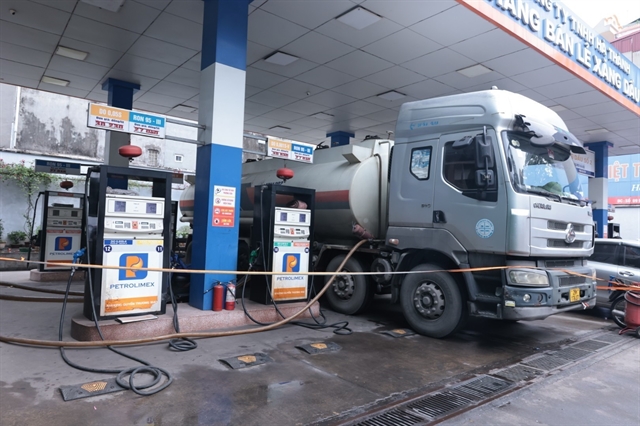 |
| A petrol station in Hà Nội receives fuel deliveries to meet market demand on the morning of March 8. — VNA/VNS Photo Trần Việt |
HÀ NỘI — Petrol companies in Việt Nam say they are ready to secure fuel supplies and prepare contingency reserves after the Government eased several policy bottlenecks affecting the import and management of petroleum products.
Under Resolution 36/NQ-CP dated March 6, adjustments to the fuel price management mechanism have been introduced, helping importers become more proactive in ensuring market supply.
The resolution allows retail fuel prices to be adjusted once market prices increase by 7 per cent compared with the base price of the previous adjustment period, replacing the earlier fixed weekly adjustments. The change is expected to give key distributors greater financial flexibility when importing fuel.
A representative of PetroVietnam Oil Corporation (PVOIL) said the new policy framework has enabled major fuel traders to be more flexible in securing supply for the domestic market.
PVOIL confirmed that its supply plan for March has been fully arranged and the company is negotiating with international traders for shipments in the coming months. However, market conditions have become more challenging.
As of the morning of March 8, only two out of 10 fuel purchase tenders issued by the company had been finalised, while the rest remained open until next week.
“In the past, most tenders were closed quickly and fully subscribed. The current situation reflects tighter supply in the global market,” the representative said.
Industry insiders noted that Vietnamese importers have traditionally sourced refined fuel from Singapore and South Korea due to preferential import tariffs. However, refineries in these markets depend heavily on crude oil from the Middle East, meaning supply could tighten if regional tensions escalate.
To mitigate risks, companies are exploring alternative suppliers, including Australia and China – markets that were previously less attractive due to the lack of tariff incentives.
Domestic production is also being strengthened.
A representative of Bình Sơn Refining and Petrochemical Joint Stock Company (BSR) said the central biofuel plant is ready to produce about 60,000 tonnes of ethanol for blending E10 biofuel gasoline.
By the end of March, ethanol from the plant is expected to be supplied to the Dung Quất Oil Refinery, allowing the facility to begin blending E10 fuel and increase domestic fuel output at a time when import channels face disruption risks.
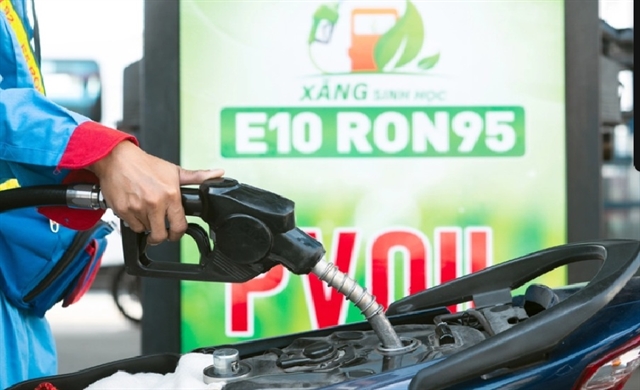 |
| A petrol station sells E10 biofuel gasoline in Tân Phú Ward, HCM City. — Photo tuoitre.vn |
BSR said it has already signed contracts to purchase around three million barrels of crude oil for the March–May period and plans to buy additional volumes in May and June to keep the refinery operating at 118–120 per cent of design capacity.
Meanwhile, Petrovietnam has instructed its subsidiaries to strengthen crude oil reserves, maintain refinery operations and prepare import scenarios in case global supply disruptions intensify.
The group said domestic fuel supply remains secured for the next few months. It has also directed its representatives at Nghi Sơn Refinery and Petrochemical LLC to work with partners to prepare additional crude supply if necessary.
Kazutaka Yamato, general director of Nghi Sơn Refinery and Petrochemical LLC, said the company continues to diversify crude supply sources and has secured sufficient imports to maintain stable operations.
He added that contingency plans have been prepared and the company is working closely with suppliers, regulators and investors to manage potential risks if geopolitical tensions persist.
Experts say that, over the long term, Việt Nam needs to strengthen energy security through increased domestic exploration, diversification of crude oil inputs for refineries and expanded use of biofuels like E10 and E15.
Dr Nguyễn Hồng Minh, former deputy director of the Vietnam Petroleum Institute, said expanding domestic refining capacity and strengthening strategic fuel reserves would also help ensure stable supply amid global energy market volatility.
He also suggested that refineries should continue testing and processing different types of crude oil to diversify feedstock supply and improve technological flexibility in refining operations.
Expanding the use of biofuels such as E10 and E15 could also help reduce pressure on fossil fuel imports while supporting energy transition goals and emissions reduction commitments, he added.
These measures are consistent with Resolution 70-NQ/TW issued by the Politburo on August 20, 2025 on ensuring national energy security to 2030. The resolution calls for diversifying energy supply sources, strengthening strategic reserves and enhancing domestic refining capacity to reduce dependence on imports while improving the resilience of the national energy system.
The Government has also tasked the Ministry of Industry and Trade, Quảng Ngãi Province and Petrovietnam with finalising a proposal to establish a national petrochemical and energy centre in the Dung Quất Economic Zone.
The project is expected to require investment of between US$16.1 billion and $20.5 billion, and will be implemented in two phases from 2025 to 2045. Once completed, the complex is projected to meet at least 30 per cent of the country’s fuel demand while maintaining strategic reserves equivalent to 30 days of supply for the domestic market. — BIZHUB/VNS
Economy
 Economy
 Economy
 Economy
 Economy
 Economy
 Economy
 Economy
 Economy
 Economy
 Economy
 Economy
 Economy
 Economy
Economy
Economy




